Skip to content
← 2025

Physics · 2025 · Set 55/5/1

CBSE Class 12 Physics 2025 — Set 55/5/1

CBSE Class XII Board 2025 · Set 55/5/1

Real board examination
Sets

About the 2025 exam: CBSE issued its Physics papers in several series in 2025 (55/4, 55/5, 55/6 …); the series 1 and 2 official PDFs were image-only and there was no series 3. Three distinct series are available here — 55/4/1, 55/5/1 and 55/6/1 — complete (33/33), digitised from the official CBSE papers.

About this paper

The real Class-12 board examination held in 2025. Every question below is solved the concept-first way. Sample papers are labelled honestly — never shown as a past exam.

Total marks
70
Questions
33
Duration
180 min
Sections
5

The marks / questions / duration above are the official exam pattern. We currently have 33 of this paper’s questions (100% of the full paper), with 33 fully solved. Questions we couldn’t yet extract or verify are held — never shown as complete.

Sections & marks

SectionTypeQuestionsMarks eachTotal
ASection AMCQ / Assertion-Reason16116
BSection BVery short answer5210
CSection CShort answer7321
DSection DCase-based248
ESection ELong answer3515
Total3370

The question paper

The questions we hold for this paper, laid out by section. Solutions are on the Answers tab.

Board Examination

Physics

CBSE Class XII Board 2025 · Set 55/5/1

Series/Set: 55/5/1Roll No. ________
Time Allowed: 3 hoursMaximum Marks: 70

General Instructions

  1. This question paper contains 33 questions divided into 5 sections — A, B, C, D, E.
  2. Section A comprises 16 questions of 1 mark each (MCQ / Assertion-Reason).
  3. Section B comprises 5 questions of 2 marks each (Very short answer).
  4. Section C comprises 7 questions of 3 marks each (Short answer).
  5. Section D comprises 2 questions of 4 marks each (Case-based).
  6. Section E comprises 3 questions of 5 marks each (Long answer).

Above is the official exam pattern. The questions printed below are those we currently hold for this paper.

Section A

MCQ / Assertion-Reason · 1 mark each · 16 of 16 shown

Q1.
A metal sheet is inserted between the plates of a parallel plate capacitor of capacitance CC. If the sheet partly occupies the space between the plates, the capacitance: (A) remains CC (B) becomes greater than CC (C) becomes less than CC (D) becomes zero
[1]
Q2.
The electric field at a point in a region is given by E⃗=αr2 r^\vec{E}=\dfrac{\alpha}{r^{2}}\,\hat{r} (a radial field), where α\alpha is a constant and rr is the distance of the point from the origin. The magnitude of the potential at the point is: (A) αr\dfrac{\alpha}{r} (B) αr22\dfrac{\alpha r^{2}}{2} (C) α2r2\dfrac{\alpha}{2r^{2}} (D) −αr-\dfrac{\alpha}{r}
[1]
Q3.
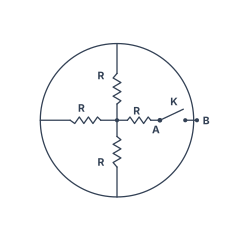
Four resistors, each of resistance RR, and a key KK are connected as shown in the figure. The equivalent resistance between points A and B when key KK is open will be: (A) 4R4R (B) ∞\infty (C) R4\dfrac{R}{4} (D) 4R3\dfrac{4R}{3} Figure — 55/5/1 Q3
[1]
Q4.
A charged particle gains a speed of 106 ms−110^{6}\ \mathrm{ms^{-1}} when accelerated from rest through a potential difference of 10 kV. It enters a region of magnetic field 0.40.4 T such that its velocity is perpendicular to the field. The radius of the circular path described by it is: (A) 2.5 cm (B) 5 cm (C) 8 cm (D) 10 cm
[1]
Q5.
A current of 10π\dfrac{10}{\pi} A is maintained in a circular loop of radius 14 cm. The value of the magnetic dipole moment associated with the loop is: (A) 0.019 A m2^2 (B) 0.14 A m2^2 (C) 0.196 A m2^2 (D) 0.615 A m2^2
[1]
Page 1 of 6
Q6.
The magnetic flux linked with a coil changes with time t as φ=(8t²+5t+7), where t is in seconds and φ is in Wb. The value of the emf induced in the coil at t=4 s is: (A) 32 V (B) 37 V (C) 64 V (D) 69 V
[1]
Q7.
Which of the following rays coming from the Sun plays an important role in keeping the earth warm? (A) Infrared rays (B) γ-rays (C) UV rays (D) Visible light rays
[1]
Q8.
The dimensions of (μvarepsilon)⁻¹, where varepsilon is the permittivity and μ the permeability of a medium, are: (A) [mathrmM⁰L¹T⁻¹] (B) [mathrmM⁰L²T⁻²] (C) [mathrmM¹L²T⁻²] (D) [mathrmM¹L⁻¹T¹]
[1]
Q9.
Which of the following electromagnetic waves has photons of the largest momentum? (A) X-rays (B) AM radio waves (C) Microwaves (D) TV waves
[1]
Q10.
A compound microscope has an objective and an eyepiece of focal lengths fo and fe respectively. To obtain a large magnification of a small object, the microscope should have: (A) fo and fe small, and fe>fo (B) fo and fe small, and fo>fe (C) fo and fe large, and fe>fo (D) fo and fe large, and fo>fe
[1]
Q11.
Two coherent light waves, each having amplitude a, superpose to produce an interference pattern on a screen. The intensity of light as seen on the screen varies between: (A) 0 and 2a² (B) 0 and 4a² (C) a² and 2a² (D) 2a² and 4a²
[1]
Q12.
The kinetic energy of an alpha particle is four times the kinetic energy of a proton. The ratio dfracλαλp of the de Broglie wavelengths associated with them will be: (A) (1)/(16) (B) (1)/(8) (C) (1)/(4) (D) (1)/(2)
[1]
Q13.
Assertion (A): The impurities in p-type Si are not pentavalent atoms. Reason (R): The hole density in the valence band in a p-type semiconductor is almost equal to the acceptor density. (A) Both A and R are true and R is the correct explanation of A. (B) Both A and R are true, but R is not the correct explanation of A. (C) A is true, but R is false. (D) Both A and R are false.
[1]
Q14.
Assertion (A): During the formation of a nucleus, the mass defect produced is the source of the binding energy of the nucleus. Reason (R): For all nuclei, the value of binding energy per nucleon increases with mass number. (A) Both A and R are true and R is the correct explanation of A. (B) Both A and R are true, but R is not the correct explanation of A. (C) A is true, but R is false. (D) Both A and R are false.
[1]
Page 2 of 6
Q15.
Assertion (A): The Balmer series in the hydrogen atom spectrum is formed when the electron jumps from a higher energy state to the ground state. Reason (R): Electron transitions take place between successive orbits only. (A) Both A and R are true and R is the correct explanation of A. (B) Both A and R are true, but R is not the correct explanation of A. (C) A is true, but R is false. (D) Both A and R are false.
[1]
Q16.
Assertion (A): The presence of only a few alpha particles at a scattering angle of 180° led Rutherford to the discovery of the nucleus. Reason (R): The size of the nucleus is approximately 10⁻⁵ times the size of an atom, and therefore only a few alpha particles are rebounded. (A) Both A and R are true and R is the correct explanation of A. (B) Both A and R are true, but R is not the correct explanation of A. (C) A is true, but R is false. (D) Both A and R are false.
[1]
Section B

Very short answer · 2 marks each · 5 of 5 shown

Q1.
The threshold frequency for a given metal is 3.6×10¹⁴ Hz. If monochromatic radiations of frequency 6.8×10¹⁴ Hz are incident on this metal, find the cut-off potential for the photoelectrons.
[2]
Q2.
(a) A point object is placed in air at a distance R/3 in front of a convex surface of radius of curvature R, separating air from a medium of refractive index n(<4). Find the nature and position of the image formed. OR (b) In a Young's double-slit set-up, the intensity of the central maximum is I₀. Calculate the intensity at a point where the path difference between the two interfering waves is λ/3.
[2]
Q3.
A voltmeter of resistance 1000Ω can measure up to 25 V. How will you convert it so that it can read up to 250 V?
[2]
Q4.
When a neutron collides with ²³⁵₉₂mathrmU, the nucleus gives ¹⁴⁰₅₄mathrmXe and ⁹⁴₃₈mathrmSr as fission products and two neutrons are ejected. Calculate the mass defect and the energy released (in MeV) in the process. Given: m(²³⁵₉₂mathrmU)=235.04393u, m(¹⁴⁰₅₄mathrmXe)=139.92164u, m(⁹⁴₃₈mathrmSr)=93.91536u, m(¹₀n)=1.00866u, 1u=931mathrmMeV/c².
[2]
Q5.
The resistance of a wire at 25°C is 10.0Ω. When heated to 125°C, its resistance becomes 10.5Ω. Find (i) the temperature coefficient of resistance of the wire, and (ii) the resistance of the wire at 425°C.
[2]
Page 3 of 6
Section C

Short answer · 3 marks each · 7 of 7 shown

Q1.
(a) Draw the energy-band diagrams for conductors, semiconductors and insulators at T=0 K. How is an electron-hole pair formed in a semiconductor at room temperature? (b) Carbon and silicon both are members of group IV of the periodic table and have the same lattice structure. Carbon is an insulator whereas silicon is a semiconductor. Explain.
[3]
Q2.
A parallel plate capacitor has plate area A and plate separation d. Half of the space between the plates is filled with a material of dielectric constant K in two ways as shown in the figure [(a) and (b)]. Find the values of the capacitance of the capacitors in the two cases.
[3]
Q3.
In a Young's double-slit experiment, the two slits are separated by 1.0 mm and the screen is 1.0 m away from the slits. A beam of light consisting of two wavelengths 500 nm and 600 nm is used to obtain interference fringes. Calculate: (a) the distance between the first maxima for the two wavelengths. (b) the least distance from the central maximum where the bright fringes due to both wavelengths coincide.
[3]
Q4.
Differentiate between half-wave and full-wave rectification. With the help of a circuit diagram, explain the working of a full-wave rectifier.
[3]
Q5.
An electron of mass m and charge -e is revolving anticlockwise around the nucleus of an atom. (a) Obtain the expression for the magnetic dipole moment (μ) of the atom. (b) If vecL is the angular momentum of the electron, show that vecμ=-(e)/(2m)vecL.
[3]
Q6.
A rectangular glass slab ABCD (refractive index 1.5) is surrounded by a transparent liquid (refractive index 1.25) as shown in the figure. A ray of light is incident on face AB at an angle i such that it is refracted out grazing the face AD. Find the value of angle i.
[3]
Page 4 of 6
Q7.
(a) Two small solid metal balls A and B of radii R and 2R having charge densities 2σ and 3σ respectively are kept far apart. Find the charge densities on A and B after they are connected by a conducting wire. OR (b) Two long straight parallel wires are kept a distance d apart, parallel to each other, as shown in the figure. They are uniformly charged having linear charge densities λ and -λ/2 respectively. Find the point where the net electric field is zero and identify the region in which it lies.
[3]
Section D

Case-based · 4 marks each · 2 of 2 shown

Q1.
A galvanometer shows the direction and strength of the current through it. A coil in a magnetic field experiences a torque and gets deflected when current passes. In equilibrium the deflecting torque is balanced by the spring's restoring torque: NBAI=kφ, where N is the number of turns, A the area of each turn, B the radial magnetic field, k the torsional constant and φ the angular deflection. Since the full-scale current Ig is very small, a small shunt converts the galvanometer into an ammeter and a large series resistance converts it into a voltmeter. (i) The current sensitivity of a galvanometer is given by: (A) (k)/(NBA) (B) (NBA)/(k) (C) (kBA)/(N) (D) (kNB)/(A) (ii) A galvanometer of resistance 6Ω shows full-scale deflection for a current of 0.2 A. The shunt to convert it into an ammeter of range (0-5) A is: (A) 0.25Ω (B) 0.30Ω (C) 0.50Ω (D) 6.0Ω (iii) The resistance of the ammeter in case (ii) will be: (A) 0.20Ω (B) 0.24Ω (C) 6.0Ω (D) 6.25Ω (iv)(a) A galvanometer is converted into a voltmeter of range (0-V) by a series resistance R₁. If R₁ is replaced by R₂, the range becomes (0-2V). The galvanometer resistance is: (A) (R₂-2R₁) (B) (R₂-R₁) (C) (R₁+R₂) (D) (R₁-2R₂) OR (iv)(b) A current of 5 mA flows through a galvanometer of 100 turns, each of area 18mathrmcm², in a magnetic field 0.20 T. The deflecting torque is: (A) 3.6×10⁻³ N m (B) 1.8×10⁻⁴ N m (C) 2.4×10⁻³ N m (D) 1.2×10⁻⁴ N m
[4]
Q2.
According to the photon picture, light travels as bundles of energy called photons, each of energy hnu where nu is the frequency; the number of photons determines the intensity. A photon incident on a metal transfers its energy hnu to a free electron: part is used as the work function and the rest appears as the electron's kinetic energy. (i) Which graph shows the variation of photoelectric current I with the intensity of light? (A)/(B)/(C)/(D) [graph options] (ii) When the frequency of the incident light is increased without changing its intensity, the saturation current: (A) increases linearly (B) decreases (C) increases non-linearly (D) remains the same (iii) Which of the following graphs can be used to obtain the value of Planck's constant? (A) Photocurrent vs Intensity of incident light (B) Photocurrent vs Frequency of incident light (C) Cut-off potential vs Frequency of incident light (D) Cut-off potential vs Intensity of incident light (iv)(a) Red, yellow and blue light of the same intensity are incident on a metal surface successively; if KR, KY, KB are the maximum kinetic energies of the photoelectrons, then: (A) KR>KY>KB (B) KY>KB>KR (C) KB>KY>KR (D) KR>KB>KY OR (iv)(b) Which of the following metals exhibits the photoelectric effect with visible light? (A) Caesium (B) Zinc (C) Cadmium (D) Magnesium
[4]
Page 5 of 6
Section E

Long answer · 5 marks each · 3 of 3 shown

Q1.
(a)(i) Three batteries E₁, E₂ and E₃ of emfs and internal resistances (4mathrmV,2Ω), (2mathrmV,4Ω) and (6mathrmV,2Ω) respectively are connected as shown in the figure. Find the values of the currents passing through batteries E₁, E₂ and E₃. (ii) The ends of six wires, each of resistance R(=10Ω), are joined as shown in the figure. The points A and B of the arrangement are connected in a circuit. Find the effective resistance offered by it to the circuit. OR (b)(i) A current I(=1mathrmA) is passing through a copper rod (n=8.5×10²⁸mathrmm⁻³) of varying cross-section as shown in the figure. The areas of cross-section at points A and B are 1.0×10⁻⁷mathrmm² and 2.0×10⁻⁷mathrmm² respectively. Calculate: (I) the ratio of the electric fields at points A and B; (II) the drift velocity of free electrons at point B. (ii) Two point charges q₁(=16μmathrmC) and q₂(=1μmathrmC) are placed at points vecr₁=(3mathrmm)hati and vecr₂=(4mathrmm)hatj. Find the net electric field vecE at the point vecr=(3mathrmm)hati+(4mathrmm)hatj.
[5]
Q2.
(a)(i) Define self-inductance of a coil. Derive the expression for the energy required to build up a current I in a coil of self-inductance L. (ii) The currents passing through two inductors of self-inductances 10 mH and 20 mH increase with time at the same rate. Draw graphs showing the variation of: (I) the magnitude of the induced emf with the rate of change of current in each inductor; (II) the energy stored in each inductor with the current flowing through it. OR (b)(i) Define the term mutual inductance. Deduce the expression for the mutual inductance of two long coaxial solenoids of the same length having different radii and different numbers of turns. (ii) The current through an inductor is uniformly increased from zero to 2 A in 40 s. An emf of 5 mV is induced during this period. Find the flux linked with the inductor at t=10 s.
[5]
Q3.
(a)(i) Draw a ray diagram of a reflecting telescope (Cassegrain) and explain the formation of the image. State two important advantages that a reflecting telescope has over a refracting telescope. (ii) In a refracting telescope, the focal length of the objective is 50 times the focal length of the eyepiece. When the final image is formed at infinity, the length of the tube is 102 cm. Find the focal lengths of the two lenses. OR (b)(i) Write any two advantages of a compound microscope over a simple microscope. Draw a ray diagram for image formation at the near point by a compound microscope and explain it. (ii) A thin plano-concave lens with its curved face of radius of curvature R is made of glass of refractive index n₁. It is placed coaxially in contact with a thin equiconvex lens of the same radius of curvature of refractive index n₂. Obtain the power of the combination.
[5]
Page 6 of 6