Skip to content
← 2025

Physics · 2025 · Set 55/6/1

CBSE Class 12 Physics 2025 — Set 55/6/1

CBSE Class XII Board 2025 · Set 55/6/1

Real board examination
Sets

About the 2025 exam: CBSE issued its Physics papers in several series in 2025 (55/4, 55/5, 55/6 …); the series 1 and 2 official PDFs were image-only and there was no series 3. Three distinct series are available here — 55/4/1, 55/5/1 and 55/6/1 — complete (33/33), digitised from the official CBSE papers.

About this paper

The real Class-12 board examination held in 2025. Every question below is solved the concept-first way. Sample papers are labelled honestly — never shown as a past exam.

Total marks
70
Questions
33
Duration
180 min
Sections
5

The marks / questions / duration above are the official exam pattern. We currently have 33 of this paper’s questions (100% of the full paper), with 33 fully solved. Questions we couldn’t yet extract or verify are held — never shown as complete.

Sections & marks

SectionTypeQuestionsMarks eachTotal
ASection AMCQ / Assertion-Reason16116
BSection BVery short answer5210
CSection CShort answer7321
DSection DCase-based248
ESection ELong answer3515
Total3370

The question paper

The questions we hold for this paper, laid out by section. Solutions are on the Answers tab.

Board Examination

Physics

CBSE Class XII Board 2025 · Set 55/6/1

Series/Set: 55/6/1Roll No. ________
Time Allowed: 3 hoursMaximum Marks: 70

General Instructions

  1. This question paper contains 33 questions divided into 5 sections — A, B, C, D, E.
  2. Section A comprises 16 questions of 1 mark each (MCQ / Assertion-Reason).
  3. Section B comprises 5 questions of 2 marks each (Very short answer).
  4. Section C comprises 7 questions of 3 marks each (Short answer).
  5. Section D comprises 2 questions of 4 marks each (Case-based).
  6. Section E comprises 3 questions of 5 marks each (Long answer).

Above is the official exam pattern. The questions printed below are those we currently hold for this paper.

Section A

MCQ / Assertion-Reason · 1 mark each · 16 of 16 shown

Q1.
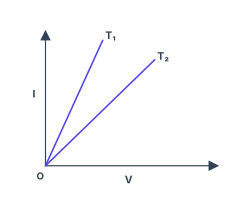
The figure shows the voltage (VV) versus the current (II) graphs for a wire at two temperatures T1T_1 and T2T_2. One can conclude that: (A) T2=2T1T_2 = 2T_1 (B) T1>T2T_1 > T_2 (C) T1=T2/3T_1 = T_2/3 (D) T1<T2T_1 < T_2 Figure — 55/6/1 Q1
[1]
Q2.
If RsR_s and RpR_p are the equivalent resistances of nn resistors, each of value RR, in series and parallel combinations respectively, then the value of (Rs−Rp)(R_s - R_p) is: (A) (n2−1)n2R\dfrac{(n^2-1)}{n^2}R (B) (n2+1)(n2−1)R\dfrac{(n^2+1)}{(n^2-1)}R (C) (n2−1)nR\dfrac{(n^2-1)}{n}R (D) (n2+1)Rn2\dfrac{(n^2+1)R}{n^2}
[1]
Q3.
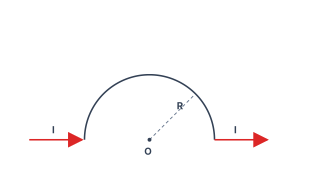
The value of magnetic field at point O in the given figure is: (A) μ0I2πR\dfrac{\mu_0 I}{2\pi R} (B) μ0IπR\dfrac{\mu_0 I}{\pi R} (C) μ0I4R\dfrac{\mu_0 I}{4R} (D) μ0IR\dfrac{\mu_0 I}{R} Figure — 55/6/1 Q3
[1]
Q4.
A piece of a diamagnetic material, free to move when placed in a uniform magnetic field: (A) moves along the field (B) moves opposite to the field (C) moves perpendicular to the field (D) does not move at all
[1]
Q5.
A galvanometer can be converted into an ammeter of desired range by connecting a: (A) small resistance in series (B) large resistance in series (C) small resistance in parallel (D) large resistance in parallel
[1]
Page 1 of 6
Q6.
A proton and an α-particle enter with the same velocity vecv in a uniform magnetic field vecB (with vecv perp vecB). The ratio of the radii of their paths (rp : r_α) is: (A) 2 (B) (1)/(2) (C) (1)/(4) (D) 4
[1]
Q7.
A vertically held bar magnet is dropped along the axis of a copper ring having a cut as shown in the diagram. The acceleration of the falling magnet is: (A) zero (B) less than g (C) g (D) greater than g
[1]
Q8.
An ac source is connected to a resistor and an inductor in series. The voltage across the resistor and inductor are 8 V and 6 V respectively. The voltage of the source is: (A) 10 V (B) 12 V (C) 14 V (D) 16 V
[1]
Q9.
Two coherent waves, each of intensity I₀, produce interference pattern on a screen. The average intensity of light on the screen is: (A) zero (B) I₀ (C) 2I₀ (D) 4I₀
[1]
Q10.
The work function of a material is 2.21 eV. Which of the following cannot produce photoelectrons from it? (A) Red light (B) Blue light (C) Violet light (D) Green light
[1]
Q11.
The momentum (in kg m/s) of a photon of frequency 6.0×10¹⁴ Hz is: (A) 6.63×10⁻²⁵ (B) 1.326×10⁻²⁷ (C) 2.652×10⁻²⁶ (D) 3.978×10⁻²⁴
[1]
Q12.
Inside a nucleus, the nuclear forces between proton and proton, proton and neutron, neutron and neutron are Fpp, Fpn and Fₙₙ respectively. Then: (A) Fpp > Fpn > Fₙₙ (B) Fpn > Fₙₙ > Fpp (C) Fₙₙ > Fpp > Fpn (D) Fpp = Fpn = Fₙₙ
[1]
Q13.
Assertion (A): In a reflecting telescope, the image does not have chromatic aberration. Reason (R): Chromatic aberration occurs only due to refraction of light through an optical medium. (A) Both Assertion (A) and Reason (R) are true and Reason (R) is the correct explanation of the Assertion (A). (B) Both Assertion (A) and Reason (R) are true, but Reason (R) is not the correct explanation of the Assertion (A). (C) Assertion (A) is true, but Reason (R) is false. (D) Both Assertion (A) and Reason (R) are false.
[1]
Page 2 of 6
Q14.
Assertion (A): A hole is an apparent free particle with effective positive electronic charge. Reason (R): A hole is not necessarily a vacancy left behind by an electron in the valence band. (A) Both Assertion (A) and Reason (R) are true and Reason (R) is the correct explanation of the Assertion (A). (B) Both Assertion (A) and Reason (R) are true, but Reason (R) is not the correct explanation of the Assertion (A). (C) Assertion (A) is true, but Reason (R) is false. (D) Both Assertion (A) and Reason (R) are false.
[1]
Q15.
Assertion (A): X-rays are produced when slow moving electrons are stopped by a metal target of high atomic number. Reason (R): X-rays consist of low-energy photons. (A) Both Assertion (A) and Reason (R) are true and Reason (R) is the correct explanation of the Assertion (A). (B) Both Assertion (A) and Reason (R) are true, but Reason (R) is not the correct explanation of the Assertion (A). (C) Assertion (A) is true, but Reason (R) is false. (D) Both Assertion (A) and Reason (R) are false.
[1]
Q16.
Assertion (A): The binding energy per nucleon is practically constant for mass number in the range (30 < A < 170). Reason (R): Nuclear forces between the nucleons for mass numbers in the range (30 < A < 170) are not short-range. (A) Both Assertion (A) and Reason (R) are true and Reason (R) is the correct explanation of the Assertion (A). (B) Both Assertion (A) and Reason (R) are true, but Reason (R) is not the correct explanation of the Assertion (A). (C) Assertion (A) is true, but Reason (R) is false. (D) Both Assertion (A) and Reason (R) are false.
[1]
Section B

Very short answer · 2 marks each · 5 of 5 shown

Q1.
Find the equivalent resistance between points A and B for the network shown in the figure.
[2]
Q2.
(a) In Young's double-slit experiment, find the resultant intensity at points at which the interfering waves of intensity I₀ each have a path difference of (i) (λ)/(3), and (ii) (λ)/(2). OR (b) A point source of light in air is kept at a distance of 12 cm in front of a convex spherical surface of glass of refractive index 1.5 and radius of curvature 30 cm. Find the nature and position of the image formed.
[2]
Q3.
A laser beam of frequency 3.0×10¹⁴ Hz produces average power of 9 mW. Find (i) the energy of a photon of the beam, and (ii) the number of photons emitted per second on an average by the source.
[2]
Q4.
A right angled isosceles glass prism ABC is kept in contact with an equilateral triangular prism DBC as shown in the figure. Both prisms are made of the same glass of refractive index 1.6. Trace the path of the ray MN incident normally on face AB as it passes through the combination.
[2]
Page 3 of 6
Q5.
In an n-type semiconductor electron-hole combination is a continuous process at room temperature. Yet the electron concentration is always greater than the hole concentration in it. Explain.
[2]
Section C

Short answer · 3 marks each · 7 of 7 shown

Q1.
Distinguish between the emf and the terminal voltage of a cell. Two cells of emfs E₁ and E₂ and internal resistances r₁ and r₂ are connected in parallel. Derive an expression for the emf and internal resistance of the equivalent cell.
[3]
Q2.
A rectangular loop carries a current of 1 A. A straight long wire carrying 2 A current is kept near the loop in the same plane as shown in the figure. Find: (i) the torque acting on the loop, and (ii) the magnitude and direction of the net force on the loop.
[3]
Q3.
(a) State Lenz's law. A metallic rod of length L is rotated about an axis passing through its end M perpendicular to its length, with a constant angular velocity ω in a uniform magnetic field B parallel to the axis. Obtain an expression for the emf induced between its ends. OR (b) Define self-inductance of a coil. Derive an expression for the self-inductance of a long solenoid of cross-sectional area A and length l, having n turns per unit length.
[3]
Q4.
Name the electromagnetic wave used (i) in radar, (ii) in eye surgery and (iii) as diagnostic tool in medicine. Write their wavelength range also.
[3]
Q5.
Draw a ray diagram showing the image formation when a concave mirror produces a real, inverted and magnified image of an object and hence obtain the mirror formula.
[3]
Page 4 of 6
Q6.
How is the necessary force provided to an electron to keep it moving in a circular orbit according to Bohr model of hydrogen atom? Derive an expression for the total energy of an electron moving in an orbit of radius r in hydrogen atom. Give the significance of negative sign in this expression.
[3]
Q7.
(a) Consider the so-called D-T reaction (Deuterium-Tritium reaction). In a thermonuclear fusion reactor, the following nuclear reaction occurs: ²₁mathrmH + ³₁mathrmH arrow ⁴₂mathrmHe + ¹₀n. Find the amount of energy released in the reaction. Given: m(²₁mathrmH) = 2.014102 u, m(³₁mathrmH) = 3.016049 u, m(⁴₂mathrmHe) = 4.002603 u, m(¹₀n) = 1.008665 u, 1 u = 931 MeV/c². (b) Show that the nuclear density is independent of mass number.
[3]
Section D

Case-based · 4 marks each · 2 of 2 shown

Q1.
Case study (Capacitors): A capacitor is a system of two conductors separated by an insulator, with charges Q and -Q and potential difference V; the ratio Q/V = C is the capacitance, depending only on geometry and the medium. Inserting a dielectric polarises it, changing the field, capacitance and stored energy. Capacitors can be arranged in series/parallel. (i) A capacitor of capacitance C, plate area A and separation d, is filled with air [Fig.(a)]. The separation is increased to 2d and one plate is shifted as shown in Fig.(b). The capacitance of the new system is: (A) (C)/(4) (B) (C)/(2) (C) 2C (D) 4C (ii) A slab (area A, thickness d₁) of a linear dielectric of dielectric constant K is inserted between charged plates (charge density σ) of a parallel plate capacitor; opposite charges of density σp appear on the slab faces. The dielectric constant K is given by: (A) (σ+σp)/(σ) (B) (σ)/(σ-σp) (C) (σ+σp)/(σp) (D) (σ)/(σp). (iii) An electric field E is established between the plates of an air-filled parallel plate capacitor with charges Q and -Q; V is the volume enclosed. The energy stored is: (A) varepsilon₀ E² (B) varepsilon₀ Q² E (C) (1)/(2)varepsilon₀ E² V (D) varepsilon₀ E Q V. (iv)(a) Three capacitors A, B and M, each of capacitance C, are connected to a capacitor N of capacitance 2C and a battery as shown in the figure. If the charges on A and N are QA and QN respectively, then QN/QA is: (A) (1)/(6) (B) (1)/(3) (C) 3 (D) 6. OR (iv)(b) A slab (area A and thickness d/2) of dielectric constant K is inserted in a parallel plate capacitor of plate area A and plate separation d. If C and C₀ are the capacitances with and without the dielectric, then C/C₀ is: (A) (K+1)/(2K) (B) (2K)/(K+1) (C) (K)/(K-1) (D) (K-1)/(K).
[4]
Q2.
Case study (Extrinsic semiconductors and p-n junction): Extrinsic semiconductors are made by doping intrinsic semiconductors with a suitable impurity, giving p-type and n-type semiconductors. A p-n junction is the basic building block of many devices; during its formation diffusion and drift occur, creating a depletion region and a junction potential barrier whose width changes on forward/reverse bias. A diode can rectify ac voltages. (i) Which of the following is a donor impurity atom for Ge? (A) Boron (B) Antimony (C) Aluminium (D) Indium. (ii) When a pentavalent atom occupies the position of an atom in the crystal lattice of Si, four of its electrons form covalent bonds with four silicon neighbours while the fifth remains bound to the parent atom. The energy required to set this electron free is about: (A) 0.5 eV (B) 0.1 eV (C) 0.05 eV (D) 0.01 eV. (iii) During formation of a p-n junction: (A) a layer of negative charge on n-side and a layer of positive charge on p-side appear; (B) a layer of positive charge on n-side and a layer of negative charge on p-side appear; (C) the electrons on p-side of the junction move to n-side initially; (D) initially diffusion current is small and drift current is large. (iv)(a) In a reverse-biased p-n junction: (A) the drift current is of the order of few mA; (B) the applied voltage mostly drops across the depletion region; (C) the depletion region width decreases; (D) the current increases with increase in applied voltage. OR (iv)(b) The output frequency of a full-wave rectifier with 50 Hz as input frequency is: (A) 25 Hz (B) 50 Hz (C) 100 Hz (D) 200 Hz.
[4]
Page 5 of 6
Section E

Long answer · 5 marks each · 3 of 3 shown

Q1.
(a)(i) Write the principle of working of an ac generator. Draw its labelled diagram and explain its working. (ii) A resistor of 400 Ω, an inductor of (5)/(π) H and a capacitor of (50)/(π)μF are joined in series across an ac source v = 140sin(100π t) V. Find the rms voltages across these three circuit elements. The algebraic sum of these voltages is more than the rms voltage of the source. Explain. OR (b)(i) Write the principle of working of a transformer. With the help of a labelled diagram, explain the working of a step-up transformer. (ii) An ideal transformer is designed to convert 50 V into 250 V. It draws 200 W power from an ac source whose instantaneous voltage is given by vᵢ = 20sin(100π t) V. Find: (I) rms value of input current; (II) expression for instantaneous output voltage; (III) expression for instantaneous output current.
[5]
Q2.
(a)(i) Draw a ray diagram to show the image formation by a compound microscope. Obtain the expression for the total magnification of the microscope when the final image is formed at infinity. (ii) In a compound microscope, an object is placed at a distance of 1.5 cm from the objective of focal length 1.25 cm. The eyepiece has a focal length of 5 cm. The final image is formed at infinity. Calculate the distance between the objective and the eyepiece. OR (b)(i) Using Huygens' principle, show the refraction of a plane wavefront propagating in air at a plane interface between two media and hence verify Snell's law. (ii) Use mirror formula to deduce that a convex mirror always produces a virtual image of an object kept in front of it.
[5]
Q3.
(a)(i) The electric field in a region is given by vecE = 40xhati N/C. Find the amount of work done in taking a unit positive charge from a point (0, 3 m) to the point (5 m, 0). (ii) A charge Q is distributed over two concentric hollow spheres of radii r and R(>r) such that their surface charge densities are equal. Find: (I) the electric field, and (II) the potential at their common centre. OR (b)(i) Obtain an expression for the electric field vecE due to a dipole of dipole moment vecp at a point on its equatorial plane and specify its direction. Hence, find the value of the electric field: (I) at the centre of the dipole (r=0), and (II) at a point r gg a, where 2a is the length of the dipole. (ii) An electric field vecE = (10x + 5)hati N/C exists in a region in which a cube of side L is kept as shown in the figure. Here x and L are in metres. Calculate the net flux through the cube.
[5]
Page 6 of 6