Q.(a)
🔒You're viewing a preview — the full solution, concept, methods & PYQ mapping are locked.
🔒 Start your 14-day free trial to unlock the full solution →Part (a)Concept understanding — Angular Magnification
What is Angular Magnification?
When you look at a tiny object — say a grain of salt — you hold it close to your eye to see it bigger. But there is a limit: bring it too close and it blurs. The closest distance at which your eye can focus comfortably is called the near point, conventionally taken as 25 cm for a normal eye. At that distance, the object subtends a certain angle at your eye. That angle determines how large it appears — not its physical size, but the fraction of your field of view it occupies.
Now imagine using a magnifying glass. The same grain of salt now looks much larger. Why? Because the lens lets you bring the object even closer than 25 cm while still seeing a clear, magnified image. That image is formed at a comfortable viewing distance, but the angle it subtends at your eye is far bigger than the angle the object would subtend at 25 cm without the lens.
Angular magnification is simply the ratio of these two angles:
Angular magnification M=θobjectθimage
where θimage is the angle subtended by the image when viewed through the instrument, and θobject is the angle subtended by the object when viewed with the naked eye at the near point (25 cm).
Why "Angular" and Not "Linear"?
A common confusion: a microscope or telescope does not give you a physically larger object — it gives you a larger apparent size. The image on your retina is bigger because the rays entering your eye are steeper. That steepness is measured by the angle. So magnification here is about angles, not actual lengths.
Angular magnification is dimensionless. It tells you how many times wider the image appears compared to the object seen directly at the near point.
A Concrete Example
Take a simple magnifier (a convex lens) of focal length f=5 cm. You place the object just inside the focal point so that a virtual, erect image forms at infinity (or at the near point). For the "image at infinity" case, the angle subtended by the image is θimage≈h/f, where h is the object height. The angle subtended by the object at the near point (25 cm) is θobject≈h/25.
Thus:
M=h/25h/f=f25
For f=5 cm, M=5. The image appears 5 times larger than the object seen at 25 cm.
For a magnifier, the formula M=1+f25 applies when the image is formed at the near point (25 cm) — giving slightly higher magnification than the infinity-focus case.
The Big Picture
Angular magnification is the language of all optical instruments:
- Simple magnifier: M≈25/f (image at infinity) …
Part (b)Concept understanding — Compound Microscope Magnification
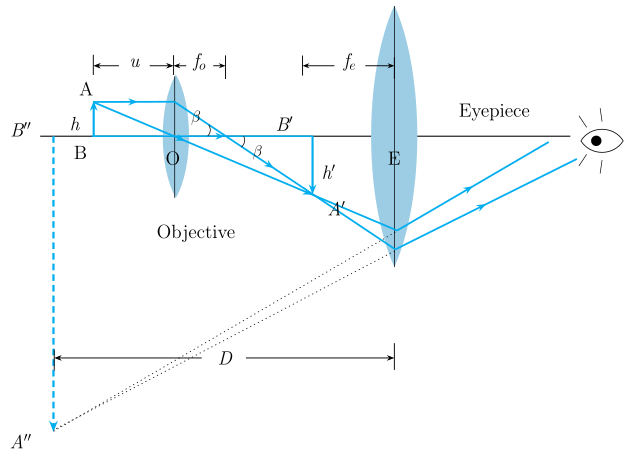
What a Compound Microscope Does
A single magnifying glass can only magnify so much before the image gets too
blurry to use. A compound microscope solves this by using two converging
lenses in sequence: the objective (short focal length, closest to the tiny
object) forms a real, enlarged image first, and the eyepiece (acting as a
simple magnifier) then magnifies that image further before it reaches your eye.
"Compound" just means the total magnification is the product of what each lens
contributes on its own.
The Two-Stage Picture
- Objective lens — the object sits just beyond the objective's focal point fo, so it forms a real, inverted, enlarged image inside the tube.
- Eyepiece — that real image now acts as the "object" for the eyepiece, which is positioned so the image it forms is easy for a relaxed eye to view.
The distance between the objective's image and the eyepiece is the tube length, usually written L.
Magnifying Power: Image at Infinity (Normal Adjustment)
The most common case tested is when the eyepiece is adjusted so the final image
forms at infinity (a relaxed eye needs no accommodation). Here the total
magnifying power is:
M=foL×feD
Where:
- L = tube length (separation between objective and eyepiece)
- fo = focal length of the objective
- fe = focal length of the eyepiece
- D = the least distance of distinct vision (usually 25 cm)
M=foL⋅feD
Why it looks like this: L/fo is (approximately) the objective's own
linear magnification — a real image formed far beyond fo is much bigger than
the object. D/fe is the eyepiece behaving as a simple magnifier viewing that
image. Multiplying the two stages gives the total magnifying power.
Magnifying Power: Image at the Near Point
If instead the eyepiece is adjusted so the final image forms at the near point
D (maximum magnification, but the eye must accommodate), the eyepiece
contributes a slightly larger factor:
M=foL(1+feD)
Don't mix the two formulas up. "Image at infinity" (relaxed eye) uses
D/fe; "image at the near point" (maximum magnification, eye strained) uses
1+D/fe. A question that doesn't specify usually means normal adjustment
(image at infinity).
Why Both Lenses Need Short Focal Lengths
To get large magnifying power, both fo and fe should be small — but the
objective's focal length matters most for a different reason too: a very
short fo lets the object be placed very close to the lens, which is what lets
a microscope resolve tiny structures a simple magnifier never could.
Worked Example
Problem: A compound microscope has an objective of focal length 1.0 cm
and an eyepiece of focal length 5.0 cm. The tube length is 20 cm
and the final image is formed at infinity (normal adjustment, D=25 cm). …
Part (a)
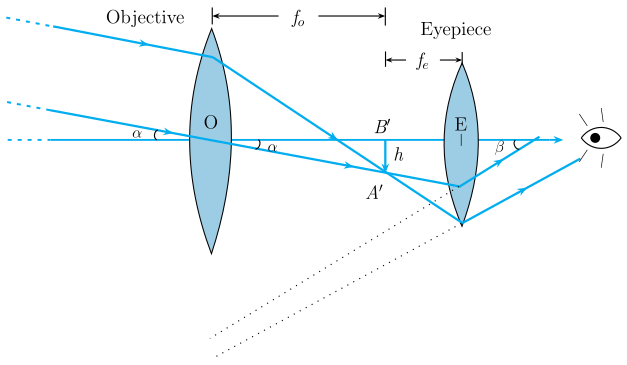
(i) Astronomical telescope (image at infinity — normal adjustment): the objective forms a real, inverted image of the distant object at its focal plane; this image lies at the focus of the eyepiece, which sends the final image to infinity. (Rays from the object → objective → intermediate image at the common focus → eyepiece → parallel rays to the eye.)
(ii) fo=150 cm, fe=6.0 cm, final image at infinity: …
(a) Telescope in normal adjustment: tube length =fo+fe=156 cm, magnification =fo/fe=25. (b) Simple magnifier: image is virtual at 12 cm on the object side, with linear magnification 4.0.
Part (a)
(i) Astronomical telescope, image at infinity
The objective (large fo) forms a real, inverted, diminished image of the distant object at its focal plane. In normal adjustment this intermediate image lies exactly at the first focus of the eyepiece (short fe), so the eyepiece sends the final image to infinity and the eye views it relaxed. A labelled ray diagram shows parallel rays from the distant object converging at the common focal point Fo=Fe, then emerging as a parallel (magnified-angle) beam through the eyepiece.
(ii) Numerical
With the final image at infinity, the two focal points coincide, so the lens separation (tube length) is
L=fo+fe=150+6.0=156 cm.
The angular magnification in normal adjustment is …
- CBSE 2026Set 55/3/11 markMCQQ.A telescope has an objective lens of focal length 144 cm and an eyepiece of focal length 6.0 cm. The magnifying power and the length of the telescope tube will be respectively : (A) 24, 150 cm (B) 42, 138 cm (C) 24, 138 cm (D) 42, 150 cm
›Reveal solutionSolution
For a telescope in normal adjustment, the magnifying power is the ratio of objective to eyepiece focal lengths (M=fo/fe), and the tube length is their sum (L=fo+fe). Here, M=144/6=24 and L=144+6=150 cm, so the correct option is (A).
The question gives you a telescope with an objective of focal length fo=144 cm and an eyepiece of focal length fe=6.0 cm. You need the magnifying power and the length of the telescope tube.
The key idea is that a telescope is used to view distant objects. Light from a faraway object arrives as nearly parallel rays. The objective lens forms a real, inverted image at its focal plane. The eyepiece then acts as a magnifier to view that image.
For relaxed viewing (normal adjustment), the eyepiece is adjusted so that the final image is at infinity. This means the image formed by the objective must lie exactly at the focal point of the eyepiece. So the distance between the two lenses — the tube length — is simply the sum of their focal lengths.
The magnifying power (or angular magnification) is defined as the ratio of the angle subtended at the eye by the final image to the angle subtended by the object when viewed directly. For a telescope in normal adjustment, this ratio simplifies beautifully to the ratio of the focal lengths.
For a telescope in normal adjustment:
M=fefoandL=fo+fe
Let's apply this directly.
- Magnifying power:
M=fefo=6.0144=24
- Tube length:
L=fo+fe=144+6.0=150 cm
So the magnifying power is 24 and the tube length is 150 cm. …
- CBSE 2025Set 55/5/11 markMCQQ.A compound microscope has an objective and an eyepiece of focal lengths fo and fe respectively. To obtain a large magnification of a small object, the microscope should have: (A) fo and fe small, and fe>fo (B) fo and fe small, and fo>fe (C) fo and fe large, and fe>fo (D) fo and fe large, and fo>fe
›Reveal solutionSolution
A compound microscope achieves high magnification when both lenses have short focal lengths, with the objective's focal length shorter than the eyepiece's: fo and fe small, and fe>fo. The correct option is (A).
Why focal lengths matter for magnification
A compound microscope uses two converging lenses in tandem. The objective forms a real, magnified image of the tiny object, and the eyepiece acts as a magnifying glass to view that intermediate image. The total magnification is the product of the magnifications produced by each lens, so to maximize it we need to understand how each focal length enters the formula.
The objective's magnification depends on how far the real image forms relative to the object distance. For a small object placed just beyond the focal point of the objective, the image distance vo is much larger than the object distance uo, giving magnification mo=uovo. In the standard microscope setup, the object is very close to the focus, so uo≈fo, and the image forms near the other end of the tube at distance L (the tube length). This gives:
mo≈foL
The eyepiece magnifies the intermediate image like a simple magnifying glass. When the final image is at the near point D (typically 25 cm), the angular magnification is:
me=1+feD
For large D compared to fe, this simplifies to me≈feD.
M=mo×me≈foL×feD=fofeLD
Step-by-step analysis
-
Total magnification is inversely proportional to both focal lengths. From the formula above, M∝fofe1. To maximize M, we need both fo and fe to be as small as possible. This immediately rules out options (C) and (D), which suggest large focal lengths.
-
Compare the two focal lengths. Now we must decide between options (A) and (B): should fe>fo, or fo>fe?
-
Physical constraints of microscope design. In a practical compound microscope, the objective must form a real image at a reasonable distance (the tube length L, typically 15–20 cm). If fo were too large, the object would need to be placed far from the lens, defeating the purpose of examining a small specimen up close. The objective typically has fo in the range of a few millimetres to about 2 cm. …
-
- CBSE 2025Set A1 markQ.Fill in the blank with appropriate word: Simple microscope is a converging lens of ______ focal length.
›Reveal solutionSolution
A simple microscope must have a short focal length to give useful magnification.
A simple microscope is just a single convex (converging) lens used to view a small object placed within its focal length, forming a magnified, virtual, erect image. Its angular magnification (when the image is formed at the near point D = 25 cm) is given by m = 1 + D/f. This shows that the magnification increases as the focal length f decre …
- CBSE 2025Set ANNUAL1 markMCQQ.The magnifying power of a telescope is 9. When it is adjusted for parallel rays, the distance between the objective and eyepiece is 20 cm. The focal lengths of the lenses are(i) 10 cm, 20 cm(ii) 15 cm, 5 cm(iii) 18 cm, 2 cm(iv) 11 cm, 9 cm
›Reveal solutionSolution
fo = 18 cm and fe = 2 cm.
…
- CBSE 2024Set 55/5/11 markMCQQ.The focal lengths of the objective and the eyepiece of a compound microscope are 1 cm and 2 cm respectively. If the tube length of the microscope is 10 cm, the magnification obtained by the microscope for the most suitable viewing by a relaxed eye is ______. (A) 250 (B) 200 (C) 150 (D) 125
›Reveal solutionSolution
For a compound microscope with a relaxed eye, the total magnification is the product of objective and eyepiece magnifications. Assuming the "tube length" L refers to the distance between the objective's second focal point and the eyepiece's first focal point, the magnification is 125.
A compound microscope uses two converging lenses: an objective lens with a short focal length and a short aperture, and an eyepiece lens with a larger focal length and aperture. The objective forms a real, inverted, and magnified intermediate image. This intermediate image then acts as the object for the eyepiece, which functions like a simple magnifier to produce the final, highly magnified virtual image.
For the most suitable viewing by a relaxed eye, the final image formed by the eyepiece is at infinity. This condition is met when the intermediate image formed by the objective lens falls exactly at the first focal point of the eyepiece.
The total magnification (M) of a compound microscope is the product of the linear magnification produced by the objective (Mo) and the angular magnification produced by the eyepiece (Me):
M=Mo×Me
Let's break down the calculation for each part.
-
Identify Given Parameters and Standard Values:
- Focal length of the objective, fo=1 cm.
- Focal length of the eyepiece, fe=2 cm.
- Tube length of the microscope, L=10 cm.
- Least distance of distinct vision (for a relaxed eye, the final image is at infinity, but the eyepiece magnification is still referenced to D), D=25 cm.
-
Understand the Definition of Tube Length (L) for the Formula:
The term "tube length" can sometimes be ambiguous. In the context of the standard formula for compound microscope magnification, M=(foL)(feD), the tube length L is specifically defined as the distance between the second focal point of the objective (Fo′) and the first focal point of the eyepiece (Fe). This is crucial for the formula to hold true.
Watch outIf "tube length" were interpreted as the physical distance between the objective and eyepiece lenses, the calculation would be different and would not lead to any of the given options. For competitive exams, when the formula M=(L/fo)(D/fe) is implied by the options, assume L refers to the distance between the internal focal points.
-
Calculate the Magnification of the Objective (Mo):
For a relaxed eye, the intermediate image (I1) formed by the objective must be at the first focal point of the eyepiece (Fe).
Given our definition of L (distance between Fo′ and Fe), the image I1 is formed at a distance vo=fo+L from the objective lens.
The object for the objective (O) is placed just outside its first focal point (Fo).
Using the lens formula for the objective:
fo1=vo1−uo1
uo1=vo1−fo1=fo+L1−fo1=fo(fo+L)fo−(fo+L)=fo(fo+L)−L …
-
- CBSE 2024Set 55/2/11 markMCQQ.Assertion (A) : The magnifying power of a compound microscope is negative. Reason (R) : The final image formed is erect with respect to the object. (A) Both Assertion (A) and Reason (R) are true and Reason (R) is the correct explanation of the Assertion (A). (B) Both Assertion (A) and Reason (R) are true, but Reason (R) is not the correct explanation of the Assertion (A). (C) Assertion (A) is true, but Reason (R) is false. (D) Assertion (A) is false and Reason (R) is also false.
›Reveal solutionSolution
The magnifying power of a compound microscope is negative because the final image is inverted relative to the object, not erect. The assertion is true, but the reason given is false.
The sign of magnifying power in optical instruments tells us about the orientation of the final image relative to the object. A negative magnifying power means the image is inverted; a positive one means it is erect. This is a convention used consistently in ray optics.
For a compound microscope, the objective lens forms a real, inverted, and magnified image of the object. This intermediate image then acts as the object for the eyepiece, which works as a simple magnifier. The eyepiece produces a virtual, magnified image that is erect with respect to the intermediate image. But because the intermediate image itself was already inverted, the final image ends up inverted relative to the original object.
Let’s trace the orientation step by step.
-
The objective lens inverts the object.
The objective has a short focal length and forms a real image. For a real image formed by a convex lens, the image is always inverted with respect to the object. So the intermediate image is inverted.
-
The eyepiece does not re-invert.
The eyepiece is used as a simple magnifier — the object (the intermediate image) is placed just inside its focal point. A simple magnifier always produces a virtual image that is erect relative to the object placed before it. So the eyepiece takes the inverted intermediate image and produces a final image that is erect with respect to that intermediate image.
-
Net orientation: inverted.
If the intermediate image is inverted, and the eyepiece keeps that orientation (erect relative to the intermediate image), the final image remains inverted relative to the original object.
Mathematically, the magnifying power M of a compound microscope is given by:
M=−foL⋅feD …
-
- CBSE 2024Set ANNUAL1 markMCQQ.What should be increased to increase the angular magnification of a simple microscope?(a) The power of the lens(b) The focal length of the lens(c) Lens aperture(d) Object size
›Reveal solutionSolution
Angular magnification m=D/f (or 1+D/f), so increasing the power (1/f) directly increases m.
For a simple microscope (magnifying glass), the angular magnification is m=fD (normal adjustment, image at infinity) or m=1+fD (image at the near point), where D is the least distance of distinct vision and f is the focal length. Since m∝f1, and the power of a lens is P=f1, increasing the power of the lens (equivalently, decreasing f) directly increases the angular magnification. Increasing lens aperture …
- CBSE 2019Set ANNUAL1 markMCQQ.The magnifying power of an astronomical telescope for normal adjustment is -(a) - f_o / f_e(b) - f_o × f_e(c) - f_e / f_o(d) - f_o + f_e
›Reveal solutionSolution
Magnifying power in normal adjustment: M = −f_o/f_e.
In normal adjustment the final image is formed at infinity, so the length of the telescope is f_o + f_e and the angular magnification is
M=−fefo,
…
- CBSE 2018Set ANNUAL1 markMCQQ.A magnifying glass is to be used at the fixed object distance of 1 inch. If it is to produce an erect image 5 items magnified, its focal length should be-(a) 0.2"(b) 0.8"(c) 1.25"(d) 5"
›Reveal solutionSolution
Use m = v/u with m = +5, u = −1" → v = −5"; then the lens equation gives f = 1.25".
A magnifying glass gives an erect, virtual, magnified image, so magnification m = +5.
With m=uv and u=−1′′: v=mu=5×(−1)=−5′′ (virtual, same side).
…
- CBSE 2018Set ANNUAL1 markQ.Fill in the blank: In a Galilean telescope the eye lens is a ______ lens.
›Reveal solutionSolution
The eyepiece of a Galilean telescope is a concave (diverging) lens.
A Galilean telescope consists of a convex (converging) objective lens and a concave (diverging) eye lens. The concave eyepiece is placed before the objective's focal point so that it intercepts the converging rays and produces a virtual, erect and magnified image.
…
🎓Unlock everything free for 14 days
- ✓Full step-by-step solutions
- ✓Concept-first explanations
- ✓Methods, shortcuts & mistakes
- ✓PYQ mapping + timed mock tests
Full access for 14 days. No credit card required.