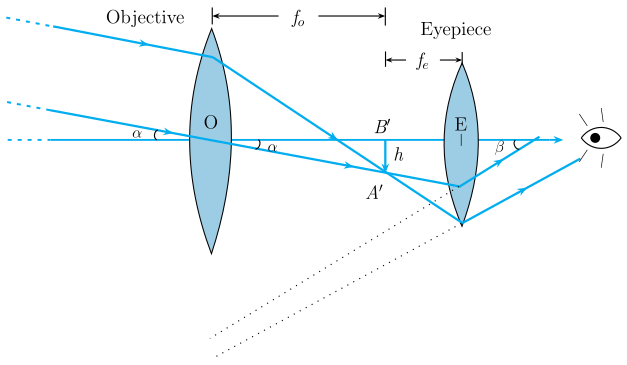
Q.(a) Draw the ray diagram to show the image formation by a refracting telescope and write the expression for angular magnification for the telescope in normal adjustment.
You're viewing a preview — the full solution, concept, methods & PYQ mapping are locked.
Start your 14-day free trial to unlock the full solution →A refracting telescope uses two convex lenses to form a magnified image of a distant object; in normal adjustment, the final image is at infinity and the angular magnification is . Reflecting telescopes are preferred because they eliminate chromatic aberration and allow much larger apertures without the weight and support problems of large lenses.
The Concept: Why Two Lenses?
A telescope solves a simple problem: distant objects subtend a very small angle at the eye, so they look tiny. To see detail, we need to increase that angle — that is, we need angular magnification.
The refracting telescope does this in two stages. First, a large objective lens (long focal length) collects light from the distant object and forms a real, inverted, diminished image at its focal plane. Second, an eyepiece (short focal length) acts like a magnifying glass to view that intermediate image. The net effect is that the angle subtended by the final image at the eye is much larger than the angle subtended by the original object.
In normal adjustment, the eyepiece is positioned so that the intermediate image lies exactly at its focal point. This sends the final rays out parallel — the image is at infinity — which is the most relaxed viewing condition for the eye.
Step-by-Step Solution
Part (a): Ray Diagram and Angular Magnification
1. Draw the ray diagram
For a refracting telescope in normal adjustment:
- Draw a large convex lens on the left — the objective (focal length ).
- Draw a smaller convex lens on the right — the eyepiece (focal length ).
- Mark the common focal point between them: the second focal point of the objective coincides with the first focal point of the eyepiece.
- From a distant object (effectively at infinity), draw two parallel rays coming from the top of the object, hitting the objective.
- The objective converges these rays to form a real, inverted image at its focal plane — this is the intermediate image.
- This intermediate image lies exactly at the focal point of the eyepiece. So the eyepiece takes the rays diverging from this point and makes them parallel again — the final image is at infinity.
- Show the final parallel rays emerging from the eyepiece at a steeper angle than the incoming rays.
The key geometric insight: the intermediate image is shared between the two lenses — it sits at the focal plane of both. This is what "normal adjustment" means.
2. Derive the angular magnification
Angular magnification is defined as:
Let the distant object subtend an angle at the objective (and at the unaided eye). After the telescope, the final parallel rays emerge at an angle relative to the axis.
From the ray diagram:
- The intermediate image height is formed at the focal plane of the objective. For small angles, .
- The eyepiece sees this same height at its focal point. The emerging rays make angle .
Therefore:
This is the angular magnification of a refracting telescope in normal adjustment. Since , the magnification is large. …
Unlock everything free for 14 days
- Full step-by-step solutions
- Concept-first explanations
- Methods, shortcuts & mistakes
- PYQ mapping + timed mock tests
Full access for 14 days. No credit card required.