Chemistry · Ch 7 — Alcohols, Phenols and Ethers
Preparation of Ethers
Preparation of Ethers
Ethers can be built in two principal ways: by dehydrating an alcohol, or by the Williamson synthesis, which joins an alkoxide (or phenoxide) ion to an alkyl halide.
1. Dehydration of alcohols
Heating an alcohol with a protic acid such as or removes water from it, and depending on the temperature the product can be either an alkene or an ether. Ethanol illustrates both outcomes with the same acid:
At the higher temperature (443 K) elimination dominates and ethene is formed; at the somewhat lower temperature (413 K) substitution wins out and ethoxyethane (diethyl ether) is the main product.
Ether formation here is a nucleophilic bimolecular substitution () in which one molecule of alcohol acts as the nucleophile and attacks a second, protonated alcohol molecule:
The second alcohol molecule attacks a protonated (oxonium-like) form of the first, displacing water, and a final loss of a proton gives the neutral ether.
Because the alkene-forming (elimination) pathway is always competing with this substitution, acid-catalysed dehydration to an ether only works cleanly for primary alcohols with an unhindered alkyl group, and only if the temperature is kept low; otherwise the alkene becomes the major product. Secondary and tertiary alcohols dehydrate through a carbocation (-type) pathway instead, and here elimination competes so effectively with substitution that the corresponding ethers are essentially never obtained this way — the alkene forms almost exclusively.
2. Williamson synthesis
This is the more generally useful laboratory route, since it can build both symmetrical ethers (where the two alkyl groups are identical) and unsymmetrical ones (where they differ). A sodium alkoxide is treated with an alkyl halide:
The alkoxide oxygen is the nucleophile and it displaces the halide from the alkyl halide by an attack. This attack goes cleanly only when the alkyl halide is primary — the alkoxide ion approaches the back of the C–X bond, so a crowded carbon blocks the approach. Ethers with a secondary or tertiary group can still be assembled this way, but only by choosing that group as the alkoxide partner and keeping the halide primary; if the alkyl halide itself is secondary or (worse) tertiary, elimination takes over. Sodium tert-butoxide reacting with bromomethane shows the successful pairing — the crowded group sits on the alkoxide, the halide stays primary, and the S_N2 attack goes cleanly:
With a tertiary halide the alkoxide instead acts purely as a base, pulling off a -hydrogen, and an alkene is the only product — none of the intended ether forms. For sodium methoxide reacting with tert-butyl bromide, the only organic products are 2-methylpropene and methanol, alongside sodium bromide: …
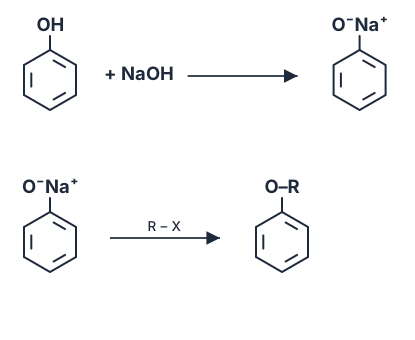
Drawn by us to help you understand the concept clearly, and verified to make sure it's accurate. For exams, practice from your NCERT textbook's own diagram.
Redrawn from the NCERT page with the structures, printed labels (:ÖH, OH, :Ö⁻ Na⁺, O⁻Na⁺, :Ö – R, O–R) and reagent placement exactly as …