Chemistry · Ch 9 — Amines
Electrophilic Substitution
Electrophilic Substitution
Electrophilic Substitution
Aromatic amines such as aniline undergo electrophilic substitution readily, and the reason traces directly back to the resonance picture of aniline discussed earlier in this chapter. Aniline is a resonance hybrid in which the lone pair on nitrogen is delocalised into the ring, and this delocalisation piles up electron density specifically at the ortho and para positions relative to the group. Consequently, the group is both a powerful activating group and an ortho-, para-directing group: it makes the ring far more nucleophilic than benzene itself, and it steers incoming electrophiles preferentially to the ortho and para positions.
This same high reactivity, however, is a double-edged sword — it makes aromatic amines too reactive for some substitutions to be controlled cleanly, as the individual reactions below show.
(a) Bromination
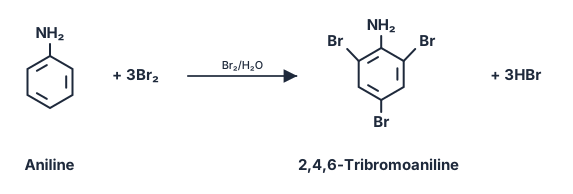
Aniline reacts with bromine water at room temperature — no catalyst is needed at all, unlike the Friedel–Crafts-type conditions ordinary benzene derivatives require — to give a white precipitate of 2,4,6-tribromoaniline:
Drawn by us to help you understand the concept clearly, and verified to make sure it's accurate. For exams, practice from your NCERT textbook's own diagram.
Redrawn from the NCERT page with the structures, printed labels (NH2, + 3Br2, Br, + 3HBr) and reagent placement exactly as the textbook prints them. Every element of this display was checked against the printed page during the sweep's blind-judge verification pass, so wh …
All three positions ortho and para to the amino group are substituted at once, precisely because the ring is so strongly activated that bromination does not stop after a single substitution.
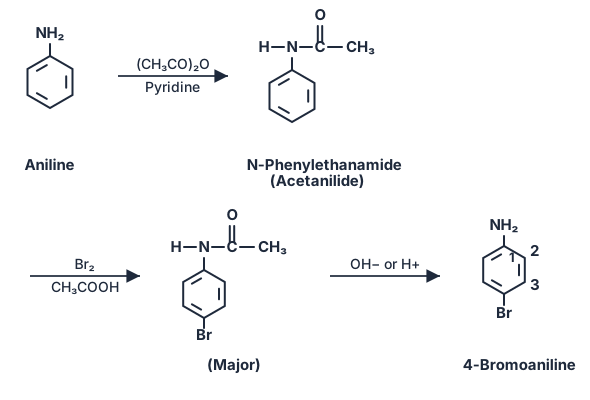
Controlling the reaction by protecting the amino group. If the goal is to prepare a mono-substituted derivative of aniline — say, a single bromine introduced cleanly at the para position — the very high activating power of the free group has to be moderated. This is done by first acetylating the amino group with acetic anhydride (in the presence of pyridine), converting it to the much less strongly activating (acetamido) group. Once the desired electrophilic substitution has been carried out on this protected ring, the acetamido group is removed again by hydrolysis (with or ), regenerating the free amine:
Drawn by us to help you understand the concept clearly, and verified to make sure it's accurate. For exams, practice from your NCERT textbook's own diagram.
Redrawn from the NCERT page with the structures, printed labels (NH2, CH3, Br) and reagent placement exactly as the textbook prints them. Every element of this display was checked against the printed page during the sweep's blind-judge verification pass, so wha …
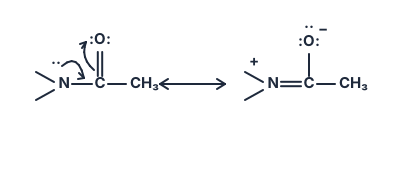
Acetylation works because the lone pair on the acetanilide nitrogen is now delocalised over the amide's own carbonyl oxygen as well as into the ring:
Drawn by us to help you understand the concept clearly, and verified to make sure it's accurate. For exams, practice from your NCERT textbook's own diagram.
Redrawn from the NCERT page with the structures, printed labels (··, :O:, CH3) and reagent placement exactly as the textbook prints them. Every element of this display was checked against the printed page during the sweep's blind-judge verification pass, so wha …
Since some of the nitrogen lone pair is now "spent" donating into the carbonyl group rather than the ring, less of it is available for donation into the benzene ring itself. The activating effect of is therefore distinctly weaker than that of the free group — strong enough to still direct ortho, para, but mild enough to let the reaction be controlled so that a single, largely para-selective substitution product can be isolated.
(b) Nitration
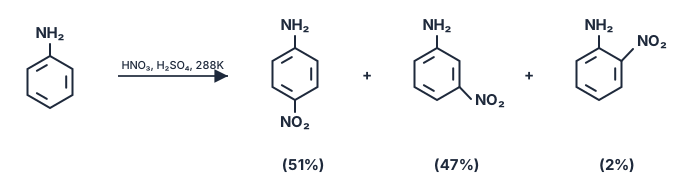
Direct nitration of aniline (with /) is problematic for two separate reasons: the strongly oxidising, strongly acidic nitrating mixture attacks the highly electron-rich ring and generates tarry oxidation products alongside the nitro compound, and in the strongly acidic medium a large fraction of the aniline is protonated to the anilinium ion, which — since it carries no lone pair available for donation — behaves as a meta-directing, deactivating group instead. The result is a mixture that contains a substantial amount of the meta isomer alongside the expected ortho and para ones:
Drawn by us to help you understand the concept clearly, and verified to make sure it's accurate. For exams, practice from your NCERT textbook's own diagram.
Redrawn from the NCERT page with the structures, printed labels (NH2, NO2) and reagent placement exactly as the textbook prints them. Every element of this display was checked against the printed page during the sweep's blind-judge verification pass, so what …
As with bromination, this can be controlled by first protecting the amino group as its acetamido derivative. Acetanilide's more modest activating power keeps the nitration clean, giving the para-nitro compound as the major product; hydrolysis of the amide then liberates the free amine:
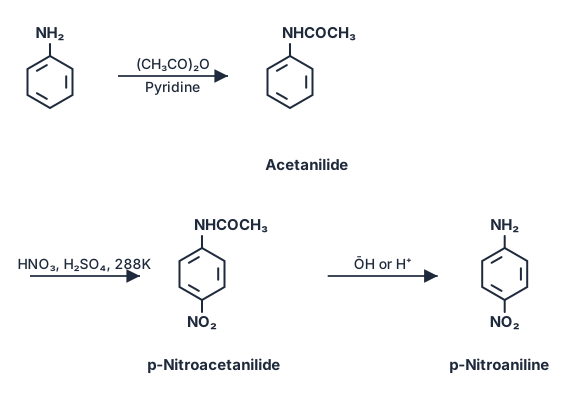
Drawn by us to help you understand the concept clearly, and verified to make sure it's accurate. For exams, practice from your NCERT textbook's own diagram.
Redrawn from the NCERT page with the structures, printed labels (NH2, NHCOCH3, NO2) and reagent placement exactly as the textbook prints them. Every element of this display was checked against the printed page during the sweep's blind-judge verification pass, so wha …
(c) Sulphonation
Aniline reacts with concentrated sulphuric acid to form anilinium hydrogensulphate (a simple acid–base salt, since sulphuric acid protonates the basic amino nitrogen). Heating this salt with sulphuric acid at 453–473 K then brings about electrophilic sulphonation of the ring itself, giving p-aminobenzenesulphonic acid — better known as sulphanilic acid — as the major product:
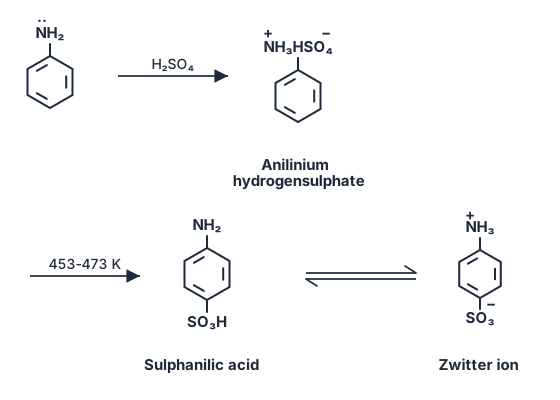
Drawn by us to help you understand the concept clearly, and verified to make sure it's accurate. For exams, practice from your NCERT textbook's own diagram.
Redrawn from the NCERT page with the structures, printed labels (NH2, ··, NH3HSO4, SO3H, NH3, SO3) and reagent placement exactly as the textbook prints them. Every element of this display was checked against the printed page during the sweep's blind-judge verification pass, so …
Sulphanilic acid is interesting structurally because it exists predominantly as a zwitterion: the strongly acidic group transfers its proton internally to the basic amino nitrogen, so the molecule is better represented as , with both a positively charged ammonium centre and a negatively charged sulphonate centre coexisting in the same molecule (an internal salt), in equilibrium with the neutral form. …