Chemistry · Ch 1 — Some Basic Concepts of Chemistry
Volume
Volume
Volume
Volume is the amount of three-dimensional space that a substance occupies. Since space is measured in three dimensions, the fundamental unit of volume is the cube of a length unit. In the SI system, the base unit of length is the metre, so the SI unit of volume is the cubic metre ().
A cubic metre is a very large volume for typical chemistry laboratory work. A cube that is 1 m on each side holds 1000 litres of water — far more than any single experiment would use. For this reason, chemists almost never work directly in cubic metres. Instead, they use smaller derived units that are more practical for the quantities of liquids, solutions, and gases handled in the lab.
The most common volume units in chemistry are the cubic centimetre () and the cubic decimetre (). A cubic centimetre is exactly the volume of a cube that is 1 cm on each side. A cubic decimetre is the volume of a cube that is 1 dm (10 cm) on each side. These two units are directly related to each other and to the litre.
The litre (symbol L) is a non-SI unit that is universally accepted for use with the SI system. It was originally defined as the volume of 1 kilogram of pure water at its maximum density, but it is now defined as exactly . This gives the following chain of equalities:
Notice that is exactly the same volume as . The millilitre and the cubic centimetre are interchangeable in practice, though the millilitre is preferred when referring to liquid volumes measured with laboratory glassware.
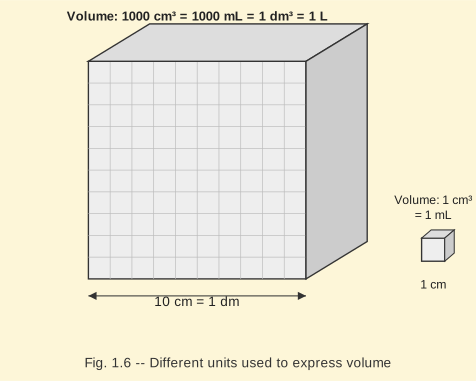
A quick way to remember the relationship: one litre is a cube that is 10 cm on each side. .
Drawn by us to help you understand the concept clearly, and verified to make sure it's accurate. For exams, practice from your textbook's own diagram.
Fig. 1.6 makes the relationship between these volume units visual. The large cube measures 10 cm on each side, so its volume is 10 x 10 x 10 = 1000 cm3 -- which is the same volume as 1000 mL, 1 dm3, and 1 L. The small cube on the right is a single 1 cm x 1 cm x 1 cm building block, with a volume of exactly 1 cm3, equal to 1 mL. The larg …
The table of SI prefixes (Table 1.3 in the textbook) shows the full range of multipliers from (yocto) to (yotta). For volume, the most frequently encountered prefixes are milli (), centi (), and deci (), giving millilitres, centilitres, and decilitres respectively. The decilitre is common in nutritional and biological contexts, but in chemistry the litre, millilitre, and cubic centimetre dominate.
Do not confuse the cubic centimetre () with the centimetre itself. A common error is to think that , but volume requires three dimensions. is the volume of a cube 1 cm long, 1 cm wide, and 1 cm high — that is .
Laboratory Measurement of Volume
In the chemistry laboratory, the volume of liquids and solutions is measured using a variety of glassware, each designed for a specific purpose and with a characteristic level of precision.
Drawn by us to help you understand the concept clearly, and verified to make sure it's accurate. For exams, practice from your textbook's own diagram.
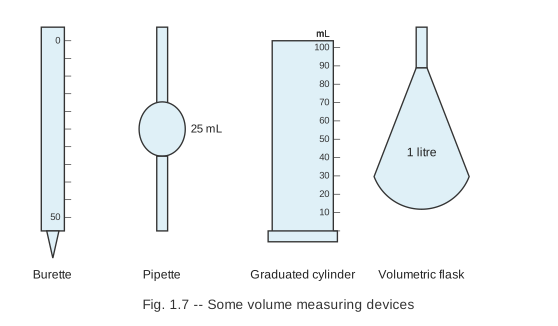
Fig. 1.7 shows the four pieces of glassware described in the text, side by side. The burette (far left) is a long graduated tube read from top to bottom, used for titrations. The pipette delivers one exact, fixed volume. The graduated cylinder (marked 0 to 100 mL here) gives an approximate reading suitable for rough measurements. The volumetric flask has a single calibration mark on its narrow ne …
A graduated cylinder is a tall, narrow cylinder marked with a scale along its side. It is used for measuring approximate volumes of liquid — typically to the nearest millilitre or 0.1 mL depending on the size of the cylinder. It is not precise enough for analytical work but is perfectly adequate for preparing rough solutions or measuring solvents.
A burette is a long, graduated tube with a stopcock at the bottom. It is used in titrations to deliver variable, precisely measured volumes of a solution. The volume delivered is read from the difference between the initial and final liquid levels. Burettes are typically graduated to 0.1 mL, and the volume can be estimated to 0.01 mL.
A pipette is used to transfer a fixed, exact volume of liquid. Volumetric pipettes (also called transfer pipettes) have a single calibration mark and deliver a specific volume — for example, 10.00 mL or 25.00 mL — with high accuracy. Measuring pipettes are graduated along their length and can deliver variable volumes, but with less precision than volumetric pipettes. …