Physics · Ch 10 — Thermal Properties of Matter
Heat Transfer
Heat Transfer
The Three Modes of Heat Transfer
Heat moves from a hotter body to a colder one. There are exactly three ways this happens: conduction, convection, and radiation. In solids, the dominant mechanism is conduction; in fluids (liquids and gases), convection usually dominates; and radiation requires no medium at all — it can travel through vacuum.
Conduction
Conduction is the transfer of heat through a material without any bulk movement of the material itself. In a metal rod heated at one end, the atoms at the hot end vibrate more vigorously. These vibrations are passed to neighbouring atoms, and free electrons in metals also carry kinetic energy from the hot region to the cold region. This is why metals are generally good conductors.
Fourier's Law of Heat Conduction
Consider a slab of uniform material of cross-sectional area and thickness . One face is at temperature and the other at , with . Experiments show that the rate of heat flow (the heat current) is:
- proportional to the area ,
- proportional to the temperature difference ,
- inversely proportional to the thickness .
Combining these, we get:
where is a constant called the thermal conductivity of the material. Its SI unit is .
The negative sign appears when we write the law in differential form: heat flows from higher to lower temperature, so the temperature gradient is negative in the direction of heat flow. The minus sign makes the heat current positive.
Do not confuse thermal conductivity with the Boltzmann constant. They share the same symbol but are completely different quantities.
Thermal Conductivities of Common Materials
Different materials conduct heat at vastly different rates — this is captured by the thermal conductivity . Metals have high values and are good conductors; gases like air have very low and are good insulators. This is why woollen clothes trap a layer of air: the air's low conductivity prevents heat from escaping your body. (The full table of measured values, Table 10.6, is given in the next section, §10.9.1 Conduction, along with the detailed treatment of Fourier's law.)
The thermal conductivity of air is about 0.024 W m⁻¹ K⁻¹. A thick sweater works not because wool itself is a great insulator, but because it holds still air in its fibres.
Convection
Convection is heat transfer by the actual movement of a fluid (liquid or gas). When a fluid is heated from below, the part near the heat source expands, becomes less dense, and rises. Cooler, denser fluid from above sinks to take its place. This sets up a convection current.
There are two types:
- Natural convection: The fluid motion is caused entirely by density differences due to temperature variation. Examples: sea breezes, the circulation of water in a pot being heated.
- Forced convection: The fluid is forced to move by an external agent like a pump or a fan. Examples: a car radiator fan, a forced-air furnace.
Convection is the main way heat is transferred through liquids and gases. It does not occur in solids because the particles cannot move freely.
Radiation
Radiation is the transfer of heat by electromagnetic waves (infrared radiation). Unlike conduction and convection, radiation does not require a medium — it can travel through vacuum. The Sun's heat reaches Earth entirely by radiation.
Every object emits radiation. The amount and the wavelength distribution depend on the object's temperature. At room temperature, objects emit mostly infrared radiation, which we cannot see but can feel as heat. At higher temperatures (like a red-hot iron), some radiation is in the visible range.
Stefan-Boltzmann Law
The rate at which an object radiates energy is given by the Stefan-Boltzmann law:
where:
- is the power radiated (in watts),
- is the Stefan-Boltzmann constant,
- is the surface area of the object,
- is the absolute temperature (in kelvin).
This law applies to a perfect radiator, called a black body. A black body absorbs all radiation incident on it and emits the maximum possible radiation at a given temperature.
For a real object, we introduce an emissivity factor (a number between 0 and 1):
…
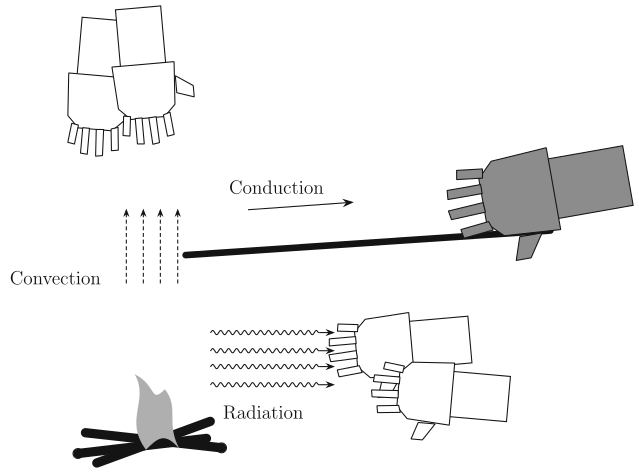
Drawn by us to help you understand the concept clearly, and verified to make sure it's accurate. For exams, practice from your textbook's own diagram.
Figure 10.13 is a single, unified illustration that shows the three distinct mechanisms by which heat travels from a fire to a nearby object — in this case, a human hand. The fire is at the centre, with logs burning. Three different paths are drawn from the fire to three different hands, each path labelled with the mode of heat transfer it represents.
The first path is a solid rod held by a gloved hand. One end of the rod is in the fire; the other end is held. This is conduction — heat flows through the material of the rod without any bulk movement of the rod itself. The gloved hand tells you that direct contact with the hot rod would burn, so the glove provides insulation.
The second path shows a series of wavy arrows rising upward from the fire, curving toward a hand held above the flames. This is convection — the air near the fire gets hot, expands, becomes less dense, and rises. The rising air carries thermal energy upward, and the hand feels that heat. The wavy shape of the arrows emphasises the fluid motion of the hot air.
The third path shows horizontal wavy arrows radiating outward from the fire, directly toward a hand held to the side. This is radiation — no medium is needed. The fire emits electromagnetic waves (infrared radiation) that travel in straight lines through empty space or air, and when they strike the hand, they transfer energy. The arrows are horizontal because radiation travels in all directions, not just upward.
The key physical idea is that heat transfer is not a single process. In everyday situations, all three mechanisms often act together, but this figure isolates each one so you can see the distinct physics behind each. Conduction requires a material medium and a temperature gradient; convection requires a fluid and bulk motion driven by density differences; radiation requires no medium at all and obeys an inverse-square law.
The textbook develops the formula for the rate of heat transfer by conduction, known as Fourier’s law of heat conduction. For a rod of length and cross-sectional area , with its ends at temperatures and (), the rate of heat flow is:
Here, is the heat transferred in time , so is the heat current (in watts). is the thermal conductivity of the material — a property that tells you how easily heat flows through it. A high (like copper) means rapid conduction; a low (like wood or the glove) means the material is an insulator. is the cross-sectional area through which heat flows, and is the temperature gradient — the rate at which temperature changes along the rod.
The formula above assumes steady-state conditions: the temperatures at the two ends are constant, and the heat flow is uniform along the rod. It does not apply if the rod is heating up or cooling down over time. …