Q.Draw the ray diagram showing refraction of monochromatic light through a glass prism of refraction angle A. Hence derive formula for refractive index μ of glass prism in terms of angle of prism and angle of minimum deviation. Also draw i-δ curve of prism. OR Using the ray diagram for refraction at a spherical convex surface separating two media μ₁ and μ₂ (μ₂ > μ₁), derive the relation μ₂/v − μ₁/u = (μ₂ − μ₁)/R, where the symbols used have their usual meanings.
You're viewing a preview — the full solution, concept, methods & PYQ mapping are locked.
Start your 14-day free trial to unlock the full solution →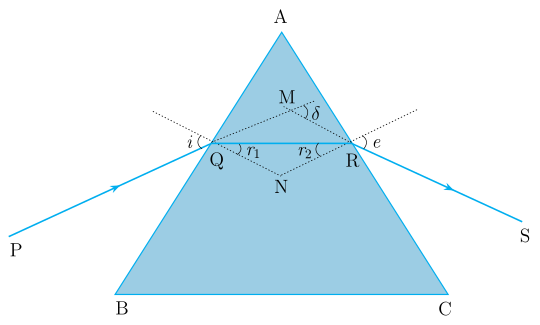
At minimum deviation, the ray passes symmetrically through the prism (r₁=r₂, i=e); combining geometry (A = r₁+r₂) and Snell's law gives .
Ray diagram (description): A monochromatic ray is incident on one refracting face of a prism of refracting angle at angle of incidence . It refracts at the first face (bending towards the normal, entering the denser glass), travels through the prism, and refracts again at the second face (bending away from the normal on exit), emerging at angle . The angle of deviation is the angle between the direction of the incident ray (extended) and the emergent ray.
Geometry: Using the angles and made by the refracted ray with the normals at the two faces, geometry of the prism gives:
and considering the deviations at each face,
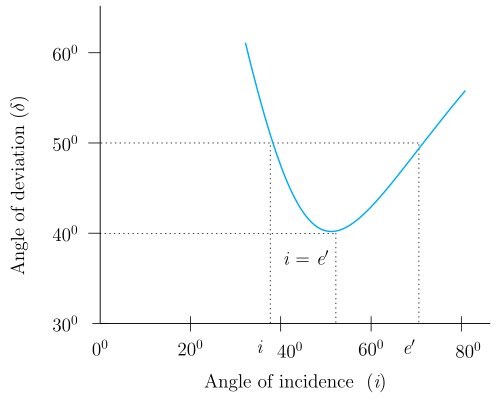
Minimum deviation condition: As the angle of incidence is varied, first decreases, reaches a minimum value , and then increases. At this minimum, the ray passes symmetrically through the prism: , and correspondingly . At this condition:
Applying Snell's law at the first face, , with :
i–δ curve: Plotting the angle of deviation (y-axis) against the angle of incidence (x-axis) gives a roughly U-shaped curve: is large for small , decreases as increases, reaches a single minimum value at one particular angle of incidence (where the ray passes symmetrically, ), and then increases again as increases further. The curve is (nearly) symmetric about this minimum point.
…
Unlock everything free for 14 days
- Full step-by-step solutions
- Concept-first explanations
- Methods, shortcuts & mistakes
- PYQ mapping + timed mock tests
Full access for 14 days. No credit card required.