Chemistry · Ch 9 — Hydrocarbons
Conformations
Conformations
The Tetrahedral Carbon and the Shape of Alkanes
The foundation of alkane structure is the tetrahedral geometry of carbon. In methane, the simplest alkane, the carbon atom sits at the centre of a regular tetrahedron with its four hydrogen atoms at the four corners. This arrangement, predicted by VSEPR theory, gives all H–C–H bond angles a value of .
When we move from methane to larger alkanes, we are essentially joining these tetrahedral units together. Each carbon–carbon bond is formed by the head-on overlap of hybrid orbitals from two carbon atoms, while each carbon–hydrogen bond results from the overlap of a carbon orbital with the orbital of hydrogen. These are sigma () bonds, and they are the strongest type of covalent bond.
The bond lengths in alkanes are fixed and characteristic: the C–C bond length is pm, and the C–H bond length is pm. These values are a direct consequence of the size of the hybrid orbitals and the extent of their overlap.
The Concept of Conformation
A single C–C sigma bond is cylindrically symmetric. This means that the two carbon atoms (and the groups attached to them) can rotate freely relative to each other about the bond axis, without breaking the bond. This rotation is not completely free — there is a small energy barrier — but it is rapid at room temperature.
Because of this rotation, a molecule like ethane () can exist in an infinite number of spatial arrangements. Each distinct arrangement of atoms in space, produced by rotation about a single bond, is called a conformation.
Conformations are different spatial arrangements of the same molecule that interconvert by rotation about sigma bonds. They are not isomers — they are the same compound, just momentarily twisted into a different shape.
Representing Conformations: Sawhorse and Newman Projections
To study conformations, we need a way to draw them on paper. Two standard methods are used.
Sawhorse Projection
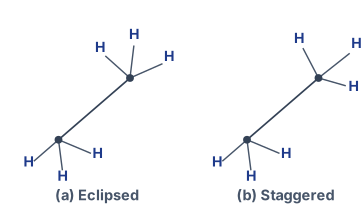
In a sawhorse projection, the C–C bond is drawn as a diagonal line, slightly tilted. The front carbon is represented by the lower-left end of the line, and the rear carbon by the upper-right end. All six bonds (three on each carbon) are shown as lines meeting at the carbon atoms. This gives a perspective view of the molecule, like a carpenter's sawhorse.
Drawn by us to help you understand the concept clearly, and verified to make sure it's accurate. For exams, practice from your NCERT textbook's own diagram.
The figure shows two simple line drawings of the ethane molecule, each drawn as a Sawhorse projection. In this style, the carbon–carbon bond is represented as a long diagonal line running from the lower left to the upper right of the drawing. This diagonal line is the “backbone” of the molecule, and it is viewed obliquely — not end-on, as in a Newman projection, but from a slight angle so that both carbon atoms and their attached groups are visible.
On the front carbon (the one at the lower-left end of the diagonal), three C–H bonds are drawn as lines radiating outward. On the back carbon (the upper-right end), another three C–H bonds are drawn. The figure presents two separate drawings side by side: one labelled eclipsed and the other labelled staggered. In the eclipsed drawing, the three C–H bonds on the front carbon line up directly behind the three C–H bonds on the back carbon — they appear to overlap when viewed along the bond. In the staggered drawing, the front C–H bonds are rotated by 60° relative to the back ones, so that each front bond sits in the gap between two back bonds.
The Sawhorse projection is a useful middle ground between a full 3D drawing and a Newman projection. It preserves the tetrahedral geometry around each carbon while showing the relative orientation of the two ends of the C–C bond.
The physical idea the figure teaches is that rotation about a single C–C bond is not completely free — the molecule can exist in different conformations (different spatial arrangements of atoms that interconvert by rotation). The eclipsed conformation has the hydrogen atoms on adjacent carbons as close together as possible, which creates a small repulsive interaction (torsional strain). The staggered conformation has them as far apart as possible, making it the more stable arrangement. The energy difference between these two conformations is small — about 12 kJ/mol for ethane — but it is the reason why molecules prefer the staggered form at room temperature.
The textbook does not develop a formula directly from this figure, but the figure sets up the concept of torsional strain and the dihedral angle (the angle between a C–H bond on the front carbon and a C–H bond on the back carbon). For ethane, the dihedral angle in the staggered conformation is 60°, and in the eclipsed conformation it is 0°. …
Newman Projection
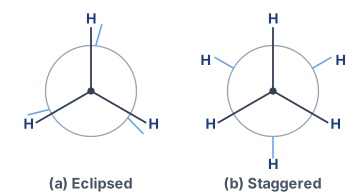
The Newman projection is more powerful for comparing conformations. You look straight down the C–C bond axis. The front carbon is represented by a dot, and the rear carbon by a circle. The three bonds on the front carbon are drawn as lines radiating from the dot at angles. The three bonds on the rear carbon are drawn as lines radiating from the circumference of the circle, also at angles, but offset from the front bonds.
When drawing a Newman projection, always imagine you are looking directly along the C–C bond. The front carbon hides the rear carbon, so the dot (front carbon) sits inside the circle (rear carbon).
Drawn by us to help you understand the concept clearly, and verified to make sure it's accurate. For exams, practice from your NCERT textbook's own diagram.
The figure is a Newman projection, a way of looking at a molecule along a specific carbon–carbon bond. In this case, the bond is the single C–C bond of ethane (). You imagine sighting straight down that bond, so the front carbon atom is reduced to a dot (the centre of the projection) and the back carbon atom is represented by a circle. The three bonds from the front carbon are drawn as lines meeting at the dot, spaced apart. The three bonds from the back carbon are drawn as lines that start at the circle and extend outward, also spaced apart.
The figure shows two specific arrangements of these bonds, called conformations. In the eclipsed conformation, the three bonds on the front carbon line up exactly with the three bonds on the back carbon — they overlap when viewed along the axis. In the staggered conformation, the back bonds are rotated by relative to the front bonds, so each front bond sits exactly between two back bonds.
The physical idea is that these are not different molecules; they are the same molecule at different rotational positions around the C–C single bond. Because the bond is a bond (formed by head-on overlap of orbitals), rotation around it is possible. However, the two conformations are not equal in energy. The eclipsed conformation has higher energy because the electron clouds of the C–H bonds on the front and back carbons are forced closer together, creating torsional strain. The staggered conformation is lower in energy and is the most stable arrangement.
The key result the textbook develops with this figure is the torsional energy barrier — the energy difference between the eclipsed and staggered conformations. For ethane, this barrier is about . The energy varies with the dihedral angle (the angle between a front C–H bond and a back C–H bond, measured in the projection). …
Conformations of Ethane
Ethane is the simplest molecule to study conformations. Consider the Newman projection looking down the C–C bond. As the rear carbon rotates relative to the front, the relative positions of the hydrogen atoms change.
Two extreme conformations are of particular interest.
1. The Eclipsed Conformation
In this conformation, the three hydrogen atoms on the front carbon are exactly aligned with (directly behind) the three hydrogen atoms on the rear carbon. In the Newman projection, the three lines from the dot (front H atoms) line up perfectly with the three lines from the circle (rear H atoms). The dihedral angle — the angle between a bond on the front carbon and a bond on the rear carbon — is .
2. The Staggered Conformation
In this conformation, the rear carbon is rotated by relative to the front. Now, each hydrogen on the front carbon lies exactly midway between two hydrogens on the rear carbon. In the Newman projection, the three lines from the dot are staggered between the three lines from the circle. The dihedral angle is .
Relative Stability of Ethane Conformations
The staggered conformation is more stable than the eclipsed conformation by approximately kJ/mol.
Why is the Staggered Conformation More Stable?
The energy difference arises from two factors:
-
Torsional Strain: In the eclipsed conformation, the electron clouds of the C–H bonds on the front carbon are forced into close proximity with the electron clouds of the C–H bonds on the rear carbon. This repulsion between the bonding electron pairs raises the energy of the molecule. This type of strain is called torsional strain (or Pitzer strain).
-
Minimised Repulsion: In the staggered conformation, the C–H bonds are as far apart as possible. The repulsion between them is minimised, resulting in a lower energy state.
The energy barrier to rotation in ethane is only about kJ/mol. At room temperature, the molecules have enough thermal energy to rotate freely, passing through the eclipsed conformation billions of times per second. We cannot isolate a single conformation of ethane; we can only talk about the average structure.
Conformations of Butane
When we move to butane (), the situation becomes more complex. We now consider rotation about the C2–C3 bond (the central bond). The groups attached to the two central carbons are not all identical: one carbon has a methyl () group and two hydrogens, and the other carbon also has a methyl group and two hydrogens.
As we rotate the rear carbon, we encounter several distinct conformations. The most important are named based on the relative positions of the two methyl groups.
The Four Key Conformations of Butane (about the C2–C3 bond)
| Conformation Name | Dihedral Angle (between the two groups) | Relative Stability |
|---|---|---|
| Anti | Most stable | |
| Gauche | Intermediate | |
| Eclipsed (methyl-methyl) | Least stable | |
| Eclipsed (methyl-H) | Less stable than gauche, more stable than methyl-methyl eclipsed |
Detailed Analysis of Each Conformation
1. Anti Conformation ()
In the Newman projection, the two methyl groups are on opposite sides of the C–C bond. They are as far apart as possible. This minimises both torsional strain and steric strain (the repulsion between bulky groups that are forced close together). The anti conformation is the global energy minimum for butane.
2. Gauche Conformation () …