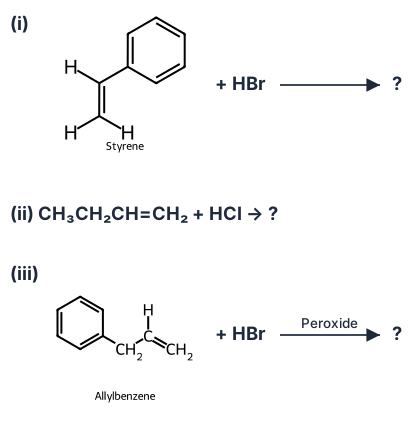
Q.Write the products of the following reactions:
You're viewing a preview — the full solution, concept, methods & PYQ mapping are locked.
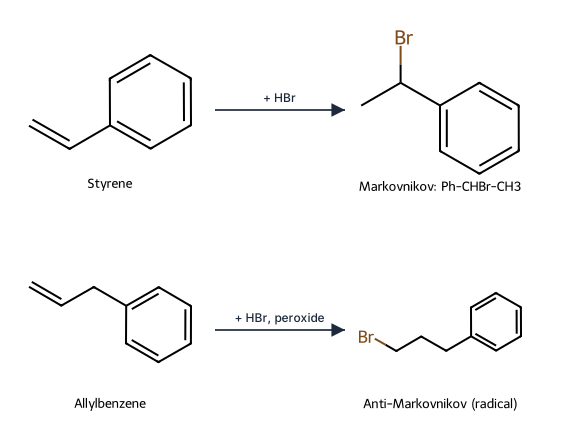
Start your 14-day free trial to unlock the full solution →(i) and (ii) follow Markovnikov's rule. (iii) is peroxide-catalysed anti-Markovnikov addition — but the radical that forms is a plain secondary radical, not a benzylic one (the ring is one saturated carbon removed from it), and the product has Br on the TERMINAL carbon, not the internal one. Products: (i) ; (ii) ; (iii) .
(i)
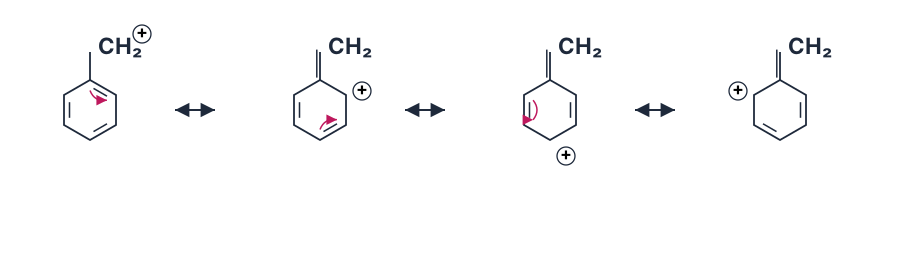
Styrene. Protonating the terminal carbon puts the positive charge on the ring-attached carbon, giving a benzylic carbocation stabilised by resonance into the ring — far more stable than the alternative primary cation. Markovnikov addition:
(ii)
But-1-ene. Protonation at the terminal carbon gives a secondary carbocation, more stable than the primary cation from protonating the internal carbon. Markovnikov addition:
The peroxide/anti-Markovnikov effect only applies to HBr, never HCl — no special conditions change this outcome.
(iii)
Allylbenzene: . Peroxide reverses which carbon gets the halogen — via a free-radical chain, Br adds to the LESS substituted (terminal) carbon, leaving the radical on the more substituted (internal) carbon, because a more substituted radical is more stable regardless of what else is nearby. …
Unlock everything free for 14 days
- Full step-by-step solutions
- Concept-first explanations
- Methods, shortcuts & mistakes
- PYQ mapping + timed mock tests
Full access for 14 days. No credit card required.