Q.A primary alkyl halide would prefer to undergo _____________.
You're viewing a preview — the full solution, concept, methods & PYQ mapping are locked.
Start your 14-day free trial to unlock the full solution →
Primary alkyl halides strongly prefer the pathway because the steric hindrance around the carbon is minimal, allowing the backside attack to proceed easily. The correct answer is (ii).
The key to predicting the reaction mechanism for an alkyl halide lies in understanding the structure of the carbon that carries the leaving group. For a primary alkyl halide, that carbon is bonded to only one other carbon (or hydrogen atoms). This makes it very open and accessible.
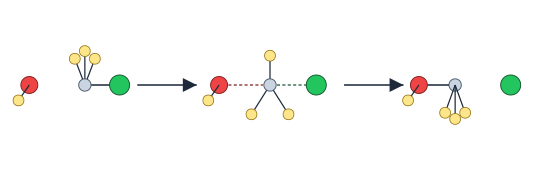
In an reaction, the nucleophile must approach from the back side, directly opposite the leaving group. If the carbon is crowded (like in tertiary halides), this approach is blocked. But in a primary halide, there is almost no steric hindrance — the nucleophile can easily reach the carbon. This is why primary halides are the best substrates for reactions.
The pathway, on the other hand, requires the formation of a carbocation intermediate. A primary carbocation is extremely unstable (it has no alkyl groups to donate electron density and stabilize the positive charge). So primary halides almost never react via under normal conditions.
Let’s walk through the reasoning step by step.
-
Identify the substrate type. A primary alkyl halide has the leaving group (e.g., Cl, Br, I) attached to a carbon that is bonded to exactly one other carbon atom. The general structure is .
-
Consider the mechanism. This is a one-step, concerted process where the nucleophile attacks the carbon from the back, and the leaving group departs simultaneously. The rate depends on both the nucleophile and the substrate concentration. For a primary carbon, the backside is wide open — there are no bulky groups blocking the approach. This makes the reaction very fast and favorable.
-
Consider the mechanism. This is a two-step process: first, the leaving group leaves to form a carbocation; then the nucleophile attacks the carbocation. The rate depends only on the substrate concentration. The first step is the slow one, and it requires the carbocation to be stable. A primary carbocation () is highly unstable — it has no alkyl groups to stabilize the positive charge via hyperconjugation or inductive effects. So the activation energy for forming it is very high, making essentially impossible for primary halides under typical conditions.
-
Evaluate the other options. …
Unlock everything free for 14 days
- Full step-by-step solutions
- Concept-first explanations
- Methods, shortcuts & mistakes
- PYQ mapping + timed mock tests
Full access for 14 days. No credit card required.