Q.Which compound in each of the following pairs will react faster in reaction with ?
You're viewing a preview — the full solution, concept, methods & PYQ mapping are locked.
Start your 14-day free trial to unlock the full solution →In reactions, the nucleophile attacks from the back, so the leaving group's ability and steric hindrance around the carbon determine the rate. For pair (i), reacts faster because iodide is a better leaving group than bromide. For pair (ii), reacts much faster because the bulky tert-butyl group in blocks the backside attack.
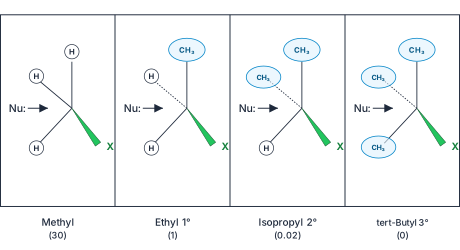
The Core Idea: What Makes an Reaction Fast?
An reaction is a single-step, bimolecular substitution. The nucleophile ( here) attacks the carbon from the side opposite the leaving group. This means two things matter enormously:
- The leaving group must be able to depart easily. A good leaving group stabilises the negative charge it carries after leaving. In the halogens, this ability increases down the group: .
- The carbon centre must be accessible. The nucleophile needs a clear path to the back of the carbon. Any bulky groups near that carbon physically block the attack — this is steric hindrance.
Let's apply these two principles to each pair.
Pair (i): vs
Both are primary alkyl halides with no branching at the reacting carbon. So steric hindrance is identical — the only difference is the leaving group.
Step 1: Compare leaving group ability.
The leaving group departs as a halide ion ( or ). The better the leaving group, the lower the activation energy for the step.
Iodide () is a much better leaving group than bromide (). Why? Iodine is larger and more polarisable — its negative charge is spread over a bigger volume, making it more stable in solution. Also, the bond is weaker than the bond, so it breaks more easily.
Step 2: Apply the rate effect.
Since the nucleophile and the carbon skeleton are identical, the reaction with the better leaving group will be faster.
A quick memory aid: In reactions, the rate of halide leaving groups follows the trend . This is exactly the opposite of bond strength — weaker bonds break faster.
Result for (i): reacts faster than .
Pair (ii): vs
Here, the leaving group is the same (chloride) in both, but the carbon skeleton is drastically different.
Step 1: Examine the carbon centre.
- is methyl chloride — the carbon is attached to three hydrogens and one chlorine. There is almost no steric bulk around the backside.
- is tert-butyl chloride — the carbon is attached to three methyl groups and one chlorine. Those three methyl groups are large and stick out in all directions.
Step 2: Visualise the backside attack. …
Unlock everything free for 14 days
- Full step-by-step solutions
- Concept-first explanations
- Methods, shortcuts & mistakes
- PYQ mapping + timed mock tests
Full access for 14 days. No credit card required.