Biology · Ch 2 — Biological Classification
Dinoflagellates
Dinoflagellates
Dinoflagellates are mostly marine and photosynthetic organisms, and, like other protists, they are primarily aquatic. They appear yellow, green, brown, blue or red depending on the main pigments present in their cells, so their colour is a direct clue to their pigmentation.
Key structural features:
- the cell wall has stiff cellulose plates on the outer surface, giving the cell an armoured appearance
- most of them have two flagella — one lies longitudinally and the other transversely in a furrow between the wall plates; this arrangement produces their characteristic spinning movement …
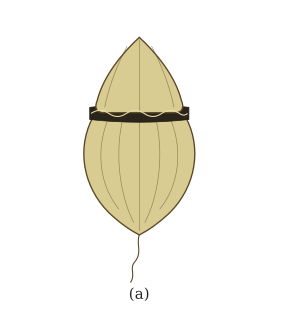
Drawn by us to help you understand the concept clearly, and verified to make sure it's accurate. For exams, practice from your NCERT textbook's own diagram.
This composite figure shows four representative members of the Kingdom Protista. In (a) a dinoflagellate is drawn with its stiff cellulose plates on the cell surface and a furrow housing its flagella; these are mostly marine, photosynthetic forms. In (b) Euglena is shown as a spindle-shaped cell with a long flagellum and a flexible pellicle instead of a cell wall, able to switch between photosynthesis and a heterotrophic mode. In (c) a slime mould appears as an irregular, lobed mass that creeps over decaying material engulfing organic matter. In (d) Paramoecium is a slipper-sha …