Thermal Expansion Coefficient: From Intuition to Precision
The Intuition: What Happens When Things Get Hot?
Think about a metal railway track on a summer day. The track is laid in sections with small gaps between them. On a hot afternoon, those gaps get smaller — sometimes the track even buckles. Why? Because the metal expands when heated.
Or consider a mercury thermometer. The liquid mercury sits in a bulb at the bottom. When your body warms the bulb, the mercury expands and rises up the narrow tube. The hotter you are, the higher it climbs.
This is thermal expansion: most materials get bigger when heated and smaller when cooled. The atoms inside vibrate more vigorously as temperature rises, pushing their neighbours slightly farther apart. The entire object grows in every direction.
But different materials expand by different amounts. A steel rod and an aluminium rod of the same length, heated by the same amount, will not end up the same length. Aluminium expands more. So we need a number that tells us how much a given material expands per degree of temperature change. That number is the thermal expansion coefficient.
The Precise Statement: Defining the Coefficient
There are actually three coefficients, depending on whether we care about length, area, or volume. For a first meeting, we focus on the most common one: the linear thermal expansion coefficient, denoted by the Greek letter α (alpha).
α=L01⋅ΔTΔL
Where:
- L0 is the original length of the object (at some starting temperature)
- ΔL is the change in length (final length minus original length)
- ΔT is the change in temperature (final temperature minus initial temperature)
What this formula says in plain English: The coefficient α is the fractional change in length per degree of temperature change. If α=2.5×10⁻⁵per∘C, it means that for every 1∘C rise in temperature, the material expands by 0.0025% of its original length.
How to Use It: The Working Formula
From the definition, we can rearrange to get the practical formula:
ΔL=αL0ΔT
So the final length L after a temperature change is:
L=L0+ΔL=L0(1+αΔT)
For small temperature changes (say, less than 100∘C), this linear approximation is excellent. For very large changes, the coefficient itself may change slightly with temperature, but at the introductory level we treat α as constant.
A Concrete Example
A steel bridge girder is 50.00m long at 20∘C. The linear expansion coefficient of steel is α=1.2×10⁻⁵/∘C. How much longer is it on a 40∘C day?
Step 1: Identify the quantities.
- L0=50.00m
- ΔT=40−20=20∘C
- α=1.2×10⁻⁵/∘C
Step 2: Apply the formula.
ΔL=αL0ΔT=(1.2×10⁻⁵)(50.00)(20)
Step 3: Calculate.
ΔL=1.2×10−5×1000=0.012m=1.2cm
So the girder expands by 1.2cm. That is why bridges have expansion joints — without them, the structure would buckle.
Two Important Cousins: Area and Volume Expansion
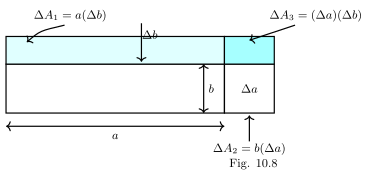
For a thin sheet (like a metal plate), we care about area expansion. The area expansion coefficient is approximately 2α. For a solid object, the volume expansion coefficient is approximately 3α. These come from the same idea: if every linear dimension grows by a factor (1+αΔT), then area grows by (1+αΔT)2≈1+2αΔT, and volume by (1+αΔT)3≈1+3αΔT.
These approximations (2α and 3α) are valid only when αΔT is small compared to 1. For most solids and modest temperature changes, this is true. For gases, the expansion is much larger and a different treatment is needed.
What the Coefficient Tells Us About Materials
| Material | α (per ∘C) | Behaviour |
|----------|--------------------------------|-----------| …