Physical Education · Ch 6 — Test and Measurement in Sports
30 Second Chair Stand Test
30 Second Chair Stand Test
30 Second Chair Stand Test
- Purpose: to determine lower body strength.
- Objective: to complete the maximum number of stands in 30 seconds.
- Equipment: a straight-back chair without arms, and a stopwatch.
Procedure
The chair is placed against a wall, or somewhere it stays stable. The individual first sits on the chair with the back straight, arms crossed over the chest, and feet firmly on the floor shoulder-width apart. On the command "Go" the person stands up completely and then returns to the seated position - this counts as one stand. The individual should be encouraged to do as many complete stands as possible in 30 seconds.
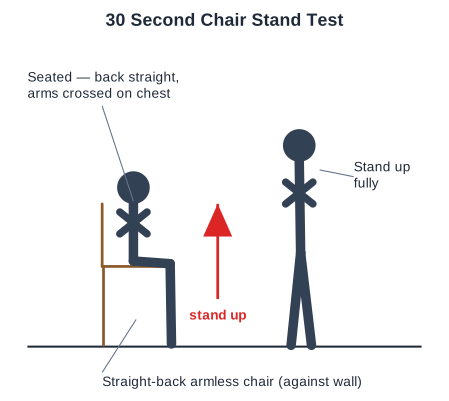
Drawn by us to help you understand the concept clearly, and verified to make sure it's accurate. For exams, practice from your NCERT textbook's own diagram.
A line drawing of an older adult performing the 30-second chair stand test on a straight-back armless chair placed against a wall. One figure is shown seated with the back straight and arms crossed over the chest; a second figure is shown standing fully upright. An upward arrow between them shows the stand-up movement …
Scoring
The maximum number of complete stands is counted as the score. If the individual is halfway through a stand when time runs out, that stand is counted as a full stand.
Why It Matters (Physiological Rationale)
Standing up from a chair without using the arms requires the quadriceps, hamstrings and glutes to generate enough force to lift the entire body weight repeatedly. This is one of the most functionally important strength movements for older adults, because it is directly embedded in everyday activities — getting up from a chair, a bed, or the toilet — and a decline in this strength is strongly linked to loss of independence and increased fall risk.
Benefits of Regular Testing
- Directly predicts how well an older adult can manage common daily transfers (sitting to standing) without assistance.
- Because it is quick and needs only a chair, it is one of the most practical strength tests to repeat regularly in a community or clinical setting.
- Improvement over successive tests is a meaningful, motivating sign that a lower-body strengthening programme is working.
Common Mistakes & Precautions
- Pushing off with the arms, even briefly, invalidates a stand; the arms must stay crossed over the chest throughout.
- Not standing up fully, with the hips and knees completely extended, before sitting back down; a partial stand should not be counted.
- Using a chair with wheels, a soft cushion, or one that is not stabilised against a wall, all of which risk a fall. …