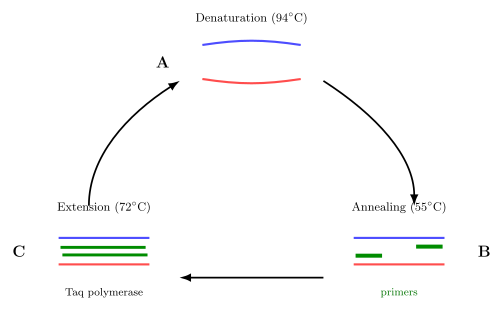
Q.Identify and explain steps 'A', 'B' and 'C' in the PCR diagram given below.
You're viewing a preview — the full solution, concept, methods & PYQ mapping are locked.
Start your 14-day free trial to unlock the full solution →The diagram shows the three temperature-controlled steps of PCR — denaturation (A), annealing (B), and extension (C) — which together amplify a specific DNA sequence exponentially.
Polymerase Chain Reaction, or PCR, is a technique that copies a specific segment of DNA millions of times in a few hours. It was developed by Kary Mullis in the 1980s and has become a cornerstone of molecular biology, used in everything from disease diagnosis to forensic science. The process relies on a heat-stable DNA polymerase (usually Taq polymerase) and a thermal cycler that precisely changes the temperature of the reaction mixture. The diagram you are referring to shows the three repeating steps that make up one PCR cycle.
Let us walk through each step as labelled in the diagram.
Step A: Denaturation — This is the first step, where the reaction mixture is heated to a high temperature (the NCERT text does not give an exact figure). At this high temperature, the hydrogen bonds between the two strands of the target DNA break apart. The double-stranded DNA molecule unwinds and separates into two single strands. Think of it like unzipping a zipper — each single strand now serves as a template for the next step. This step is essential because DNA polymerase can only work on single-stranded DNA.
The exact temperature for denaturation depends on the DNA sequence and the polymerase used, but it is always high enough to separate the strands without permanently damaging the enzyme.
Step B: Annealing — The temperature is now lowered so the primers can bind. This allows the two short, synthetic DNA primers (which were added to the reaction mixture) to bind, or "anneal," to their complementary sequences on each single-stranded template. Each primer is designed to flank the target region — one binds to the start of the sequence on one strand, and the other binds to the end of the sequence on the opposite strand. The primers act as starting points for DNA synthesis. The exact annealing temperature is chosen to ensure specific binding; too low, and primers may stick to the wrong places; too high, and they may not bind at all. …
Unlock everything free for 14 days
- Full step-by-step solutions
- Concept-first explanations
- Methods, shortcuts & mistakes
- PYQ mapping + timed mock tests
Full access for 14 days. No credit card required.