Q.Draw structures of the following derivatives.
You're viewing a preview — the full solution, concept, methods & PYQ mapping are locked.
Start your 14-day free trial to unlock the full solution →This question tests your ability to draw the products of carbonyl-group derivatisation reactions. Each derivative replaces the C=O oxygen with a specific nitrogen- or oxygen-containing group. The final structures are shown below.
The key idea is that every carbonyl compound (aldehyde or ketone) can be transformed into a derivative by reacting with a nucleophile that adds across the C=O bond, then usually eliminates water. The product retains the carbon skeleton of the original carbonyl compound, but the oxygen is replaced by a new functional group.
Let's work through each one systematically.
-
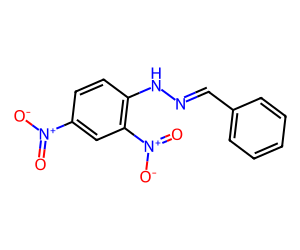
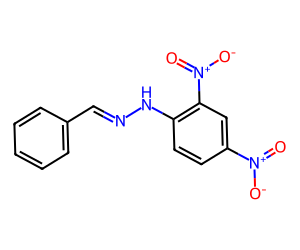
The 2,4-dinitrophenylhydrazone of benzaldehyde
Benzaldehyde is . 2,4-Dinitrophenylhydrazine (2,4-DNP) has the structure (with the nitro groups at positions 2 and 4). The reaction is a condensation: the -NH2 group attacks the carbonyl carbon, water is eliminated, and a C=N double bond (a hydrazone) forms.
The product is : the benzene ring of benzaldehyde is attached to a CH group, which is double-bonded to N, which is single-bonded to NH, which is attached to the 2,4-dinitrophenyl ring.
TipThe "2,4-dinitrophenylhydrazone" name tells you exactly which pieces connect: the carbonyl compound's carbon skeleton forms the "one" part, and the 2,4-DNP reagent forms the "hydrazone" part.
-
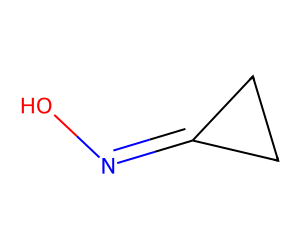
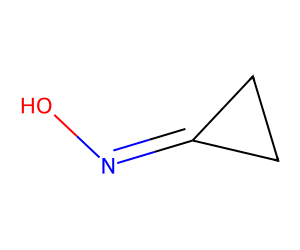
Cyclopropanone oxime
Cyclopropanone is a three-carbon ring with a C=O group. An oxime forms when a carbonyl reacts with hydroxylamine (). The product has a C=N-OH group.
The ring remains intact. The carbon that was the carbonyl carbon becomes a C=N-OH group. Draw a triangle (cyclopropane ring) with one corner being the carbon of the C=N-OH group.
CH2 / \ CH2 C = N - OH -
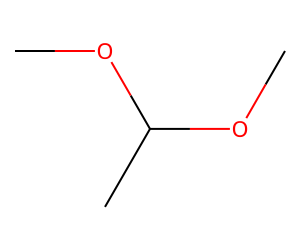
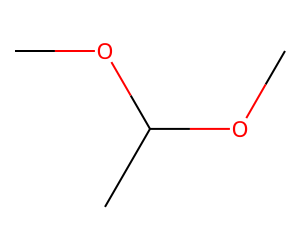
Acetaldehydedimethylacetal
This is an acetal: two ether groups attached to the same carbon. Acetaldehyde is . Reacting it with two molecules of methanol () in the presence of acid gives the dimethyl acetal. The carbonyl oxygen is replaced by two -OCH3 groups.
The product is . Draw the central carbon with a hydrogen, a methyl group, and two methoxy groups.
     OCH3
      |
 CH3 - C - H
      |
     OCH3
Watch outDon't forget the hydrogen on the central carbon. Acetaldehyde has one H on the carbonyl carbon, and that H is retained in the acetal.
-
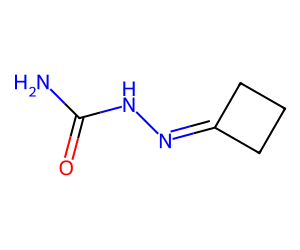
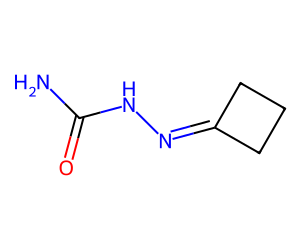
The semicarbazone of cyclobutanone
Cyclobutanone is a four-carbon ring with a C=O group. Semicarbazide is . The reaction forms a semicarbazone: the carbonyl oxygen is replaced by =N-NH-CO-NH2.
The cyclobutanone ring (four /carbonyl-derived carbons in a closed ring) stays intact, with its former carbonyl carbon now bearing the semicarbazone group: cyclobutylidene=N–NH–CO–NH.
-
The ethylene ketal of hexan-3-one
Hexan-3-one is (a six-carbon chain with the carbonyl at carbon 3). A ketal forms when a ketone reacts with a diol. Ethylene glycol () is a diol, so the product is a cyclic ketal: a five-membered ring containing two oxygen atoms. …
Unlock everything free for 14 days
- Full step-by-step solutions
- Concept-first explanations
- Methods, shortcuts & mistakes
- PYQ mapping + timed mock tests
Full access for 14 days. No credit card required.