Chemistry · Ch 9 — Amines
Gabriel Phthalimide Synthesis
Gabriel Phthalimide Synthesis
Gabriel Phthalimide Synthesis
Gabriel synthesis is a method built specifically to give primary amines, and it is prized because — unlike ammonolysis of alkyl halides (Section 9.4.2) — it delivers the primary amine cleanly, without the accompanying mixture of secondary and tertiary amines and quaternary salt.
The three-step sequence
Step 1 — deprotonation of phthalimide. Phthalimide (the cyclic imide of phthalic acid, with an between the two carbonyls) is treated with ethanolic potassium hydroxide. The acidic imide N–H is removed, giving the potassium salt of phthalimide, in which nitrogen now carries a negative charge (as its potassium salt) and is a good nucleophile.
Step 2 — alkylation. This potassium salt is then heated with an alkyl halide (). The phthalimide nitrogen, now nucleophilic, displaces the halide in a nucleophilic substitution, giving N-alkylphthalimide.
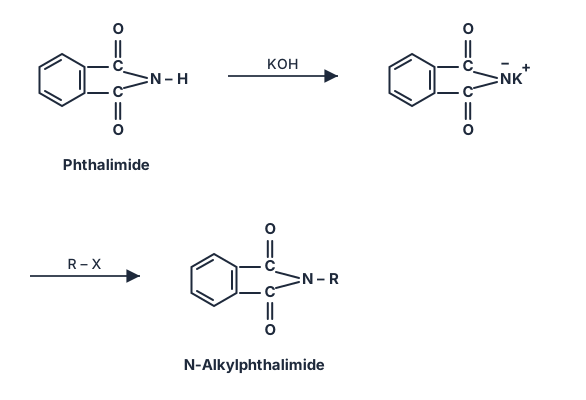
Drawn by us to help you understand the concept clearly, and verified to make sure it's accurate. For exams, practice from your NCERT textbook's own diagram.
Redrawn from the NCERT page with the structures, printed labels (N – H, N – R) and reagent placement exactly as the textbook prints them. Every element of this display was checked against the printed page during the sweep's blind-judge verification pass, so wha …
Step 3 — alkaline hydrolysis. N-alkylphthalimide is finally hydrolysed with aqueous NaOH. The two carbon–nitrogen bonds of the imide ring are broken, releasing the free primary amine and leaving behind the disodium salt of phthalic acid:
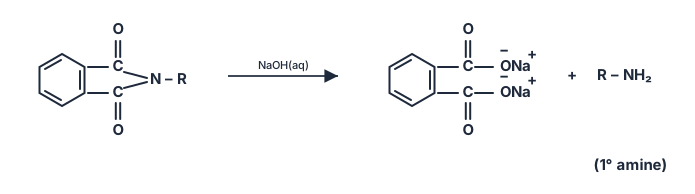
Drawn by us to help you understand the concept clearly, and verified to make sure it's accurate. For exams, practice from your NCERT textbook's own diagram.
Redrawn from the NCERT page with the structures, printed labels (N – R, Na, R – NH2) and reagent placement exactly as the textbook prints them. Every element of this display was checked against the printed page during the sweep's blind-judge verification pass, so wh …
Because the alkyl group is introduced onto a nitrogen that is locked inside the phthalimide ring, it cannot go on to react a second or third time the way ammonia's own product can in ammonolysis — so the amine obtained is the pure primary amine, with no over-alkylation.
The one thing this method cannot do
Gabriel synthesis cannot be used to prepare primary aromatic amines. The alkylation step (Step 2) is a nucleophilic substitution at a saturated carbon, and this requires an alkyl halide. Aryl halides do not undergo nucleophilic substitution with the phthalimide anion under these conditions, so an aniline-type amine can never be reached by this route — it is restricted to primary amines built from alkyl (or benzyl) halides. …