Physical Education · Ch 8 — Fundamentals of Kinesiology and Biomechanics in Sports
Axis
Axis
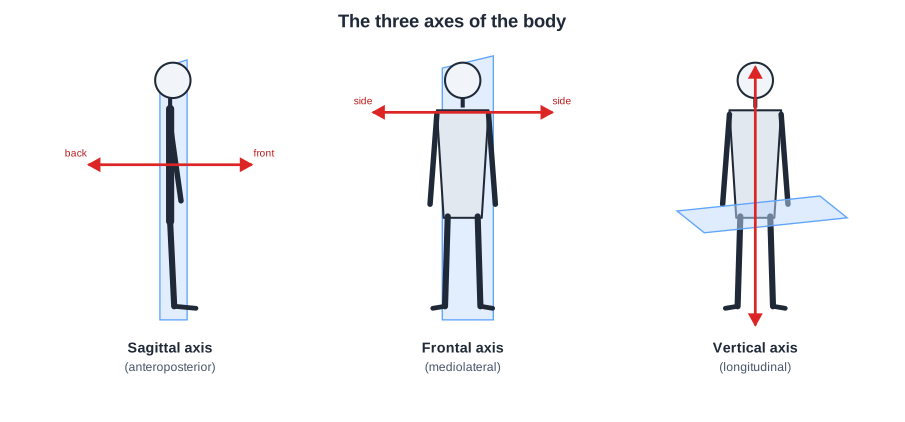
An axis is a point or straight line around which an object moves or about which the movement of a body segment occurs. There are three axes of rotation, and each axis is perpendicular to its plane.
Drawn by us to help you understand the concept clearly, and verified to make sure it's accurate. For exams, practice from your textbook's own diagram.
A standing figure with the three axes drawn as arrows through the body: the sagittal (anteroposterior) axis passing horizontally from back to front (perpendicular to the frontal plane), the frontal (mediolateral) axis passing horizontally from side to side (perpendicular to the sagittal plane), and the vertical (longitudinal) axis passing …
A simple way to picture an axis
Think of a door swinging on its hinge, or a wheel turning on its axle — the hinge or axle is the axis, a fixed line that does not itself move while everything around it rotates. Every joint movement in the body works the same way: a body segment rotates around a fixed axis passing through the joint.
The three axes
- a. Sagittal axis (anteroposterior axis) — passes horizontally from posterior to anterior (back to front). It is perpendicular to the frontal plane, so the movements that occur about it are abduction and adduction.
- b. Frontal axis (transverse / mediolateral axis) — also horizontal, running from side to side. It is perpendicular to the sagittal plane, so flexion and extension take place about it.
- c. Vertical axis (longitudinal axis) — passes vertically from inferior to superior (bottom to top). It is perpendicular to the transverse plane, so rotation takes place about it.
Sporting examples for each axis
- Sagittal axis — a gymnast performing a cartwheel, or a swimmer's legs kicking sideways out and back in during breaststroke, rotate about this axis (abduction and adduction of the limb).
- Frontal axis — a diver somersaulting forwards or backwards off the board, a gymnast performing a forward or backward roll, and a footballer swinging the leg to kick a ball, all rotate about this axis (flexion and extension).
- Vertical axis — a figure skater or a discus thrower spinning on the spot, and a gymnast performing a twisting somersault, rotate about this axis (rotation).