Question 34 of 54
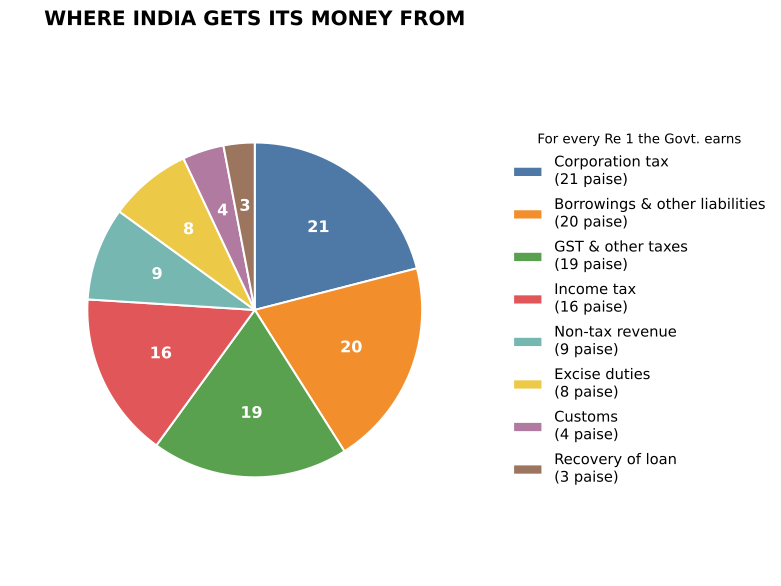
Q.(a)
(i) From the information given in the diagram, categorize the items into revenue receipts and capital receipts, stating valid reasons. [Diagram – WHERE INDIA GETS ITS MONEY FROM? For every ₹ 1 that the Govt. earns : Corporation tax 21 paise | Recovery of loan 3 paise | Non-tax revenue 9 paise | Borrowings and other liabilities 20 paise | GST and other taxes 19 paise | Customs 4 paise | Income tax 16 paise | Excise duties 8 paise]
(ii) Distinguish between Revenue deficit and Fiscal deficit.
(OR)
(b)
(i) From the following data, calculate the primary deficit. (Amount in ₹ crore) |
(i) Revenue deficit | 40 |
(ii) Non-debt creating capital receipts | 190 |
(iii) Tax revenue | 125 |
(iv) Capital expenditure | 220 |
(v) Interest payments | 20 |
(ii) Elaborate ‘Economic stability’ function of the Government Budget.
Goa GbshseCBSE Class XII Board 2023Subjective· 6mImportance★★★★★
63% · 34/54 Questions
You're viewing a preview — the full solution, concept, methods & PYQ mapping are locked.
Start your 14-day free trial to unlock the full solution →- Part (a): Taxes + non-tax revenue = revenue receipts (no liability/asset change); recovery of loan + borrowings = capital receipts. Revenue deficit = revenue expenditure over revenue receipts; fiscal deficit = total borrowing requirement.
- Part (b): Fiscal deficit = 40 + 220 − 190 = 70; primary deficit = 70 − 20 = ₹50 crore. Stability = counter-cyclical fiscal policy (expansionary in slump, contractionary in boom).
Part (a)
(i) Categorising the receipts.
Revenue receipts neither create a liability nor reduce an asset; they are regular and recurring:
- Corporation tax (21 paise), GST & other taxes (19), Income tax (16), Excise duties (8), Customs (4) — all tax revenues, creating no liability.
- Non-tax revenue (9 paise) — interest, dividends, fees earned without creating an obligation.
Capital receipts either create a liability or reduce an asset:
- Borrowings and other liabilities (20 paise) — must be repaid → create a liability.
- Recovery of loan (3 paise) — money previously lent is returned → reduces a financial asset.
(ii) Revenue Deficit vs Fiscal Deficit.
| Basis | Revenue Deficit | Fiscal Deficit |
|---|---|---|
| Definition | Excess of revenue expenditure over revenue receipts | Excess of total expenditure over total receipts other than borrowings |
| Formula | Rev. Expenditure − Rev. Receipts | Total Expenditure − (Revenue Receipts + Non-debt Capital Receipts) |
Unlock everything free for 14 days
- Full step-by-step solutions
- Concept-first explanations
- Methods, shortcuts & mistakes
- PYQ mapping + timed mock tests
Full access for 14 days. No credit card required.