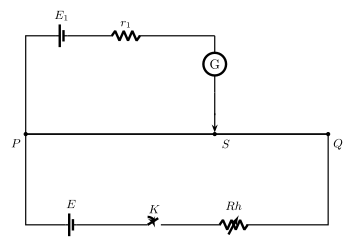
Q.In a potentiometer experiment, PS is the balancing length obtained for a cell of emf E₁ and internal resistance r₁ as shown in the figure below. How does the balancing length change, if
You're viewing a preview — the full solution, concept, methods & PYQ mapping are locked.
Start your 14-day free trial to unlock the full solution →The balance length l₁ = E₁/k depends on the potential gradient k, so anything that lowers k (for the same driver current) increases the balance length, while a parallel identical cell doesn't change E₁ at all since no current is drawn at balance.
At the balance point, no current flows through the galvanometer branch, and
where is the potential gradient (potential drop per unit length) of the potentiometer wire.
i) Length of the potentiometer wire doubled
Doubling the wire's length (same material and cross-section, so its resistance also doubles) while keeping the driver circuit otherwise unchanged reduces the potential gradient (voltage per unit length) to half, since the total voltage across the wire stays roughly the same but is now spread over twice the length:
So the balancing length increases (doubles).
ii) External resistance R added in series with the potentiometer wire
Adding a series resistance increases the total resistance of the driver circuit, which reduces the current flowing through the potentiometer wire, and hence reduces the potential gradient (since resistance-per-unit-length). With unchanged, therefore increases.
iii) A second identical cell connected in parallel with E₁ (positive terminals together)
…
Unlock everything free for 14 days
- Full step-by-step solutions
- Concept-first explanations
- Methods, shortcuts & mistakes
- PYQ mapping + timed mock tests
Full access for 14 days. No credit card required.