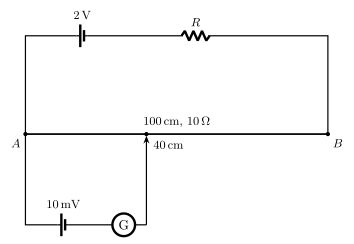
Q.A potentiometer wire of length 100 cm has resistance 10 Ω. It is connected in series with R and an accumulator of emf 2V and negligible internal resistance. A source of emf 10mV is balanced against 40 cm of the potentiometer wire, as shown in diagram. What is the value of R in ohm ?
🔒You're viewing a preview — the full solution, concept, methods & PYQ mapping are locked.
🔒 Start your 14-day free trial to unlock the full solution →Concept understanding — Potentiometer Principle
The Intuition: Why "No Current" Matters
Imagine you want to measure the voltage of a battery. You grab a voltmeter and connect it across the terminals. But here's the problem: a voltmeter draws a tiny current to work. That current flows through the battery's internal resistance, causing a small voltage drop inside the battery itself. So the voltmeter shows a value slightly less than the battery's true EMF (electromotive force). For a fresh battery this error is tiny, but for a weak cell or a sensitive measurement it becomes significant.
What if you could measure voltage without any current flowing out of the source? That would give you the true, undisturbed EMF. That's exactly what a potentiometer does.
The Setup: A Uniform Wire and a Known Reference
A potentiometer uses a long, uniform wire (often 10 m) stretched along a scale. A known voltage, say from a standard cell or a driver circuit, is applied across the entire wire. Because the wire is uniform, the potential drop per unit length is constant. If the total voltage across the wire is V and its length is L, then the potential drop per unit length (the potential gradient) is:
k=LV
This k is a known constant, typically a few millivolts per centimetre.
Now, the unknown EMF E is connected in series with a galvanometer and a jockey (a sliding contact). One end of the unknown cell connects to one end of the wire; the other end goes through the galvanometer to the jockey.
The Principle: Balancing to Zero Current
You slide the jockey along the wire until the galvanometer shows exactly zero deflection. At that point, no current flows through the unknown cell. This is the balance point or null point, at some length l from the start of the wire.
Why does the galvanometer read zero? Because the potential difference across the length l of the wire exactly opposes the unknown EMF. They are equal and opposite, so no net voltage drives current through the galvanometer branch.
At balance:
E=k⋅l
Since k=V/L, we can also write:
E=LV⋅l
E=klorE=LVl
The Critical Point: "No Current" Is the Whole Point
At balance, the unknown cell supplies zero current. This means there is no voltage drop across its internal resistance. The potentiometer measures the cell's true EMF, not its terminal voltage under load. This is the fundamental advantage over a voltmeter.
If you accidentally slide past the balance point, the galvanometer deflects in the opposite direction — that tells you which way to go back.
A Common Comparison
Think of a seesaw. You want to find the weight of an unknown object. You put it on one side, then add known weights on the other side until the seesaw balances perfectly level. At balance, the torque from the unknown weight equals the torque from the known weights. No motion, no acceleration — just a static equilibrium. …
The 10 mV source balances against the potential across 40 cm of wire. With driving current I = 2/(R+10), the drop across 40 cm is I·10·(40/100) = 4I = 0·01 V, giving R = 790 Ω. Option (c).
Step 1 — driving-loop current (emf 2 V, negligible internal resistance, wire 10 Ω in series with R):
I = 2/(R + 10).
Step 2 — potential drop across the full 100 cm wire = I × 10 V; across 40 cm it is a fraction 40/100:
V₄₀ = I × 10 × (40/100) = 4I.
Step 3 — at balance this equals the unknown emf, 10 mV = 0·01 V: …
- CBSE 2026Set ANNUAL1 markQ.Name an instrument for measurement of e.m.f. of a cell.
›Reveal solutionSolution
The potentiometer measures emf by a null-deflection (zero-current) method, so it draws no current from the cell and gives the true emf, not just terminal voltage.
A potentiometer is used to measure the emf of a cell. Its working principle is based on comparing the emf of the unknown cell against a known potential gradient along a uniform wire, using a balance-point (null-deflection) method: at the balancing length, no current is drawn from the cell being measured, so inte …
- CBSE 2026Set SEM31 markMCQQ.A potentiometer wire of length 100 cm has resistance 10 Ω. It is connected in series with R and an accumulator of emf 2V and negligible internal resistance. A source of emf 10mV is balanced against 40 cm of the potentiometer wire, as shown in diagram. What is the value of R in ohm ?(a) 700(b) 750(c) 790(d) 800
›Reveal solutionSolution
The 10 mV source balances against the potential across 40 cm of wire. With driving current I = 2/(R+10), the drop across 40 cm is I·10·(40/100) = 4I = 0·01 V, giving R = 790 Ω. Option (c).
Step 1 — driving-loop current (emf 2 V, negligible internal resistance, wire 10 Ω in series with R):
I = 2/(R + 10).
Step 2 — potential drop across the full 100 cm wire = I × 10 V; across 40 cm it is a fraction 40/100:
V₄₀ = I × 10 × (40/100) = 4I.
Step 3 — at balance this equals the unknown emf, 10 mV = 0·01 V: …
- CBSE 2023Set F1 markMCQQ.What is mainly measured by potentiometer? (A) Current (B) Resistance (C) Potential difference (D) All of these
›Reveal solutionSolution
A potentiometer mainly measures potential difference (and EMF).
A potentiometer works on the principle that the potential drop across a length of uniform wire carrying a steady current is proportional to that length. By finding the balance (null) point it compares an unknown potential difference or EMF against a known one, drawing no current from the source at balance. Thus …
- CBSE 2023Set B1 markQ.Write True or False: Voltmeter is more superior to potentiometer.
›Reveal solutionSolution
A potentiometer measures potential difference without drawing any current at the balance point, making it more accurate than a voltmeter, which always draws some current.
A voltmeter, however high its resistance, is still a finite-resistance device connected across the points being measured, so it always draws a small current and hence slightly changes the very potential difference it is trying to measure — introducing an error, particularly noticeable when measuring the emf of a cell with internal resistance. A potentiometer, by contrast, works on a null-deflection (balance) principle: at the balance point, no current is drawn from the source be …
- CBSE 2023Set ANNUAL1 markMCQQ.The instrument for the accurate measurement of the emf of a cell is :(a) voltmeter(b) ammeter(c) slide wire bridge(d) potentiometer
›Reveal solutionSolution
A potentiometer measures emf accurately because it works on a null method drawing no current from the cell.
A voltmeter always draws a small current, so it reads terminal voltage (emf minus the internal-resistance drop), not the true emf. A potentiometer is balanced until no current flows through the cell being tested; at balance the cell delivers zero current, its internal resistance causes …
- CBSE 2022Set ANNUAL1 markQ.Define potential gradient of the potentiometer wire.
›Reveal solutionSolution
Potential drop per unit length along the potentiometer wire.
The potential gradient of a potentiometer wire is defined as the fall in potential per unit length of the wire:
K=LV …
- CBSE 2022Set ANNUAL1 markQ............. is a device can be used to measure potential difference, internal resistance of cell and compare emfs of two cells.
›Reveal solutionSolution
The device described is the potentiometer.
A potentiometer works on the principle that the potential drop along a uniform wire is proportional to its length (V∝l) when a steady current flows. Because it draws no current from the cell at the balance point, it acts as an ideal voltmeter and can:
…
- CBSE 2020Set 55/1/11 markMCQQ.A potentiometer can measure emf of a cell because (A) the sensitivity of potentiometer is large. (B) no current is drawn from the cell at balance. (C) no current flows in the wire of potentiometer at balance. (D) internal resistance of cell is neglected.
›Reveal solutionSolution
A potentiometer measures emf accurately because at the balance point no current is drawn from the cell being tested, ensuring the terminal voltage equals the true emf. The answer is (B).
Why a potentiometer can measure emf
The fundamental challenge in measuring the emf of a cell is that any measuring device that draws current will cause a voltage drop across the cell's internal resistance. What you measure is then the terminal voltage V=E−Ir, not the true emf E.
A potentiometer solves this elegantly through its null method. At the balance point, the potential difference across a length of the potentiometer wire exactly matches the emf of the test cell. When these are equal and opposite, no current flows through the test cell. With zero current, there's no drop across the internal resistance, so the terminal voltage is the emf.
This is the conceptual heart of why potentiometers work as emf-measuring instruments.
Examining each option
-
Option (A): Sensitivity
Sensitivity determines how precisely you can locate the balance point (how much the galvanometer deflection changes per unit length). High sensitivity improves measurement precision, but it doesn't address the fundamental issue of why the measurement gives emf rather than terminal voltage. A sensitive voltmeter still draws current and still measures terminal voltage, not emf.
-
Option (B): No current from the cell at balance
This is the key. At balance, the galvanometer shows zero deflection because no current flows in the galvanometer circuit. By Kirchhoff's laws, this means no current is drawn from the test cell either. With I=0, the voltage drop across internal resistance r is Ir=0, so the terminal voltage equals the emf:
Vterminal=E−Ir=E
The potentiometer measures the potential difference that would exist if no current were drawn—which is precisely the definition of emf.
- Option (C): No current in the potentiometer wire …
-
- CBSE 2020Set ANNUAL1 markMCQQ.If the length of a potentiometer wire is increased by keeping constant potential difference across the wire, then _______. (A) null point is obtained at larger distance (B) there is no change in the null point (C) potential gradient is increased (D) null point is obtained at shorter distance
›Reveal solutionSolution
Potential gradient K = V/L falls as L rises (V fixed), and the balance length l = emf/K, so l grows.
For a potentiometer, the potential gradient is K=LV, where V is the (constant) potential difference maintained across the wire and L its length. The balancing length for an emf ε is l=ε/K. If L increases while V stays fixed, K decrease …
- CBSE 2018Set ANNUAL1 markMCQQ.Potentiometer is preferred to voltmeter to measure e.m.f. of a cell because(a) both draws same current from the source(b) potentiometer draws more current than voltmeter from the source(c) potentiometer draws less current than voltmeter from the source(d) potentiometer draws no current but voltmeter draws current from the source
›Reveal solutionSolution
A potentiometer measures e.m.f. exactly because, at balance, it draws no current from the cell — a voltmeter always draws some current and so under-reads.
Why a voltmeter can't measure true e.m.f. exactly: A voltmeter, however high its resistance, always draws a small but non-zero current i from the cell being measured. This current causes a potential drop ir across the cell's internal resistance r, so the voltmeter actually reads the terminal potential difference V=ε−ir, which is slightly less than the true e.m.f. ε.
…
- CBSE 2018Set ANNUAL1 markQ.Fill in the blank: Potentiometer is also called an ______ voltmeter.
›Reveal solutionSolution
A potentiometer measures potential difference/emf without drawing current at balance, so it acts as an ideal voltmeter.
An ordinary voltmeter has finite resistance and always draws a small current from the circuit it is measuring, so it slightly reduces the reading (it cannot measure true emf).
…
🎓Unlock everything free for 14 days
- ✓Full step-by-step solutions
- ✓Concept-first explanations
- ✓Methods, shortcuts & mistakes
- ✓PYQ mapping + timed mock tests
Full access for 14 days. No credit card required.