Q.With the help of a diagram, obtain an expression for the electric field at a point outside a charged thin spherical shell. The figure shows four positively charged particles. A Gaussian surface encloses q1 and q2 :
You're viewing a preview — the full solution, concept, methods & PYQ mapping are locked.
Start your 14-day free trial to unlock the full solution →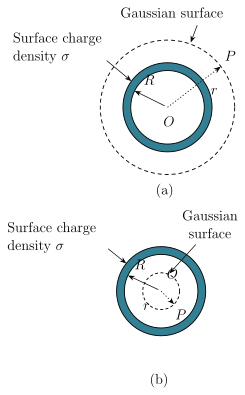
Gauss's law gives the field outside a uniformly charged spherical shell as ; but note the crucial distinction — the FLUX through a Gaussian surface depends only on the ENCLOSED charge, while the FIELD at any point on that surface is due to ALL charges present, enclosed or not.
Derivation — field outside a charged thin spherical shell: Consider a thin spherical shell of radius carrying total charge , uniformly distributed on its surface. To find the field at a point P outside the shell, at distance from the centre, choose a concentric spherical Gaussian surface of radius through P. By symmetry, is radial and has the same magnitude everywhere on this Gaussian surface, so
By Gauss's law, this equals . Since the entire shell charge lies inside the Gaussian surface (as ),
This is exactly the field of a point charge placed at the centre — i.e., outside a uniformly charged spherical shell, the shell behaves as if all its charge were concentrated at the centre.
Applying the same Gauss's-law reasoning to the figure (four point charges q1–q4, Gaussian surface enclosing only q1 and q2):
…
Unlock everything free for 14 days
- Full step-by-step solutions
- Concept-first explanations
- Methods, shortcuts & mistakes
- PYQ mapping + timed mock tests
Full access for 14 days. No credit card required.