Q.(a) Using Gauss's law, deduce an expression for electric field at a point due to a uniformly charged infinite plane thin sheet.
🔒You're viewing a preview — the full solution, concept, methods & PYQ mapping are locked.
🔒 Start your 14-day free trial to unlock the full solution →Part (a)Concept understanding — Gauss Law
Gauss's Law is a shortcut. Instead of adding up the Coulomb contribution of every charge — a nightmare of vectors and integrals — it lets you read the field straight off the symmetry of a problem. The whole idea rests on one quantity: electric flux.
Flux — field-lines counted through a surface. For a uniform field E crossing a flat area A, the flux is Φ = E·A = EA cosθ, where θ is the angle between the field and the normal to the surface. Picture the field as a bundle of lines; flux is how many pierce the surface. When E is edge-on (θ = 90°) nothing passes through and Φ = 0; when E is ⊥ to the surface (θ = 0) the count is maximal. For a closed surface, Φ is the net number of lines leaving it — lines that enter and exit cancel.
The law itself. Gauss's law states that the net flux out of any closed surface depends only on the charge trapped inside:
Φ = q_enclosed / ε₀.
Two consequences do most of the work. First, only enclosed charge counts — a charge outside sends as many lines in as out, so its net contribution is exactly zero. Second, the surface's shape is irrelevant; move the charge around inside or deform the surface, and Φ never changes.
Why symmetry makes it powerful. By itself Φ = q/ε₀ has E buried in an integral. It becomes a tool only when you pick a Gaussian surface matched to the symmetry — one where E is constant and everywhere either ⊥ to the surface (so Φ = EA) or ∥ to it (contributing nothing). Then E slides out and you solve in one line. This works for exactly three geometries:
1 — Infinite line charge (linear density λ). Use a coaxial cylinder: E = λ / 2πε₀r, falling off as ∝ 1/r.
2 — Infinite sheet (surface density σ). Use a pillbox pierced through the sheet: E = σ / 2ε₀ — uniform and completely independent of distance. The field near a large charged plane simply doesn't weaken as you step back. …
Why this formula?
Gauss's Law: Why It Holds
Gauss's Law is one of the four Maxwell's equations and a cornerstone of electromagnetism. Let's build the understanding from the ground up — not just the formula, but the why.
1. The Core Idea: Flux as "Flow" of Field
Imagine an electric field E passing through a small patch of area dA. The electric flux through that patch is:
dΦE=E⋅dA=EdAcosθ
where θ is the angle between E and the outward normal to the surface.
Why this definition?
- If E is perpendicular to the surface (θ=0), maximum field "flows through".
- If E is parallel (θ=90∘), no flux — the field just slides along the surface.
Total flux through a closed surface S is:
ΦE=∮SE⋅dA
2. The Key Insight: Flux Depends Only on Enclosed Charge
Consider a single point charge +q at the centre of a spherical surface of radius r.
- By Coulomb's law, at every point on the sphere: E=4πε01r2q, radially outward.
- The area vector dA is also radially outward.
- So E⋅dA=EdA everywhere.
The total flux:
ΦE=∮EdA=E∮dA=(4πε01r2q)(4πr2)=ε0q
Notice: The r2 cancels! The flux is independent of the radius.
3. Why Shape Doesn't Matter
Now, what if the surface is not spherical but any closed shape enclosing the charge?
- Draw a small cone from the charge to the surface.
- The flux through a patch dA at distance r is dΦ=4πε01r2qcosθdA.
- But r2cosθdA is exactly the solid angle dΩ subtended by dA at the charge.
So dΦ=4πε0qdΩ.
Integrating over the entire closed surface: ∮dΩ=4π (total solid angle around a point).
Hence:
ΦE=4πε0q⋅4π=ε0q
Result: For any closed surface enclosing q, the flux is ε0q.
4. Multiple Charges: Superposition
If there are many charges q1,q2,…,qn inside the surface, the total electric field is the vector sum of individual fields:
E=E1+E2+⋯+En
Flux is linear: …
Part (b)Concept understanding — Wheatstone Bridge
The Wheatstone Bridge – From Intuition to Precision
Imagine you have a single unknown resistor and you want to find its value. You could use an ohmmeter, but those are not always accurate for very small or very large resistances. A more elegant method is to compare it against known resistances in a circuit that acts like a balance scale — that is the Wheatstone bridge.
The core idea is simple: make the voltage at two points equal, so no current flows between them. When that happens, you know the ratio of the resistances.
The Circuit Layout
The bridge has four resistors arranged in a diamond shape:
        A
       / \
      P   Q
     /     \
    B-------C
     \     /
      R   S
       \ /
        D
A battery is connected across A and D. A sensitive galvanometer (G) is connected between B and C. The four resistors are labelled P, Q, R, and S. Usually, three are known and one (say, S) is unknown.
The Intuition: Two Voltage Dividers
Look at the left side: from A to D through P and R. That is a voltage divider. The voltage at B is a fraction of the battery voltage, determined by the ratio of P to R.
Now look at the right side: from A to D through Q and S. That is another voltage divider. The voltage at C is a fraction of the battery voltage, determined by the ratio of Q to S.
If the voltage at B equals the voltage at C, then no current flows through the galvanometer — the bridge is balanced.
The Condition for Balance
When the bridge is balanced, the voltage drop across P equals the voltage drop across Q (since both start at A), and the voltage drop across R equals the voltage drop across S (since both end at D). From the voltage divider rule:
- Voltage at B: VB=VA⋅P+RR
- Voltage at C: VC=VA⋅Q+SS
Setting VB=VC gives:
P+RR=Q+SS
Cross-multiply:
R(Q+S)=S(P+R)
RQ+RS=SP+SR
The RS terms cancel, leaving:
RQ=SP
Or, rearranged:
QP=SR
QP=SR
That is the balance condition of the Wheatstone bridge. When this holds, the galvanometer shows zero deflection.
Measuring an Unknown Resistance
Suppose S is unknown. You set P, Q, and R to known values. You adjust R (or the ratio P/Q) until the galvanometer reads zero. Then you compute:
S=PQ⋅R
This is why the bridge is so useful: you do not need to measure current or voltage accurately — you only need to detect when current is zero. That is far more sensitive and precise.
In practice, P and Q are often made equal (a 1:1 ratio), so the unknown S simply equals R. This is the "equal-arm" bridge.
Why It Works So Well
The galvanometer is a null detector — it only tells you whether current is flowing, not how much. This eliminates errors from meter calibration, battery voltage fluctuations, and temperature effects. The accuracy depends only on the precision of the known resistors. …
Part (a)
(a) Field of an infinite charged sheet (Gauss's law). Take a cylindrical Gaussian pillbox crossing a sheet of surface charge density σ, its flat faces (area A) parallel to the sheet. By symmetry E⊥ sheet; the curved surface gives no flux, each flat face gives EA, so 2EA=ε0σA:
E=2ε0σ(away from the sheet for σ>0).
(b) Two parallel sheets, each σ.
- (i) Between them: the two fields are oppositely directed and cancel: Ein=0. …
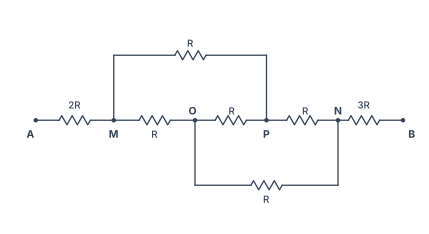
Part (a): Gauss's law gives E=2ε0σ for one infinite sheet; two like-charged sheets give E=0 between and ε0σ outside. Part (b): the Wheatstone balance is QP=SR, and the resistor network reduces (via a balanced bridge) to RAB=6R.
Part (a) — Infinite sheet and two parallel sheets
(a) Field due to a uniformly charged infinite sheet
Choose a cylindrical Gaussian pillbox piercing the sheet, with its two flat faces (each area A) parallel to the sheet.
- By symmetry E is perpendicular to the sheet and equal on both sides; flux through the curved wall is zero.
- Total flux =2EA; charge enclosed =σA. Gauss's law:
2EA=ε0σA ⇒ E=2ε0σ.
The field is uniform and points away from a positively charged sheet.
(b) Two large parallel sheets, each of density σ
Each sheet alone produces 2ε0σ.
- (i) In the region between the sheets, the two contributions point in opposite directions and cancel: Ein=0. …
Showing the 12 most recent of 46 on this concept.
- CBSE 2026Set 55/3/11 markMCQQ.Assertion (A) : In a Wheatstone bridge circuit, if we interchange the position of the cell and the galvanometer, the balance condition QP=SR remains unchanged. Reason (R) : QP=SR⇒PQ=RS, so the balance condition remains the same. (A) Both Assertion (A) and Reason (R) are true and Reason (R) is the correct explanation of the Assertion (A). (B) Both Assertion (A) and Reason (R) are true, but Reason (R) is not the correct explanation of the Assertion (A). (C) Assertion (A) is true, but Reason (R) is false. (D) Both Assertion (A) and Reason (R) are false.
›Reveal solutionSolution
The assertion is true because the Wheatstone bridge is a reciprocal network, but the reason given (a trivial algebraic manipulation) does not explain why interchanging the cell and galvanometer preserves balance. The correct option is (B).
The Wheatstone bridge is a beautiful example of a reciprocal circuit. When balanced, no current flows through the galvanometer because the potential difference across it is zero. The question asks whether swapping the positions of the cell and galvanometer affects this balance condition.
The assertion claims the balance condition QP=SR remains unchanged after the swap. This is indeed true, and follows from the reciprocity theorem in circuit theory: in a linear, bilateral network (one with resistors only, no diodes or other one-way elements), interchanging a voltage source and a current-measuring device does not change the current through the measuring device.
The reason given, however, is just the algebraic statement that QP=SR implies PQ=RS. While mathematically correct, this doesn't explain anything about the physical interchange of components. It's a red herring.
Let me show why the assertion is actually true:
-
Original configuration: The cell is connected between two opposite nodes (say A and C), and the galvanometer between the other two (B and D). At balance, the potentials at B and D are equal, so VB=VD.
-
Deriving the balance condition: Using voltage dividers along the two arms:
VB=VA+P+QQ(VC−VA),VD=VA+R+SS(VC−VA)
Setting VB=VD gives P+QQ=R+SS, which simplifies to QP=SR.
-
After interchange: Now the cell is between B and D, and the galvanometer between A and C. For balance, we need VA=VC (no current through the galvanometer).
-
New balance condition: With the cell across B–D, we can write: …
-
- CBSE 2026Set V11 markMCQQ.Consider the following statements about a balanced Wheatstone's bridge. Statement-I : The current through the galvanometer is zero. Statement-II : If the positions of the galvanometer and the battery are interchanged in the circuit, the current in the galvanometer will be zero. Among the above two statements :(a) Only Statement-I is true(b) Only Statement-II is true(c) Both the Statements are wrong(d) Both the Statements are true
›Reveal solutionSolution
(d) Both the Statements are true …
- CBSE 2026Set A1 markMCQQ.S.I. unit of electric flux is (A) Vm (B) Vm^2 (C) Jm (D) NC^-1
›Reveal solutionSolution
Φ = E·A → (V/m)(m²) = V·m.
Electric flux is Φ=E⋅A.
Unit of electric field E = N/C = V/m (volt per metre).
Unit of area A = m².
…
- CBSE 2026Set A1 markMCQQ.The surface charge densities on the surface of two conducting spheres of radii r1 and r2 are equal. The ratio of electric field intensities on the surfaces is (A) r1/r2 (B) r1^2/r2^2 (C) r2^2/r1^2 (D) 1 : 1
›Reveal solutionSolution
Just outside a charged conductor E = σ/ε₀; with equal σ the fields are equal (1:1).
The electric field just outside the surface of a charged conductor is
E=ε0σ,
which depends only on the local surface charge density σ, not on the radius.
…
- CBSE 2026Set ANNUAL1 markMCQQ.Electric flux is a(a) scalar quantity(b) vector quantity(c) scalar or vector quantity(d) constant quantity
›Reveal solutionSolution
Electric flux is a scalar quantity, even though it is defined using two vectors.
Electric flux through a surface is defined as
Φ=∮E⋅dA
Although E (electric field) and dA (area vector, normal to the surface element) are both vectors, their dot product E⋅dA=EdAcosθ is a single number (magnitude only, with a sign depending on θ) — it …
- CBSE 2026Set ANNUAL1 markMCQQ.A charge Q, is enclosed by a Gaussian spherical surface of radius R. If the radius is doubled, then the outward electric flux will(a) decrease to half(b) increase two times(c) remain unchanged(d) increase four times
›Reveal solutionSolution
Gauss's law: flux through any closed surface = Q_enclosed / epsilon_0, and this does NOT depend on the surface's size or shape.
Gauss's law states that for any closed (Gaussian) surface,
flux (phi) = Q_enclosed / epsilon_0
Here the same charge Q sits at the centre of the sphere both before and after the radius is doubled - the enclosed charge Q_enclosed is unchanged. Since flux depends ONLY on Q_enclosed and the permittivity of free space epsilon_0 (both unchanged here), the flux does not change even though the surface area (4piR^2) has increased fourfold. Doubling R spreads the same total flux over 4 ti …
- CBSE 2026Set ANNUAL1 markMCQQ.A hollow metal sphere of radius R is uniformly charged. The electric field due to the sphere at a distance r from the centre(a) increases as r increases for r<R and for r>R(b) is zero as r increases for r<R and decreases as r increases for r>R(c) is zero as r increases for r<R and increases as r increases for r>R(d) decreases as r increases for r<R and for r>R
›Reveal solutionSolution
A charged conducting (hollow metal) sphere carries all its charge on the outer surface. Gauss's law gives E=0 inside and E∝1/r2 (decreasing) outside.
Setting up Gauss's law
For a hollow, uniformly charged conducting sphere of radius R and total charge Q, all the charge resides on the outer surface (a fundamental property of conductors in electrostatic equilibrium — free charges repel each other and move to the surface where the electric field inside the conducting material is zero).
Take a concentric spherical Gaussian surface of radius r.
Case 1: r<R (inside the shell)
The Gaussian surface of radius r encloses no charge, because all the charge Q lies on the surface at radius R>r.
∮E⋅dA=ε0Qenc=0⟹E=0
This is true for every r<R — the field is zero throughout the interior, it does not "increase" or "decrease," it is simply zero.
Case 2: r>R (outside the shell)
Now the Gaussian surface encloses the entire charge Q. By spherical symmetry, E is radial and has the same magnitude everywhere on the Gaussian sphere, so
…
- CBSE 2026Set ANNUAL1 markQ.Match the Column A with Column B and write the correct pair. Column A: Electric flux. Column B:(i) μ₀nI,(ii) Volt × second,(iii) μ₀nI/2,(iv) Volt × meter,(v) Volt × meter⁻¹,(vi) Volt.
›Reveal solutionSolution
Electric flux φ_E = E·A; unit = (V/m)(m²) = V·m, option (iv).
Electric flux through a surface is φ_E = E·A (for a uniform field perpendicular to area A). The SI unit of electric field E is volt per metre (V/m) = N/C, and area is in m². Therefore the unit of electric flux is
…
- CBSE 2026Set SEM31 markMCQQ.In which case will the null condition of a Wheatstone bridge change ?(a) If the resistances in different arms are changed(b) If the positions of the battery and the galvanometer are interchanged(c) If a battery of different emf is used(d) If a galvanometer of different resistance is used
›Reveal solutionSolution
A Wheatstone bridge is balanced when P/Q = R/S — only the four arm resistances matter. Changing an arm's resistance upsets balance; interchanging the cell and galvanometer, or changing their values/emf, does not. Option (a).
Step 1 — balance condition (NCERT/CBSE Class 12 Physics, Current Electricity): P/Q = R/S for the four ratio arms.
Step 2 — evaluate each option:
- (a) Changing arm resistances alters the P/Q or R/S ratio → balance changes. This is the correct choice. …
- CBSE 2025Set D1 markMCQQ.Gauss's law states that the electric flux through a closed surface is (A) proportional to the charge enclosed (B) inversely proportional to the charge enclosed (C) zero (D) proportional to the square of the charge enclosed
›Reveal solutionSolution
Gauss's law states the total electric flux through a closed surface equals the enclosed charge divided by ε₀, so Φ ∝ q_enclosed.
Gauss's law is written as
∮E⋅dA=ε0qenc
The left side is the total electric flux Φ through the closed (Gaussian) surface. Thus
Φ=ε0qenc
…
- CBSE 2025Set D1 markMCQQ.Inside a closed surface n electric dipoles are situated. The electric flux coming out from the closed surface will be (A) q/ε0 (B) 2q/ε0 (C) nq/ε0 (D) zero
›Reveal solutionSolution
A dipole has zero net charge, so n dipoles enclose zero charge and the net flux is zero.
Gauss's law states the net electric flux out of a closed surface is Φ = q_enclosed/ε₀.
Each electric dipole consists of +q and −q; its net charge is +q + (−q) = 0. With n dipoles inside, the total enclosed charge is n × 0 = 0.
…
- CBSE 2025Set A1 markQ.Write True or False: Inside a conductor, electrostatic field is zero.
›Reveal solutionSolution
The statement is True: the electrostatic field inside a conductor is zero in equilibrium.
In electrostatic equilibrium, free charges in a conductor redistribute themselves on the surface such that the electric field inside the body of the conductor is exactly zero. If there were a residual field inside, it would exert a force on the free electrons, causing them to keep moving — contradicting the assumption …
🎓Unlock everything free for 14 days
- ✓Full step-by-step solutions
- ✓Concept-first explanations
- ✓Methods, shortcuts & mistakes
- ✓PYQ mapping + timed mock tests
Full access for 14 days. No credit card required.