Physical Education · Ch 7 — Fundamentals of Anatomy and Physiology in Sports
Structure and Functions of the Respiratory System
Structure and Functions of the Respiratory System
Respiration is made up of two phases - inspiration and expiration. You breathe in (inhale) oxygen during inspiration, and you breathe out (exhale) carbon dioxide during expiration. Respiration includes four processes:
- Ventilation - the movement of air into and out of the lungs.
- Gas exchange between the air in the lungs and the blood, sometimes called external respiration.
- Transport of oxygen and carbon dioxide in the blood.
- Gas exchange between the blood and the tissues, sometimes called internal respiration.
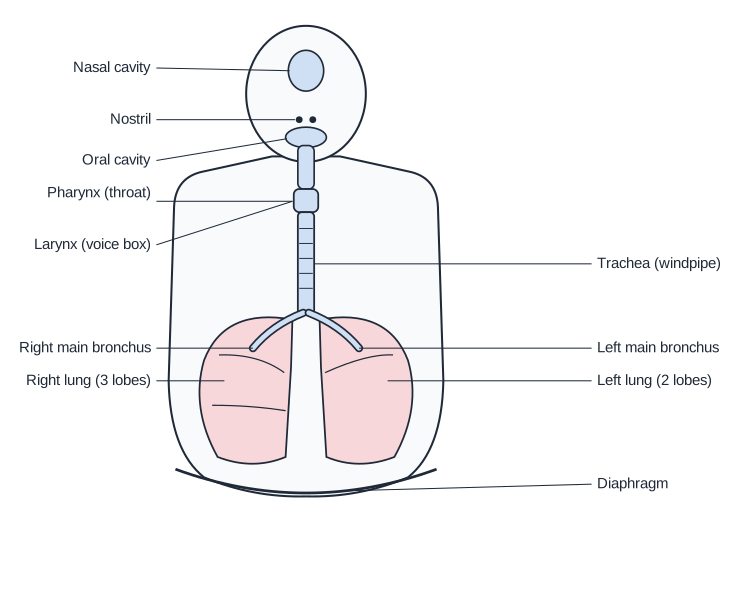
Drawn by us to help you understand the concept clearly, and verified to make sure it's accurate. For exams, practice from your textbook's own diagram.
A clean own-drawn schematic of the respiratory system in a head-and-chest outline, labelled: nasal cavity, nostril, oral cavity, pharynx, larynx, trachea, right and left main bronchus, right and left lung, …
Structure of the respiratory system
Traced in order from outside to deep inside the chest, the respiratory system consists of the following parts.
The nose and nasal cavity
The nose is the visible structure on the face and the opening to the internal nasal cavity. The nasal cavity extends from the external opening of the nose to the pharynx and is divided by the nasal septum into a right and a left side.
Pharynx
The pharynx (throat) is the common passageway of both the digestive and respiratory systems. It has three regions:
- Nasopharynx - the upper part, extending from the internal nares of the nasal cavity to the level of the uvula.
- Oropharynx - a passageway for both air and food, extending from the uvula to the epiglottis.
- Laryngopharynx - extending from the epiglottis to the lower margin of the larynx; it is where the digestive and respiratory routes finally diverge.
Larynx
The larynx consists of an outer casing of nine cartilages connected by muscles and ligaments. It is also known as the voice box.
Trachea
The trachea, or windpipe, is a membranous tube made of connective tissue and smooth muscle that carries air down into the chest.
Bronchi
The trachea divides into the left and right primary bronchi, one entering each lung. Their main job is to provide a passageway for air to move into and out of each lung, and their mucous membrane traps debris and pathogens.
Bronchioles
Bronchioles are about 1 mm in diameter and branch again and again until they become the tiny terminal bronchioles, which lead to the structures of gas exchange - there are more than 1000 terminal bronchioles in each lung. Unlike the bronchi, the muscular walls of the bronchioles contain no cartilage, so they can change size to increase or decrease the airflow.
Alveoli
An alveolar duct is a tube of smooth muscle and connective tissue that opens into a cluster of alveoli. An alveolus is one of the many small, grape-like sacs attached to the alveolar ducts; this is where gases are exchanged between the air and the blood.
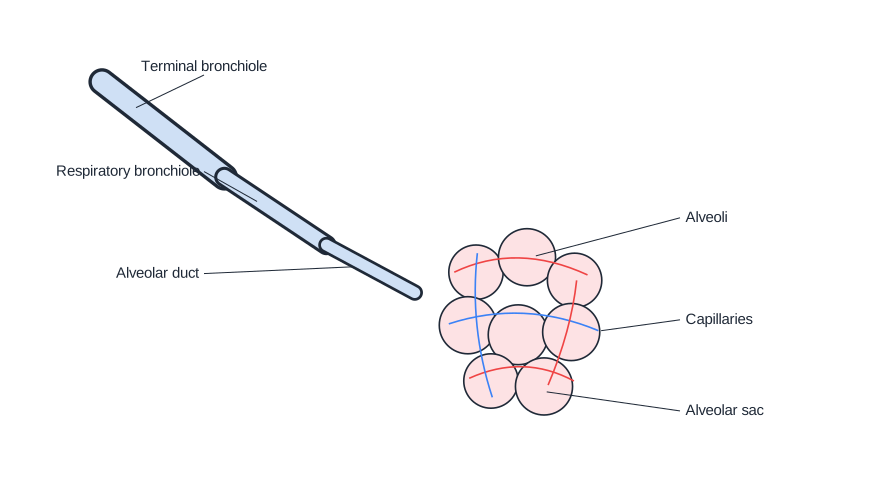
Drawn by us to help you understand the concept clearly, and verified to make sure it's accurate. For exams, practice from your textbook's own diagram.
A magnified schematic of the gas-exchange end of the airway: a terminal/respiratory bronchiole branching to an alveolar duct that opens into a cluster of grape-like alveoli (an alveolar sac), wrapped in a network of capillaries; labelled terminal bronchiole, respiratory bronchiole, al …
Lungs
The lungs are the principal organs of respiration - spongy, pinkish organs that look like two upside-down cones in the chest. The right lung has three lobes, while the left lung has only two lobes, to make room for the heart.