Q.In a given habitat we have 20 plant species and 20 animal species. Should we call this as 'diversity' or 'biodiversity'? Justify your answer.
🔒You're viewing a preview — the full solution, concept, methods & PYQ mapping are locked.
🔒 Start your 14-day free trial to unlock the full solution →Concept understanding — Biodiversity Explanation
Biodiversity: The Web of Life Around You
Imagine walking into a kitchen garden. You see a few tomato plants, some mint, maybe a rose bush. Now imagine walking into a forest — hundreds of tree species, birds calling from every direction, insects crawling under leaves, fungi on the bark, and a stream with tiny fish. That staggering variety of living things — from the tallest tree to the invisible bacteria in the soil — is what we call biodiversity.
The Simple Intuition
Biodiversity is short for biological diversity. Think of it as the "variety of life" on Earth. Just as a library with only one kind of book is boring and limited, an ecosystem with only one kind of plant or animal is fragile and poor. Biodiversity is nature's library — the more species, the richer and more stable the system.
The Precise Meaning
The NCERT textbook defines biodiversity as:
The variety of living organisms present on Earth, including the different plants, animals, fungi, and microorganisms, their genes, and the ecosystems they form.
This definition has three layers, and each matters:
- Genetic diversity — variation within a species. For example, all humans are one species, but we have different eye colours, heights, and resistance to diseases. In crops, genetic diversity means some wheat varieties resist drought while others resist pests.
- Species diversity — the number of different species in a region. A tropical rainforest has thousands of species; a cold desert has very few.
- Ecological diversity — the variety of habitats, ecosystems, and communities. A forest, a grassland, a coral reef, and a pond are all different ecosystems.
Biodiversity is not just about counting species. It includes the genes inside each species and the ecosystems they create together. Lose one layer, and the others suffer.
Why Does Biodiversity Matter?
For a commerce or humanities student, the question is natural: why should I care about how many beetles live in a forest? The answer is that biodiversity is the foundation of everything we use and consume.
Direct economic value — We depend on biodiversity for food (crops, fish, livestock), medicine (many drugs come from plants and fungi), raw materials (timber, cotton, rubber), and tourism (wildlife sanctuaries, national parks).
Indirect value — This is harder to see but more critical. Forests clean the air, wetlands purify water, bees pollinate crops, and soil microbes recycle nutrients. These are called ecosystem services. If biodiversity collapses, these services stop — and no technology can replace them at scale.
Ethical and cultural value — Every species has a right to exist, regardless of its usefulness to humans. Many cultures, especially in India, revere certain trees, animals, and rivers as sacred. Biodiversity is also a source of beauty, inspiration, and knowledge.
The NCERT textbook emphasises that biodiversity is our life insurance. It gives us resilience — when one species fails due to disease or climate change, another can take its place. A system with low biodiversity (like a wheat monoculture) is one disease away from collapse.
A Quick Look at India's Biodiversity
India is one of the world's mega-diverse countries. Though it has only 2.4% of the world's land area, it contains about 8% of all known species. This includes:
- Over 45,000 plant species
- More than 90,000 animal species
- 10 biogeographic zones — from the Himalayas to the Western Ghats to the Andaman Islands
This richness is not accidental. India's varied climate, geography, and ancient landmass have allowed many species to evolve and survive here.
The Threat: Why We Talk About It …
This should be called biodiversity, not simply diversity.
- Biodiversity refers specifically to the number and variety of organisms found in a given area — plants and animals together.
- Since the habitat here has both 20 plant species and 20 animal species, it is describing the richness of living organisms as a whole across both major groups. …
A habitat containing 20 plant species and 20 animal species together is an example of biodiversity, the term specific to the richness of living organisms in an area.
Biodiversity is defined as the number and variety of organisms found within a given area or region. It is not restricted to plants alone or animals alone — it takes in the full range of living organisms present.
- In this scenario, the habitat contains 20 different plant species and 20 different animal species, adding up to a combined richness of living organisms in that one area.
- Because this figure spans both plants and animals together, it precisely matches what biodiversity is meant to describe, rather than a narrower or more general use of the word 'diversity'. …
Showing the 12 most recent of 15 on this concept.
- GUJCET 2026Set 051 markMCQQ.Match Column - I and Column - II. And Select the correct option. Column-I:(i) dodo,(ii) quagga,(iii) thylacine,(iv) steller's sea cow. Column-II: (p) Africa, (q) Mauritius, (r) Russia, (s) Australia. (A) (i - r), (ii - s), (iii - p), (iv - q) (B) (i - q), (ii - r), (iii - s), (iv - p) (C) (i - s), (ii - r), (iii - q), (iv - p) (D) (i - q), (ii - p), (iii - s), (iv - r)
›Reveal solutionSolution
i-q, ii-p, iii-s, iv-r.
dodo (i) — Mauritius (q); quagga (ii) — Africa (p); thylacine (iii) — Australia (s); Steller's sea cow (iv) — Russia (r). …
- GUJCET 2026Set 051 markMCQQ.Oxygen available from the nature belongs to which biodiversity conservation category? (A) Narrowly utilitarian (B) Intangible benefits (C) Broadly utilitarian (D) Ethical
›Reveal solutionSolution
Ecosystem services like oxygen production = broadly utilitarian value.
The reasons to conserve biodiversity are narrowly utilitarian (direct products), broadly utilitarian (ecosystem services such as oxygen production, pollination, climate regulation), and ethical. Oxygen supplied by nature (e.g. by …
- GSEB Higher Secondary Certificate (HSC) Examination 2026Set ANNUAL1 markMCQQ.As we move away from the equator towards the poles _____ species of birds find in colombia, _____ species of birds find in New York and _____ species of birds find in Green land respectively.(a) 1200, 105, 56(b) 1400, 105, 55(c) 1400, 1200, 105(d) 1400, 105, 56
›Reveal solutionSolution
Species diversity is highest near the equator and steadily decreases towards the poles - a well-documented latitudinal diversity gradient, illustrated for birds using Colombia, New York and Greenland.
Colombia lies near the equator and hosts the richest bird diversity among these locations, at about 1,400 species. New York, at a mid/temperate latitude, has considerably fewer, about 105 species. Greenland, close to the poles, has the le …
- GSEB Higher Secondary Certificate (HSC) Examination 2025Set ANNUAL1 markMCQQ.Select the option that correctly matches Column-I with Column-II. Column-I: (p) Paul Ehrlich, (q) David Tilman, (r) Von Humboldt, (s) Edward Wilson Column-II:(i) Coined the term 'biodiversity',(ii) Analysis of the species-area relationship,(iii) Increasing species diversity contributes to higher productivity,(iv) The Rivet Popper hypothesis(a) (p-iii), (q-iv), (r-i), (s-ii)(b) (p-iv), (q-iii), (r-ii), (s-i)(c) (p-ii), (q-i), (r-iv), (s-iii)(d) (p-iv), (q-i), (r-ii), (s-iii)
›Reveal solutionSolution
Paul Ehrlich gave the Rivet Popper hypothesis; David Tilman showed higher diversity raises productivity; von Humboldt analysed the species-area relationship; Edward Wilson coined the term biodiversity.
Matching each scientist to their contribution: (p) Paul Ehrlich proposed the Rivet Popper hypothesis, comparing species loss in an ecosystem to randomly popping out rivets from an aeroplane's wing → (iv). (q) David Tilman's long-term ecosystem experiments demonstrated that plots with greater species diversity showed higher productivity and lower year-to-year variation → (iii). (r) Alexand …
- GUJCET 2024Set 101 markMCQQ.Choose the incorrect pair of extincted animal and their country from the following. (A) Dodo - Mauritius (B) Steller's Sea Cow - Russia (C) Quagga - Africa (D) Thylacine - Thailand
›Reveal solutionSolution
The Thylacine (Tasmanian wolf) was Australian — the 'Thailand' pairing is wrong.
Recorded extinctions: Dodo — Mauritius; Steller's Sea Cow — Russia; Quagga — Africa; and the Thylacine (Tasmanian tiger/wolf) — Australia. The option pairing …
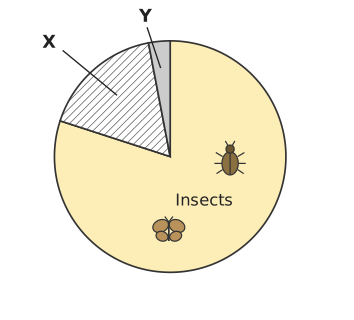
- GUJCET 2023Set 071 markMCQQ.Following figure represent the global biodiversity showing proportionate number of species at major taxa of invertebrates. Identify 'X' and 'Y'. [FIGURE] (A) X = Molluscs; Y = Crustaceans (B) X = Crustaceans; Y = Molluscs (C) X = Crustaceans; Y = Insects (D) X = Molluscs; Y = Insects
›Reveal solutionSolution
[!TLDR] Insects dominate invertebrate diversity; molluscs (~85,000 species) exceed crustaceans (~40,000), so the larger wedge X = Molluscs and the thin sliver Y = Crustaceans.
Concept
This figure, aligned with the NCERT/CBSE Biodiversity chapter, shows the proportionate number of species among major invertebrate taxa. Among all animals, insects are by far the most species-rich group (more than 900,000 described species), which is why they fill the largest portion of the chart. After insects, molluscs are the next most diverse invertebrate group, followed by crustaceans.
Solution
Rank the invertebrate groups by number of species:
- Insects: largest slice (the dominant wedge with the beetle/butterfly icons). …
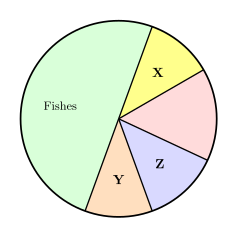
- GSEB Higher Secondary Certificate (HSC) Examination 2023Set ANNUAL1 markMCQQ.According to representing global biodiversity proportionate number of species of major texa of vertebrates, select appropriate option for label of X, Y and Z in given figure.(a) X - Mammals, Y - Birds, Z - Amphibians(b) X - Birds, Y - Amphibians, Z - Reptiles(c) X - Reptiles, Y - Amphibians, Z - Birds(d) X - Amphibians, Y - Birds, Z - Mammals
›Reveal solutionSolution
Reading the standard NCERT pie chart of vertebrate species proportions, the three labelled wedges are best identified as X-Mammals, Y-Birds, Z-Amphibians (option a).
Globally, among vertebrates the approximate species richness order is: Fishes (largest) > Birds > Reptiles > Mammals ~ Amphibians. On the NCERT pie chart the small upper-right wedge (X) fits mammals, the larger lower wedge (Y) fits birds, and the lower-right wedge (Z) fits amphibians, matching option (a …
- GSEB Higher Secondary Certificate (HSC) Examination 2023Set ANNUAL1 markMCQQ.Statement (A) : Caspian a subspecies of tiger is one of the recently extinct. Reason (R) : The colonisation of tropical pacific Islands by human.(a) Statement (A) is wrong but Reason (R) right(b) Statement (A) and Reason (R) both are true but R is not right explanation of A(c) Statement (A) is right but Reason (R) is wrong(d) Statement (A) and Reason (R) both are true, R is a right explanation of statement A
›Reveal solutionSolution
The Caspian tiger's extinction is real, and human colonisation of Pacific islands has caused extinctions - but the latter did not cause the Caspian tiger's extinction, so R does not explain A.
Assertion A: The Caspian tiger, a subspecies of tiger, is among the recently extinct - TRUE.
Reason R: Colonisation of tropical Pacific islands by humans caused many extinctions - TRUE as a general statement (island species are very vulnerable).
…
- GSEB Higher Secondary Certificate (HSC) Examination 2023Set ANNUAL1 markMCQQ.What is the reason of extinctions of steller's sea cow?(a) Habitat loss(b) Alien species invasion(c) Over-exploitation(d) Co-extinctions
›Reveal solutionSolution
Steller's sea cow was hunted to extinction - a classic case of over-exploitation.
Among the causes of biodiversity loss ('The Evil Quartet' - habitat loss, over-exploitation, alien species invasion, co-extinctions), the extinction of Steller's sea cow was caused by over-exploitation: it …
- GUJCET 2022Set 171 markMCQQ.Which species extinction in the last 500 years was due to over exploitation by humans? (A) Quagga (B) Dodo (C) Steller's sea cow (D) Thylacine
›Reveal solutionSolution
Steller's sea cow — over-exploited to extinction.
Concept. NCERT lists over-exploitation as a driver of extinction: "Many species extinctions in the last 500 years (Steller's sea cow, passenger pigeon) …
- GSEB Higher Secondary Certificate (HSC) Examination 2022Set ANNUAL1 markMCQQ.Among the invertebrate classes representing global biodiversity, which class shows the highest number of species?(a) Crustaceans(b) Molluscs(c) Annelids(d) Insects
›Reveal solutionSolution
Insects form by far the largest class of invertebrates by species count, contributing more species than all other animal groups combined.
Global biodiversity surveys consistently show that insects (class Insecta) contain the greatest number of described species of any animal group, vastly outnumbering crustaceans, molluscs and annelids. This exceptional insect diversity is a key reason why glob …
- GUJCET 2020Set x1 markMCQQ.Which of the following is called the 'Terror of Bengal'? (A) Carrot grass (B) Bloom-forming algae (C) Lantana (D) Water hyacinth
›Reveal solutionSolution
The water hyacinth (Eichhornia crassipes) is the “Terror of Bengal.”
Water hyacinth is a fast-growing invasive aquatic weed that clogs water bodies, drains dissolved oxygen and kills aquatic life. Because it grew uncontrollably in the water bodies …
🎓Unlock everything free for 14 days
- ✓Full step-by-step solutions
- ✓Concept-first explanations
- ✓Methods, shortcuts & mistakes
- ✓PYQ mapping + timed mock tests
Full access for 14 days. No credit card required.