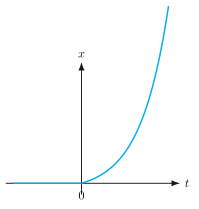
Q.Figure 2.11 shows the - plot of one-dimensional motion of a particle. Is it correct to say from the graph that the particle moves in a straight line for and on a parabolic path for ? If not, suggest a suitable physical context for this graph.
You're viewing a preview — the full solution, concept, methods & PYQ mapping are locked.
Start your 14-day free trial to unlock the full solution →The statement confuses an - graph with a spatial trajectory. This is one-dimensional motion, so the particle always moves along one straight line; the graph only tells us how its coordinate varies with time. Being flat () for means it is at rest at the origin, and the parabola for means , i.e. uniformly accelerated motion from rest.
Concept
An - graph plots the single coordinate against time; its shape is not the geometric path travelled through space. In one dimension the path is always a straight line. The graph's slope is the velocity and its curvature reflects the acceleration.
Why the statement is wrong
- For : (constant). A horizontal - line means zero velocity, i.e. the particle is at rest at the origin. It is not 'moving in a straight line'; it is not moving at all.
- For : rises as an upward-opening parabola. Comparing with the kinematic equation for constant acceleration from rest,
the parabolic - curve simply signifies uniform acceleration, with velocity increasing linearly. The particle is still moving along the same straight line in space, only speeding up.
A suitable physical context …
Unlock everything free for 14 days
- Full step-by-step solutions
- Concept-first explanations
- Methods, shortcuts & mistakes
- PYQ mapping + timed mock tests
Full access for 14 days. No credit card required.