Q.Which of the following is an ecosystem service provided by a natural ecosystem?
🔒You're viewing a preview — the full solution, concept, methods & PYQ mapping are locked.
🔒 Start your 14-day free trial to unlock the full solution →Concept understanding — Ecological Concepts
Ecological Concepts: Zooming Out From Organism to Biosphere
Point a camera at a single deer grazing in a forest, and you are looking at an organism. Zoom out a little and you see the whole herd of deer sharing that forest — a population. Zoom out further and the tigers, grasses, insects and fungi living alongside that herd come into frame — a community. Pull back once more and you see the community together with the soil, water, sunlight and air it depends on — an ecosystem. Keep pulling back and entire regions of similar ecosystems (all the world's tropical forests, say) form a biome, and every biome on Earth together makes up the biosphere.
This is the idea of levels of ecological organisation — the same living world, examined at successively larger scales. The NCERT Class XII Biology ecology unit (Chapters 11–13) is built around exactly this zoom-out: Chapter 11 (Organisms and Populations) stays at the organism/population scale, Chapter 12 (Ecosystem) zooms out to the community-plus-environment scale, and Chapter 13 (Biodiversity and Conservation) zooms out again to ask how much variety of life exists and how to protect it. "Ecological Concepts" as a bucket covers facts that sit at any of these scales — not one single narrow idea, but the connected vocabulary ecologists use to describe life at every zoom level.
If a question is specifically about who benefits and who loses when two species interact (mutualism, competition, predation, parasitism, commensalism, amensalism), that is covered in depth in the Ecological Interactions concept. This concept covers the broader structural and functional ideas around it — organisation, ecosystem function, and the systems that move matter and energy through it.
Populations: The First Zoom-Out From the Individual
A population is a group of individuals of the same species living in a defined geographical area at a given time, capable of interbreeding. Because it is a group and not a single organism, a population has properties an individual cannot have on its own — birth rate and death rate (measured per capita, not as raw counts), a sex ratio, an age distribution, and a population density (the size of the population relative to a unit of space). These "group-level" attributes are exactly what distinguishes population ecology from studying one organism's physiology.
Ecosystem Structure: What an Ecosystem Is Made Of
An ecosystem is a functional unit of nature in which living organisms interact with each other and with their physical surroundings. Every ecosystem — a pond, a forest, a crop field, even an aquarium — is built from the same two kinds of components:
- Abiotic components — the non-living inorganic and organic materials: air, water, soil, and the nutrients dissolved in them.
- Biotic components — the living organisms, organised by their functional role: producers (autotrophs that fix solar energy), consumers (heterotrophs that eat producers or each other), and decomposers (fungi and bacteria that break down dead matter).
Two things give an ecosystem its physical shape: its species composition (which plant and animal species are present) and its stratification — the vertical layering of species at different heights, such as tall trees forming the top canopy of a forest, shrubs below them, and grasses and herbs at the ground.
An ecosystem is studied as a working unit through four linked processes: productivity, decomposition, energy flow, and nutrient cycling. Every "how does an ecosystem function" question is really asking about one of these four.
Productivity: How Fast an Ecosystem Makes New Matter
Primary productivity is the rate at which producers capture solar energy and convert it into organic (biomass) matter.
- Gross Primary Productivity (GPP) — the total rate of production of organic matter, i.e. the total solar energy fixed by all producers.
- Net Primary Productivity (NPP) — what is left of GPP after the producers themselves use some of it up in their own respiration: NPP = GPP − Respiration losses (R). NPP is the biomass actually available to the consumers (herbivores and decomposers) of the ecosystem.
- Secondary productivity is the rate at which consumers assimilate the food energy they take in from producers or from other consumers.
Decomposition: Breaking Matter Back Down
Decomposers convert the complex organic compounds in dead plant and animal remains ("detritus") back into simple inorganic nutrients, so those nutrients can be reused by producers. This happens in three overlapping steps:
- Fragmentation — detritivores (like earthworms) physically break detritus into smaller particles.
- Leaching — water-soluble inorganic nutrients seep down through the soil and are lost from the topsoil layer as precipitates.
- Catabolism — bacterial and fungal enzymes chemically break down the remaining detritus into simpler inorganic substances.
Partial decomposition leaves behind a dark, colloidal, highly microbe-resistant substance called humus, which acts as a slow-release nutrient reservoir; its further breakdown to release inorganic nutrients is called mineralisation. Decomposition is largely an oxygen-requiring process, is slower when detritus is rich in lignin/chitin, and is faster when it is rich in nitrogen and simple sugars — warm, moist conditions favour it, while cold and waterlogged (anaerobic) conditions suppress it and let organic matter accumulate.
Energy Flow and Ecological Pyramids
Unlike nutrients, energy in an ecosystem flows in one direction only — from the sun, into producers, and then into successive consumers — and is progressively lost as heat at every transfer; it is never recycled back to the producers the way a nutrient is. Because a real ecosystem rarely has a single, unbranched sequence of "who eats whom," feeding relationships form an interconnected food web rather than one isolated food chain.
Ecological pyramids represent this trophic structure visually (producers at the base, successive consumers stacked above):
A pyramid of energy is always upright — it can never be inverted, because energy is always lost as heat at each transfer, so a lower trophic level must always contain more energy than the level above it. Pyramids of numbers and biomass can be inverted in some ecosystems — the classic example is a marine ecosystem, where the biomass of fish (consumers) can exceed the biomass of the phytoplankton (producers) that support them, because the phytoplankton reproduce and get eaten so fast.
Nutrient (Biogeochemical) Cycling …
Natural ecosystems perform a wide range of functions that directly or indirectly benefit human welfare, and these are collectively termed ecosystem services. The NCERT textbook explicitly recognizes that ecosystems maintain the gaseous composition of the atmosphere, regulate climate, and cycle nutrients like carbon, nitrogen, and phosphorus through biogeochemical pathways. These nutrient cycles ensure that essential elements remain available to living organisms across generations.
Forests, grasslands, and wetlands also stabilize soil through root networks and vegetation cover, preventing erosion by wind and water. Additionally, natural ecosystems act as sinks for pollutants—forests absorb carbon dioxide, wetlands filter toxins, and oceans sequester atmospheric carbon, thereby mitigating the threat of global warming. All three processes listed in the options are well-documented ecosystem services. …
Natural ecosystems provide a vast array of services including nutrient cycling, soil protection, and pollutant absorption — all three functions work together to sustain life and environmental stability.
Ecosystems are not just collections of plants and animals occupying space; they are dynamic, working systems that perform essential functions for the planet and humanity. The concept of "ecosystem services" recognizes that natural ecosystems actively contribute to maintaining conditions suitable for life, often in ways we take for granted until they're disrupted.
When we think about nutrient cycling, we're looking at one of the most fundamental services an ecosystem provides. Nutrients like nitrogen, phosphorus, and carbon don't simply appear where plants need them — they move through complex cycles involving decomposers, soil microorganisms, plants, and animals. A forest floor, for instance, is a nutrient-processing factory where fallen leaves are broken down by fungi and bacteria, releasing minerals back into the soil for uptake by tree roots. Without this cycling, nutrients would become locked away in dead matter, and new growth would be impossible. This is why healthy ecosystems are self-sustaining; they recycle their own resources.
Soil erosion prevention is another critical service, particularly visible in ecosystems with good vegetation cover. Plant roots bind soil particles together, creating a stable matrix that resists being washed away by rain or blown away by wind. Forest ecosystems, grasslands, and even wetlands act as natural anchors for soil. When these ecosystems are destroyed — through deforestation or overgrazing — the soil becomes vulnerable. The devastating dust bowls and landslides we see in degraded landscapes are direct consequences of losing this ecosystem service. …
Check each of the three listed services against a single test — 'does this happen automatically in an intact, unmanaged ecosystem, with no human input?' — all three (nutrient cycling, erosion control, pollutant absorption) pass indep …
- GSEB Higher Secondary Certificate (HSC) Examination 2026Set ANNUAL1 markMCQQ.Which of the following is not related to the structure of the Ecosystem?(a) Productivity(b) Degradation(c) Conservation(d) Energy loss
›Reveal solutionSolution
Ecosystem attributes are studied as structure (species composition, stratification) and function (productivity, decomposition, energy flow, nutrient cycling); 'conservation' is neither - it is a management practice, so it is the odd one out.
An ecosystem is described through its structural features (the identity/number of species present and how they are stratified/organised) and its functional processes: productivity (rate of biomass/organic matter production), decomposition (breakdown of dead organic matter, which the option calls 'degradation'), energy flow (unidirectional movement of energy through trophic levels, referenced here as 'energy loss'), and nutrient cycling. 'Conservation …
- GUJCET 2024Set 101 markMCQQ.Choose the correct option for P and Q in the given diagram: [FIGURE: box 'Population Density (N)' with inputs I (top), B (left) and outputs P (right, to D), Q (bottom, to E); options give the sign (+/-) of P and Q] (A) P: +, Q: + (B) P: +, Q: - (C) P: -, Q: - (D) P: -, Q: +
›Reveal solutionSolution
Natality and immigration add to N (+); mortality and emigration remove from N (−).
Population density N increases through Natality (B) and Immigration (I) — the inward arrows — and decreases through Mortality (D) and Emigration (E) — the outward arrows. P feeds the mortality (D) pathway and Q feeds t …
- GUJCET 2024Set 101 markMCQQ.Which of the following is responsible for beginning of detritus food chain? (A) Algae (B) Zooplankton (C) Phytoplankton (D) Fungi
›Reveal solutionSolution
The DFC starts with detritivores/decomposers like fungi acting on dead matter.
A grazing food chain begins with green plants, but the detritus food chain (DFC) begins with dead organic matter (detritus). It is broken down by decomposers — fungi and bacteria — which are heterotrophs that secrete digestive …
- GUJCET 2023Set 071 markMCQQ.A few organisms can tolerate and thrive in a wide range at temperatures. They are known as: (A) Eurythermal (B) Stenohaline (C) Stenothermal (D) Euryhaline
›Reveal solutionSolution
The prefix eury- means 'wide'; thermal refers to temperature — so a wide temperature tolerance is 'eurythermal'.
Concept: Tolerance ranges are named with Greek prefixes: eury- = broad/wide, steno- = narrow. The suffix names the factor: -thermal = temperature, -haline = salinity.
- Wide temperature range → eurythermal.
- Narrow temperature range → stenothermal. …
- GUJCET 2023Set 071 markMCQQ.According to Central Pollution Control Board (CPCB), particulate size ________ in diameter are responsible for Causing the greatest harm to human health. (A) 10.0 micrometers (B) 5.0 micrometers (C) 2.5 micrometers (D) 7.5 micrometers
›Reveal solutionSolution
PM2.5 — particles ≤2.5μm — are the most harmful, penetrating deep into the lungs.
Concept: Per the CPCB, particulate matter of diameter about 2.5 micrometers or less (PM2.5) is responsible for the greatest harm to human health becaus …
- GUJCET 2023Set 071 markMCQQ.Choose the correct option by matching Column-I and Column-II. Column-I: (P) Water (Prevention and Control of Pollution) Act, (Q) Environment (Protection) Act, (R) Montreal Protocol, (S) Air (Prevention and Control of Pollution) Act. Column-II:(i) 1987,(ii) 1981,(iii) 1974,(iv) 1986. (A) (P - iii), (Q - iv), (R - i), (S - ii) (B) (P - iii), (Q - i), (R - iv), (S - ii) (C) (P - ii), (Q - iii), (R - iv), (S - i) (D) (P - iv), (Q - iii), (R - ii), (S - i)
›Reveal solutionSolution
Match each law to its year: Water 1974, Environment 1986, Montreal 1987, Air 1981.
Concept: Landmark environmental legislation/agreements:
- (P) Water (Prevention and Control of Pollution) Act → 1974 = (iii)
- (Q) Environment (Protection) Act → 1986 = (iv)
- (R) Montreal Protocol → 1987 = (i) …
- GUJCET 2022Set 171 markMCQQ.In which region maximum and minimum, mean annual precipitation is observed respectively? (A) Grossland, Desert (B) Tropical forest, Temperate forest (C) Tropical forest, Desert (D) Coniferous forest, Temperate forest
›Reveal solutionSolution
Tropical forest = wettest biome; desert = driest.
Concept. In the biome distribution vs. mean annual precipitation, tropical forests receive the maximum mean annual precipitation, while …
- GUJCET 2022Set 171 markMCQQ.Which animal is capable of meeting all its water requirements through its internal fat oxidation? (A) Kangaroo rat (B) Snail (C) Kangaroo (D) Rat
›Reveal solutionSolution
Kangaroo rat = classic metabolic-water desert adaptation.
Concept. The kangaroo rat of North American deserts can meet all of its water requirements through internal oxidation of fat (metabolic water) and can, i …
- GUJCET 2022Set 171 markMCQQ.Which stage of plant succession stage is shown in the given diagram? [FIGURE] (A) Phytoplankton (B) Submerged plant stage (C) Reed - swamp stage (D) Submerged free floating plant stage
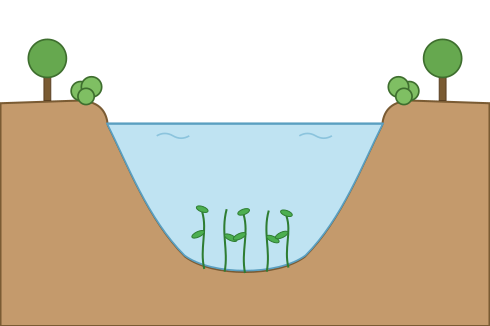
›Reveal solutionSolution
[!TLDR] The plants are rooted in the mud at the bottom of the pond and stay fully submerged, which is the submerged plant stage of pond (hydrosere) succession.
In a hydrosere, succession proceeds: phytoplankton stage -> submerged plant stage -> floating plant stage -> reed-swamp stage -> sedge-meadow -> woodland -> climax forest. The diagram shows small plants anchored (rooted) in the soil at the bottom of the pond, growing under water. Rooted, wholly submerged plants (e.g. Hydrilla, Vallisneria, Potamogeton) define the submerged plant stage. They are rooted, so this is not the free-floating plant stage (D), and reed-swamp (C) plants are emergent …
- GUJCET 2022Set 171 markMCQQ.What is the unit of measurement of thickness of ozone layer? (A) DU (B) DB (C) DO (D) DN
›Reveal solutionSolution
Ozone-column thickness is measured in Dobson Units (DU).
Concept. The amount of ozone in a vertical column of the atmosphere is expressed by the Dobson Unit. One DU corresponds to a 0.01 mm thick layer of pure ozone …
- GUJCET 2021Set 151 markMCQQ.Choose the correct statement for 'Allen's Rule'. (A) Mammals from colder climates generally have longer ears and shorter limbs to minimise heat loss (B) Mammals from colder climates generally have longer ears and longer limbs to minimise heat loss (C) Mammals from colder climates generally have shorter ears and shorter limbs to minimise heat loss (D) Mammals from colder climates generally have shorter ears and longer limbs to minimise heat loss
›Reveal solutionSolution
Allen's Rule: cold-climate mammals reduce surface area (shorter extremities) to limit heat loss.
Concept. Mammals from colder regions tend to have shorter ears and shorter limbs to minimise heat loss. …
- GUJCET 2021Set 151 markMCQQ.Amazon rain forest is being cut and cleared for cultivating which plant? (A) barley (B) maize (C) sugarcane (D) soya beans
›Reveal solutionSolution
Soyabean cultivation is a major driver of Amazon deforestation.
Concept. As noted in NCERT, the Amazon rainforest is being cleared for growing soya beans. …
🎓Unlock everything free for 14 days
- ✓Full step-by-step solutions
- ✓Concept-first explanations
- ✓Methods, shortcuts & mistakes
- ✓PYQ mapping + timed mock tests
Full access for 14 days. No credit card required.