Q.Describe the experiment carried out by Hershey and Chase. Write the conclusion they arrived at.
🔒You're viewing a preview — the full solution, concept, methods & PYQ mapping are locked.
🔒 Start your 14-day free trial to unlock the full solution →Part (a)Concept understanding — Nucleic Acid Functions
Nucleic Acid Functions – A First Look
Think of a living organism as a giant, incredibly complex factory. Every second, this factory needs to produce thousands of different products—proteins, enzymes, hormones, structural materials—in exactly the right amounts, at exactly the right places, and at exactly the right times. How does the factory know what to build and when? It needs a master blueprint and a set of working copies that can be carried to the assembly lines.
That master blueprint is DNA (deoxyribonucleic acid). The working copies are RNA (ribonucleic acid). Together, they are the nucleic acids, and their job is to store, transmit, and execute the genetic information that makes every living thing what it is.
The Two Main Functions
1. DNA – The Permanent Blueprint (Storage and Inheritance)
DNA is the long-term, stable repository of genetic information. It is like the original architectural plan for the entire factory, locked in a secure vault. Its functions are:
- Storing genetic information: DNA contains the instructions for building every protein the organism will ever need. These instructions are written in a chemical language using four "letters" (nucleotides: A, T, G, C). The sequence of these letters is the code.
- Replication (making copies): Before a cell divides, DNA makes an exact copy of itself. This ensures that each daughter cell receives a complete set of instructions. This is why children inherit traits from their parents—the DNA blueprint is passed down.
- Transmission to offspring: DNA is the molecule of heredity. It is passed from parents to offspring, carrying the genetic information that determines everything from eye colour to susceptibility to certain diseases.
DNA never leaves the nucleus of a cell. It is too precious and too large to move around. It stays safely inside, like a reference book that cannot be taken out of the library.
2. RNA – The Working Copy (Execution of the Blueprint)
RNA is the temporary, mobile copy of specific parts of the DNA blueprint. It is like a photocopy of a single page from the master plan, which a worker can carry to the factory floor. Its functions are:
- Transcription (copying the message): A specific segment of DNA (a gene) is used as a template to make a complementary RNA molecule. This RNA copy is called messenger RNA (mRNA).
- Translation (reading the message to build a protein): The mRNA travels out of the nucleus to the ribosomes (the protein-building machines). Here, another type of RNA called transfer RNA (tRNA) reads the mRNA code and brings the correct amino acids, one by one, to build a protein chain.
- Catalysis (as a biological catalyst): Some RNA molecules, called ribozymes, can act as enzymes and speed up chemical reactions. This is a less well-known but crucial function, especially in the ribosome itself (which is partly made of RNA).
Why This Matters for You
Even if you never touch a test tube, understanding nucleic acid functions helps you grasp:
- Why children resemble their parents: DNA is the hereditary material.
- How vaccines work: Many vaccines use mRNA to instruct your cells to produce a harmless piece of a virus, training your immune system.
- How genetic disorders arise: A mistake in the DNA sequence (a mutation) can lead to a faulty protein, causing diseases like sickle cell anaemia or cystic fibrosis. …
Part (b)Concept understanding — Darwinian Natural Selection
Imagine you walk into a crowded room. Some people are naturally louder, some are quieter. Some are taller, some shorter. Now imagine that, for some reason, the room is suddenly plunged into darkness, and everyone has to find the exit by touch alone. Who do you think will get out first? Probably not the loudest talker, but the person who happens to have the most sensitive fingertips or the best memory of where the door was.
That simple scenario captures the core of Darwinian natural selection. It is not about being "better" in some moral or absolute sense. It is about being a better fit for the specific situation you are in.
The Everyday Intuition: "Survival of the Fittest" — But What Does "Fittest" Mean?
The phrase "survival of the fittest" is often misunderstood. It does not mean the strongest, fastest, or most aggressive individual wins. In biology, "fitness" has a very specific meaning: the ability to survive long enough to reproduce and leave offspring.
Think of it this way: in a game of musical chairs, the "fittest" player isn't the one who dances the best. It's the one who, when the music stops, is standing on a chair. The chair is the environment. The player's ability to grab that chair is their fitness.
Darwin never used the phrase "survival of the fittest" in his first edition of On the Origin of Species. It was coined by Herbert Spencer, a philosopher, and Darwin adopted it in later editions. Darwin's own term was "natural selection," which is a more accurate description of the process.
The Precise Meaning: How Natural Selection Works
Natural selection is not a conscious force. It is a blind, automatic process that follows from three simple facts that are always true in any population of living things:
-
Variation: Individuals in a population are not identical. Even within a species, there is a range of traits — different beak sizes in birds, different fur colours in rabbits, different heights in humans. This variation is the raw material.
-
Inheritance: Many of these variations are passed from parents to offspring. A tall parent is more likely to have tall children. A fast-running cheetah is more likely to have fast-running cubs.
-
Differential Survival and Reproduction: More individuals are born than can possibly survive. Resources (food, water, shelter, mates) are limited. This creates a "struggle for existence." Individuals with traits that give them even a slight advantage in this struggle are more likely to survive and, crucially, to reproduce.
The result: Over many generations, the traits that helped those individuals survive and reproduce become more common in the population. The traits that were less helpful become rarer. The population gradually changes to become better suited to its environment.
Natural selection does not create new traits. It only acts on the variation that already exists. It is like a sieve, not a sculptor. The sieve lets through the grains of sand that are the right size for the hole, and holds back the rest. The environment is the sieve.
Why It Matters: The Engine of Adaptation
Natural selection is the mechanism that explains how life becomes adapted to its surroundings. It is why:
- A cactus has spines instead of leaves (to reduce water loss in a desert).
- A polar bear has white fur (to blend in with snow and ice).
- A human has an opposable thumb (to grip tools).
It is not a plan or a goal. It is a consequence of simple, observable facts playing out over vast stretches of time. The NCERT textbook for Class 12 Biology (Chapter 6, "Evolution") states this clearly: "Natural selection is a process in which heritable variations enabling better survival are enabled to reproduce and leave greater number of progeny."
A Few Key Points to Remember
- It acts on individuals, but it changes populations. An individual does not evolve. The population as a whole changes over generations. …
Part (a)
Hershey and Chase infected E. coli with bacteriophages whose DNA was labelled with 32P and whose protein coat was labelled with 35S. After blending and centrifuging, the radioactive 32P (DNA) was found inside the bacteria while the 35S (protein) stayed outside. …
Part (a): Hershey and Chase labelled phage DNA with 32P and protein with 35S; only DNA entered the bacterium, proving DNA is the genetic material.
Part (b): Peppered-moth colour change (industrial melanism) and resistance to herbicides/pesticides/antibiotics are both natural selection — a favourable variant increases under selective pressure.
Part (a)
Hershey and Chase (1952) used bacteriophages to settle whether DNA or protein carries heredity. DNA has phosphorus but no sulphur; protein has sulphur but no phosphorus.
- Phages grown on 32P had radioactive DNA.
- Phages grown on 35S had radioactive protein coats.
The labelled phages were allowed to attach to and infect E. coli. The mixture was agitated in a blender to detach the phage coats and then centrifuged. The heavier bacterial cells settled as a pellet.
Result: the 32P (DNA) was recovered with the bacterial pellet — it had entered the cells — while the 35S (protein) remained in the supernatant, outside the cells. …
- GSEB Higher Secondary Certificate (HSC) Examination 2025Set ANNUAL1 markMCQQ.What does the diagram below, depicting the process of natural selection, indicate?(a) Stabilizing selection(b) Directional selection(c) Disruptive selection(d) Both stabilizing and disruptive selection
›Reveal solutionSolution
A shift of the population's phenotype distribution toward one extreme (rather than a narrowing or splitting of the curve) is the signature of directional natural selection.
Natural selection can act on a population's phenotype distribution in three characteristic ways: stabilising selection favours the average/intermediate phenotype and eliminates both extremes, narrowing the curve without shifting its peak; disruptive selection favours both extreme phenotypes over the intermediate one, splitting the curve into two peaks; directional selection favours one extreme phenotype over the mean, shifting the entire curve's peak tow …
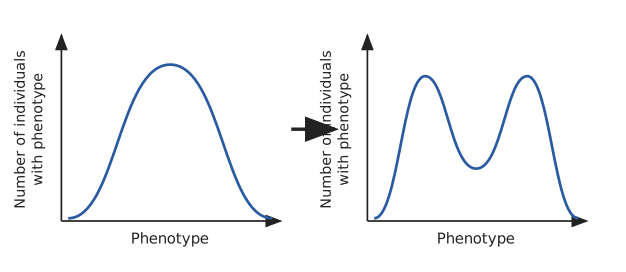
- GUJCET 2023Set 071 markMCQQ.The diagram given below represent the operation of natural selection on different trails. Choose the correct option. [FIGURE] (A) Disruptive (B) Directional (C) Stabilising (D) Stabilising & Directional Both
›Reveal solutionSolution
A single distribution splitting into two extreme peaks (intermediate selected against) is disruptive selection.
When both extreme phenotypes are favoured and the intermediate (medium-sized) individuals are selected against, the distribution develops two peaks - the signature of disruptive (diversifying) selection. (Stabilising selection narrows the single central peak; directional selection shifts the peak to one …
- GSEB Higher Secondary Certificate (HSC) Examination 2023Set ANNUAL1 markMCQQ.Among the statements given below which statement is correct on the basis of observation of Ernst Heckel?(a) Embryos never pass through the adult stages of other animals(b) During embryonic stage common to all vertebrates that are absent in adult(c) Similarities in proteins and genes performing a given function among diverse organisms(d) Homologous structures are a result of convergent evolution
›Reveal solutionSolution
Haeckel's biogenetic law (embryological evidence) noted that embryos of different vertebrates resemble each other, showing common features that disappear/modify in the adult.
Embryological evidence for evolution: von Baer and Haeckel observed that the early embryos of different vertebrates look very similar and pass through comparable stages (e.g. all show pharyngeal/gill-like structures and a tail). These embryonic similarities, present in …
- GSEB Higher Secondary Certificate (HSC) Examination 2023Set ANNUAL1 markMCQQ.In a population of 1000 individuals 490 belong to genotype MM, 420 to Mm and remaining to mm. Based on this data, the frequency of allele m in the population is ________(a) 0.6(b) 4.9(c) 4.2(d) 0.3
›Reveal solutionSolution
Counting m alleles: each mm has 2 and each Mm has 1, so q(m) = (180 + 420)/2000 = 600/2000 = 0.3.
Given 1000 individuals: MM = 490, Mm = 420, mm = 90.
Total alleles = 2 x 1000 = 2000. …
- GSEB Higher Secondary Certificate (HSC) Examination 2020Set ANNUAL1 markMCQQ.Diagrammatic representation of the operation of natural selection two peaks are formed. This condition shows ________ effect of(a) Directional(b) Stabilising(c) Disruptive(d) Distructive
›Reveal solutionSolution
When natural selection acts to favour the individuals at both extremes of a phenotypic distribution over the intermediate (average) individuals, the population splits into two peaks — this is called disruptive selection.
Natural selection can operate in three ways on a normally distributed trait:
- Directional selection favours one extreme, shifting the mean of the distribution towards it (a single shifted peak).
- Stabilising selection favours the more common intermediate phenotype over the extremes, narrowing the peak around the mean. …
- GSEB Higher Secondary Certificate (HSC) Examination 2018Set ANNUAL1 markMCQQ.By using Hardy-Weinberg law, calculate the proportions of offspring and genotypes of hamster population containing 90% M genes and 10% m gene.(a) 81% MM : 18% Mm : 1% mm(b) 64% MM : 16% Mm : 0.04% mm(c) 49% MM : 27% Mm : 0.09% mm(d) 81% MM : 9% Mm : 10% mm
›Reveal solutionSolution
With p = 0.9 and q = 0.1, genotype frequencies are p^2 : 2pq : q^2 = 0.81 : 0.18 : 0.01 = 81 percent : 18 percent : 1 percent.
Hardy-Weinberg: (p + q)^2 = p^2 + 2pq + q^2 = 1, where p = frequency of M and q = frequency of m.
- p = 0.9, q = 0.1.
- MM = p^2 = 0.9 x 0.9 = 0.81 = 81 percent. …
- GSEB Higher Secondary Certificate (HSC) Examination 2018Set ANNUAL1 markMCQQ.Arrange the main stages in the origin of Life in Chronological order. Choose the correction option.(a) C, H, N, O -> Micromolecules -> Precells -> Coacervates(b) C, H, N, O -> H2O, H2, NH3, CH4 -> Macromolecules -> Coacervates(c) H2O, H2, NH3, CH4 -> Macromolecules -> Micromolecules -> Coacervates(d) C, H, N, O -> Macromolecules -> Cells -> Precells
›Reveal solutionSolution
Life arose stepwise: free elements combined into simple molecules, then into macromolecules, which aggregated into coacervates (protocells).
Oparin-Haldane chemical evolution:
- Free elements C, H, N, O were present.
- They combined into simple inorganic molecules such as H2O, H2, NH3, CH4 (primitive atmosphere).
- Energy (UV, lightning, heat) drove formation of small organic molecules and then macromolecules (proteins, nucleic acids). …
🎓Unlock everything free for 14 days
- ✓Full step-by-step solutions
- ✓Concept-first explanations
- ✓Methods, shortcuts & mistakes
- ✓PYQ mapping + timed mock tests
Full access for 14 days. No credit card required.