Q.How long do you think the pollen grains retain viability?
🔒You're viewing a preview — the full solution, concept, methods & PYQ mapping are locked.
🔒 Start your 14-day free trial to unlock the full solution →Concept understanding — Male And Female Gametophyte
Let’s start with something you already know. Think of a plant like a mango tree. It produces flowers, and those flowers eventually turn into mangoes. How does that happen? The flower is the plant’s reproductive organ, and inside it, two tiny but crucial structures are made: the male gametophyte and the female gametophyte. These are not the “male” and “female” parts of the flower themselves (like the stamen and pistil) — they are the microscopic, single-generation cells that actually carry the genetic material to form the next plant.
The everyday intuition
Imagine you are baking a cake. The male gametophyte is like the packet of dry yeast — it’s small, mobile, and needs to be added to the mixture. The female gametophyte is like the bowl of flour, eggs, and sugar — it’s larger, stationary, and provides the environment where the yeast works. Without the yeast reaching the bowl, no cake rises. Without the bowl, the yeast has nothing to act on. In a flower, the male gametophyte (pollen grain) must travel to the female gametophyte (embryo sac) for fertilisation to happen.
The precise meaning
In NCERT biology, the male gametophyte is the pollen grain. It develops inside the anther (the top part of the stamen). A mature pollen grain contains two cells: a tube cell and a generative cell. The tube cell will grow a long tube down the style of the pistil, and the generative cell will divide to form two sperm cells. So the male gametophyte is not the whole stamen — it’s the tiny, single-celled (or two-celled) structure that carries the male genetic material.
The female gametophyte is the embryo sac. It develops inside the ovule, which is located in the ovary of the pistil. The embryo sac is a seven-celled, eight-nucleate structure (though you don’t need to memorise numbers for a prose subject — just know it’s a small, organised sac). It contains the egg cell (the female gamete) and other cells that help in fertilisation and nourishment. The female gametophyte is not the whole pistil — it’s the microscopic sac inside the ovule.
The male gametophyte (pollen grain) is haploid — it has only one set of chromosomes. The female gametophyte (embryo sac) is also haploid. When they fuse during fertilisation, they form a diploid zygote, which grows into the seed. This is why both are called “gametophytes” — they produce gametes (sperm and egg).
Why it matters …
It varies hugely by species and depends on temperature and humidity — from as little as 30 minutes in some cereals (rice, wheat) to months in some members of Rosaceae, Leguminoseae, and Solanaceae. Stored in liquid nitrogen at -196°C, pollen of many species can be kept viable for years, in pollen banks. …
Pollen viability is highly species-dependent and condition-dependent — anywhere from 30 minutes to months naturally, or years if deliberately stored in liquid nitrogen.
§1.2.1 gives the concrete range this question is asking you to estimate:
- As short as 30 minutes — in some cereals like rice and wheat, pollen loses viability within half an hour of release. This is a real constraint on their pollination window.
- Up to months — in some members of the families Rosaceae, Leguminoseae, and Solanaceae, pollen stays viable far longer.
- Years, artificially — pollen of many species can be stored in liquid nitrogen at -196°C, functioning as a pollen bank (the pollen equivalent of a seed bank), useful in crop breeding programmes. …
Showing the 12 most recent of 20 on this concept.
- GUJCET 2026Set 051 markMCQQ.Choose the correct option for column - I, II and III. Column-I:(i) Monoecious,(ii) Dioecious. Column-II: (p) Prevent both autogamy and geitonogamy, (q) Prevent autogamy but not geitonogamy. Column-III:(x) Caster, Maize, (y) Papaya, Date palm. (A) I-i, II-q, III-y (B) I-ii, II-p, III-x (C) I-ii, II-q, III-y (D) I-i, II-q, III-x
›Reveal solutionSolution
Monoecious = Castor/Maize; it prevents autogamy but not geitonogamy.
A monoecious plant bears unisexual male and female flowers on the same plant (e.g. Castor, Maize). Separating the sexes prevents self-pollination within a flower (autogamy) but pollen can still move between flowers of the same plant, so **geitonogamy is not …
- GUJCET 2026Set 051 markMCQQ.Assertion (A): Geitonogamy is genetically similar to autogamy. Reason (R): In geitonogamy pollen grains come from the same plant. (A) A and R both are correct, 'R' is the correct explanation of A (B) A and R both are correct, 'R' is not correct explanation of A (C) A is correct but 'R' is wrong (D) A is wrong but R is correct
›Reveal solutionSolution
Geitonogamy uses pollen from the same plant, so it is genetically equivalent to autogamy — R explains A.
Geitonogamy is pollination between two flowers of the same plant. Because the pollen comes from the same individual, it is genetically identical to self-pollination (autogamy), though functionally it needs a pollinator. So both statements are …
- GSEB Higher Secondary Certificate (HSC) Examination 2026Set ANNUAL1 markMCQQ.At the Micropyler end, Egg apparatus is constitute by the fusion of which cells?(a) 2 Male gamates and one egg cell(b) One Male gamate and 2 egg cells(c) 2 synergid cells and one egg cell(d) 2 synergid cells and one Male gamate
›Reveal solutionSolution
The egg apparatus, positioned at the micropylar pole of the mature embryo sac, consists of three haploid cells: two synergids and one egg cell.
The mature (7-celled, 8-nucleate) embryo sac has three distinct cell groups: (1) the egg apparatus at the micropylar end, (2) three antipodal cells at the chalazal end, and (3) one large central cell with two polar nuclei. The egg apparatus itself is made of one egg cell and two synergids. The synergids show a special thickened structure ca …
- GSEB Higher Secondary Certificate (HSC) Examination 2026Set ANNUAL1 markMCQQ.Assertion (A): The microsporangia develop further and become pollen sacs. Reason (R): Innermost layer of the microsporangium is tapetum(a) A is correct, R is wrong(b) A and R both are correct, R is not correct explanation of A(c) A and R both are correct, R is correct explanation of A(d) A is wrong, R is correct
›Reveal solutionSolution
Both the assertion and the reason are factually correct statements, but the reason (about the tapetum's location) does not causally explain the assertion (about microsporangia becoming pollen sacs).
Assertion: The microsporangia indeed develop further and become pollen sacs, which contain pollen grains at maturity - this is correct. Reason: The wall of the microsporangium has four layers, and the innermost of these is indeed the tapetum, which nourishes the developing pollen grains - this too is correct as a standalone fact. However, the reason describes the identity …
- GUJCET 2024Set 101 markMCQQ.In Cleistogamous Flowers - (A) Anthers are exposed (B) Anthers and stigma are closed (C) Stigma is exposed (D) Flowers are exposed
›Reveal solutionSolution
Cleistogamous flowers stay closed, so anthers and stigma remain enclosed → invariable autogamy.
Cleistogamous flowers never open. As the anthers and stigma lie close together within the closed flower, pollen is released directly onto the stigma, guaranteeing self- …
- GSEB Higher Secondary Certificate (HSC) Examination 2024Set ANNUAL1 markMCQQ.Which of the following layer of micro-sporangium provides nutrition to developing pollen grains?(a) Epidermis(b) Middle layer(c) Endothelium(d) Tapetum
›Reveal solutionSolution
Of the four wall layers of a microsporangium (epidermis, endothecium, middle layers, tapetum), the innermost tapetum provides nutrition to the developing pollen grains and is consumed as they mature.
A young anther's microsporangium wall, from outside to inside, consists of the epidermis (protective outer layer), the endothecium (helps in anther dehiscence), one or more middle layers (transient, get crushed as the anther matures), and the innermost tapetum, which is rich in nutrients, RNA and proteins that it supplies to the developing microspore …
- GSEB Higher Secondary Certificate (HSC) Examination 2024Set ANNUAL1 markMCQQ.In given figure, megasporogenesis is shown in angiosperms - What are ploidy in given 'X' and 'Y' respectively?(a) n, 2n(b) 2n, n(c) 3n, n(d) n, n
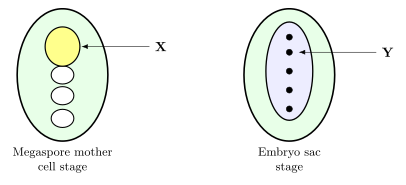
›Reveal solutionSolution
Megasporogenesis begins with a diploid megaspore mother cell (X) inside the nucellus, which undergoes meiosis; the resulting haploid functional megaspore (Y) then divides mitotically to form the embryo sac.
In the left diagram, X marks the large cell within the nucellus at the early stage — this is the megaspore mother cell, a diploid (2n) cell that has not yet undergone meiosis. It undergoes meiotic division to produce four haploid megaspores, of which usually only one survives as the functional megaspore. In the right diagram, showing the later, more deve …
- GUJCET 2023Set 071 markMCQQ.Match the following. Choose the correct option. Column-I:(i) Homothallic,(ii) Heterothallic. Column-II: (P) Monoecious, (Q) Dioecious. Column-III: (X) Coconut & Chara, (Y) Papaya & Merchantia. (A) (I - ii), (II - Q), (III - X) (B) (I - i), (II - P), (III - X) (C) (I - i), (II - P), (III - Y) (D) (I - i), (II - Q), (III - Y)
›Reveal solutionSolution
Homothallic = monoecious (bisexual); Chara and coconut are monoecious/homothallic examples.
Concept: Homothallic and monoecious both describe the bisexual condition; heterothallic and dioecious describe the unisexual condition.
- (i) Homothallic ↔ (P) Monoecious ↔ (X) Coconut & Chara (both bisexual/monoecious). …
- GSEB Higher Secondary Certificate (HSC) Examination 2023Set ANNUAL1 markMCQQ.Choose the correct option for given statements.(i) In western countries a large number of pollen product in form of syrup are available in the market.(ii) In rice, pollen grain loss viability after 30 months of their release.(iii) Pollen grain are stored at room temperature for sowing in next season by farmers.(iv) After bursting seeds of wheat and rice, pollen grains get scattered by wind at far of places.(a) (i),(iii) and(iv) true(b)(i) and(ii) true(c) (i),(ii) and(iv) true(d)(i) true
›Reveal solutionSolution
Statement (i) is correct; (ii), (iii) and (iv) are wrong, so option (d).
Examine each:
- (i) Pollen tablets/syrups are sold as food supplements in western countries - TRUE.
- (ii) In rice, pollen loses viability within about 30 MINUTES of release (not 30 months) - FALSE. …
- GSEB Higher Secondary Certificate (HSC) Examination 2023Set ANNUAL1 markMCQQ.Choose the correct option for showing right arrangement of different wall layers from sporogenous tissue to perepheral are in T.S of young anther.(a) Tapetum, Middle layer, Endothecium, Epidermis(b) Tapetum, Endothecium, Middle layer, Epidermis(c) Epidermis, Endothecium, Middle layer, Tapetum(d) Epidermis, Middle layer, Endothecium, Tapetum
›Reveal solutionSolution
Going from the sporogenous tissue (innermost) toward the periphery: tapetum -> middle layers -> endothecium -> epidermis.
A young anther (microsporangium) wall has four layers. From outside inward they are: epidermis, endothecium, middle layers, tapetum (innermost, surrounding the sporogenous tissue). The tapetum nourishes the developing pollen.
…
- GSEB Higher Secondary Certificate (HSC) Examination 2023Set ANNUAL1 markMCQQ.Which of the following option is not correct for pollen grain?(a) When pollen grain is mature it contains two cells, the vegetative cell and male gamete(b) Pollen grain is measuring about 25-50 micrometers in diameter(c) Pollen grain exine has prominent apertures called germ pore(d) Exine is made up of sporopollenin
›Reveal solutionSolution
At shedding, most pollen is 2-celled: a vegetative cell and a generative cell (not a ready 'male gamete'), so statement (a) is wrong.
Check the statements about pollen grains:
- (a) 'Mature pollen contains vegetative cell and male gamete' - INCORRECT. At maturity/shedding, pollen has a vegetative cell and a GENERATIVE cell; the generative cell later divides to form the TWO male gametes (often only after the pollen tube grows).
- (b) Pollen is about 25-50 micrometres in diameter - correct. …
- GUJCET 2022Set 171 markMCQQ.In water hyacinth and water lily, the pollination is carried out by which agent? (A) Water (B) Only wind (C) Only insects (D) Insects or wind
›Reveal solutionSolution
Both are emergent aquatics pollinated by insects or wind, not water.
Concept. Although they grow in water, water hyacinth and water lily raise their flowers above the surface, so pollination is by insects or wind (not hydrophily …
🎓Unlock everything free for 14 days
- ✓Full step-by-step solutions
- ✓Concept-first explanations
- ✓Methods, shortcuts & mistakes
- ✓PYQ mapping + timed mock tests
Full access for 14 days. No credit card required.