Electrophilic Aromatic Substitution – The First Meeting
Imagine you have a benzene ring — that perfect, flat hexagon of six carbons with alternating double bonds. It's stable, almost stubbornly so. You want to attach something new to it, say a bromine atom or a nitro group. But benzene doesn't react like an alkene. It doesn't just add across a double bond. Instead, it does something more elegant: it kicks out a hydrogen and keeps its aromatic ring intact.
That's the heart of Electrophilic Aromatic Substitution (EAS).
The Intuition: Why "Substitution" and Not "Addition"?
Benzene's stability comes from its delocalised π electrons — a cloud above and below the ring. This cloud is electron-rich, so it attracts electrophiles (electron-loving species). But if an electrophile simply added to a double bond, the ring would break its aromaticity, losing that huge stabilisation. That would be energetically costly.
So benzene does something smarter: it lets the electrophile attack, temporarily breaks aromaticity to form a high-energy intermediate (the arenium ion), and then loses a proton to restore the aromatic ring. The net result? A hydrogen is replaced by the electrophile. The ring is back to its stable, aromatic self.
Note
The key trade-off: temporary loss of aromaticity is acceptable because the final product regains it. Addition reactions would permanently destroy aromaticity — benzene avoids that.
The Precise Statement
Electrophilic Aromatic Substitution is a reaction in which an electrophile (E+) replaces a hydrogen atom on an aromatic ring, proceeding through a sigma complex (arenium ion) intermediate, and restoring aromaticity after deprotonation.
The general equation:
Ar−H+EX+Ar−E+HX+
where Ar represents an aromatic ring.
The Mechanism in Three Steps
Generation of the electrophile – Many EAS reactions need a catalyst to create a strong enough E+. For example, bromination uses FeBrX3 to polarise BrX2 into BrX+.
Attack by the aromatic ring – The π electrons of benzene attack the electrophile, forming a sigma complex (also called the arenium ion or Wheland intermediate). This intermediate is non-aromatic — it has four π electrons delocalised over five carbons, and one sp3 carbon bearing the electrophile and a hydrogen.
Benzene+E+⟶Sigma complex (non-aromatic)
Deprotonation – A base (often the counterion of the catalyst, like FeBrX4X−) removes the proton from the sp3 carbon. The pair of electrons from the C–H bond flows back into the ring, restoring the aromatic sextet.
Sigma complex+Base⟶Product+HX+
Watch out
The sigma complex is not aromatic. It's a high-energy intermediate. Students often mistakenly think it's still aromatic — it isn't. That's why the step is fast and the complex is short-lived.
Why This Matters for Exams
EAS is the gateway to understanding how to put groups onto benzene rings. The rate-determining step is usually the formation of the sigma complex (step 2). The regiochemistry (where the electrophile goes) depends on whether the ring already has a substituent — that's the topic of activating/deactivating groups and ortho/para vs. meta directors. …
Why this formula?
Electrophilic Addition Reactions: Why the Mechanism Works
Electrophilic addition is a cornerstone of alkene and alkyne chemistry. Instead of memorising the "arrow pushing," let's understand why the reaction proceeds the way it does — driven by electron density, stability, and charge.
1. The Core Idea: Why Alkenes React This Way
Alkenes have a π-bond — a cloud of electrons above and below the plane of the σ-bond. This π-electron cloud is:
Electron-rich (nucleophilic)
Exposed (not shielded by σ-bonds like in alkanes)
An electrophile (electron-lover) is attracted to this high electron density. The reaction is electrophilic addition because the electrophile attacks first.
Key principle: The π-bond acts as a Lewis base (electron donor). The electrophile is a Lewis acid (electron acceptor).
2. The General Mechanism (Two-Step)
Step 1: Formation of a Carbocation (or Bridged Intermediate)
The electrophile (E⁺) attacks the π-bond. The π-electrons form a new σ-bond to E⁺, leaving the other carbon with a positive charge — a carbocation.
C=C+EX+⟶CX+−C−E
Why does this happen?
The π-bond is weaker than a σ-bond (~260 kJ/mol vs ~350 kJ/mol). Breaking the π-bond to form a σ-bond is energetically favourable because the new σ-bond is stronger. The carbocation is a high-energy intermediate, but it's stabilised by:
Hyperconjugation (alkyl groups donate electron density)
Inductive effect (alkyl groups push electrons toward the positive carbon)
Step 2: Nucleophilic Attack
A nucleophile (Nu⁻) attacks the carbocation, forming a second σ-bond.
CX+−C−E+NuX−⟶C−Nu−C−E
Why does this happen?
The carbocation is electron-deficient (positive charge). The nucleophile is electron-rich. Opposite charges attract — this is electrostatic and orbital overlap driven.
3. The Key "Formula" — Markovnikov's Rule
Statement: In the addition of HX to an unsymmetrical alkene, the hydrogen attaches to the carbon with more hydrogens already, and the X attaches to the carbon with fewer hydrogens.
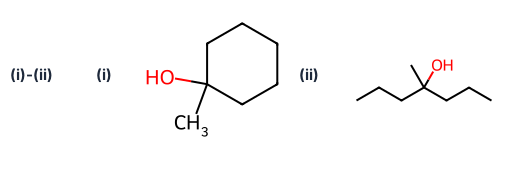
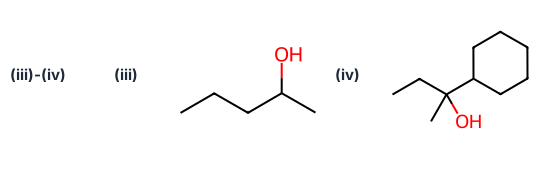
Each target is the Markovnikov alcohol of an alkene, so make it by acid-catalysed hydration (H2O, dilute H2SO4). Hydroboration-oxidation would give the anti-Markovnikov isomer and is not suitable here. …
Acid-catalysed hydration adds water across a C=C double bond so that -OH goes to the more substituted carbon (Markovnikov's rule). Choosing the alkene whose double bond sits at the carbon that must bear the -OH gives each alcohol directly.
Concept
In acid hydration the alkene is protonated to give the more stable carbocation; water then attacks that carbon, so -OH lands on the more substituted carbon. Three of these targets are tertiary alcohols and one is secondary - exactly the Markovnikov products - so acid hydration is the right method (hydroboration-oxidation would place -OH on the less substituted carbon).
Step-by-step
1-Methylcyclohex-1-ene: protonation gives the tertiary carbocation at the methyl-bearing ring carbon; water adds there, giving 1-methylcyclohexan-1-ol.
4-Methylhept-3-ene, CH3CH2CH2-C(CH3)=CH-CH2CH3: the more substituted carbon is the methyl-bearing C-4; Markovnikov addition of water puts -OH there, giving 4-methylheptan-4-ol.
Pent-1-ene, CH2=CH-CH2CH2CH3: protonation gives the secondary cation at C-2; water adds to C-2, giving pentan-2-ol. …
Method: Retrosynthetic Markovnikov-Hydration Method for Alcohols from Alkenes
Core Concept
Any tertiary or secondary alcohol whose -OH sits on the MORE substituted carbon of what would be a C-C double bond can be made by acid-catalysed (Markovnikov) hydration of the corresponding alkene: protonation of the alkene gives the more stable carbocation, and water then adds to that same carbon.
Steps
Locate the carbinol carbon (the one bearing -OH) in the target alcohol and identify the two carbons flanking it in the original chain/ring.
Mentally remove H2O from across the carbinol carbon and an adjacent carbon to "regenerate" the alkene double bond at that position — this is the alkene precursor.
Check that the carbinol carbon is the MORE substituted of the two alkene carbons (this confirms Markovnikov addition will correctly place -OH there; if it were the less-substituted carbon, hydroboration-oxidation — not acid hydration — would be needed instead).
Write the synthesis as: alkene + H2O, dilute H2SO4 (or H3PO4) --> Markovnikov alcohol, mentioning that H+ generates the more stable carbocation which water then attacks.
Repeat for each target alcohol.
Applying this: (i) 1-methylcyclohexan-1-ol comes from 1-methylcyclohex-1-ene (the tertiary ring carbon is the more-substituted alkene carbon).
(ii) 4-methylheptan-4-ol comes from 4-methylhept-3-ene (protonation gives the tertiary cation at C-4). …
Same / Similar Concept — real previous-year questions on the same or a closely similar concept, not this exact question.
GUJCET 2025Set 031 markMCQ
Q.C6H6+Xanhydrous AlCl3Isopropylbenzene(i)O2(ii)H+Y+Z. In this reaction X, Y and Z are ______ respectively.
(A) CH3CH2Cl,C6H5OH,CH3COCH3
(B) CH3CH2Cl,C6H4(OH)2,CH3CHO
(C) CH3CH2CH2Cl,C6H5OH,CH3COCH3
(D) CH3−ClCH−CH3,C6H5CHO,CH3COCH3
›Reveal solutionSolution
The products Y,Z are fixed as phenol and acetone (cumene process); the reagent X must give cumene under anhydrous AlCl3.
Cumene (i)O2,(ii)H+ phenol (C6H5OH) + acetone (CH3COCH3), so Y=C6H5OH, Z=CH3COCH3 — eliminating (B) and (D). In Friedel–Crafts alkylation, CH3CH2CH2Cl (n-propyl chloride) rearranges via a 1∘→2∘ carbocation shift to the isopropyl grou …