Q.Write all the geometrical isomers of [Pt(NH3)(Br)(Cl)(py)] and how many of these will exhibit optical isomers?
🔒You're viewing a preview — the full solution, concept, methods & PYQ mapping are locked.
🔒 Start your 14-day free trial to unlock the full solution →Concept understanding — Geometrical Isomerism Conditions
Geometrical Isomerism: The Intuition
Imagine you have two friends standing on opposite sides of a door. If the door is open, they can walk around and swap places easily — there's no real difference between who is on the left and who is on the right. But if the door is locked shut, they are stuck. One is permanently on the left side, the other on the right. That locked door creates two distinct arrangements: Friend A on the left, Friend B on the right versus Friend A on the right, Friend B on the left.
That locked door is the key idea behind geometrical isomerism.
In chemistry, molecules are three-dimensional. Atoms connected by a single bond can rotate freely — like an open door. But a double bond (or a ring structure) locks the atoms in place. If you have two different groups attached to each carbon of a double bond, you get two distinct spatial arrangements that cannot interconvert without breaking the bond. These are geometrical isomers (also called cis-trans or E-Z isomers).
The Precise Conditions
For a molecule to show geometrical isomerism, it must satisfy two conditions simultaneously:
Condition 1: There must be a restricted rotation around a bond — typically a carbon-carbon double bond (C=C) or a ring structure.
Condition 2: Each of the two atoms (or groups) involved in that restricted rotation must have two different substituents attached to it.
Let's unpack each.
Condition 1: Restricted Rotation
A single bond (C−C) allows free rotation — the atoms spin around the bond axis like a wheel. So no geometrical isomers exist there. A double bond (C=C) has a pi (π) bond that locks the molecule flat. Rotation would break the π bond, which requires a lot of energy (about 250–270 kJ/mol). At room temperature, this rotation simply does not happen.
Rings (like cyclopropane, cyclobutane, etc.) also restrict rotation because the ring is a closed loop — atoms cannot rotate past each other without breaking the ring.
Condition 2: Two Different Substituents on Each End
This is the "different groups" rule. Look at each carbon of the double bond (or each ring carbon involved). If both carbons have two different groups attached, geometrical isomers exist. If even one carbon has two identical groups, there is only one possible arrangement.
A common mistake: students check only one carbon. Both carbons must have two different substituents. If one carbon has two identical groups (like two hydrogens), the molecule is identical in both arrangements — no isomerism.
How to Check: A Step-by-Step Method
Take any molecule with a double bond. Follow these steps:
- Identify the double bond (or ring). Mark the two carbon atoms involved.
- List the two groups attached to the first carbon. Are they different from each other? If yes, proceed. If no → no geometrical isomerism.
- List the two groups attached to the second carbon. Are they different from each other? If yes → geometrical isomerism exists. If no → no geometrical isomerism.
If the two groups on a carbon are identical, the molecule is symmetric about that carbon. Flipping the other side gives the same molecule — no isomers.
Examples to Cement the Idea
Example 1: But-2-ene (CH3CH=CHCH3)
- Carbon 1 of the double bond: attached to CH3 and H → different ✓
- Carbon 2 of the double bond: attached to CH3 and H → different ✓
Result: Two geometrical isomers exist — cis (both methyl groups on the same side) and trans (methyl groups on opposite sides).
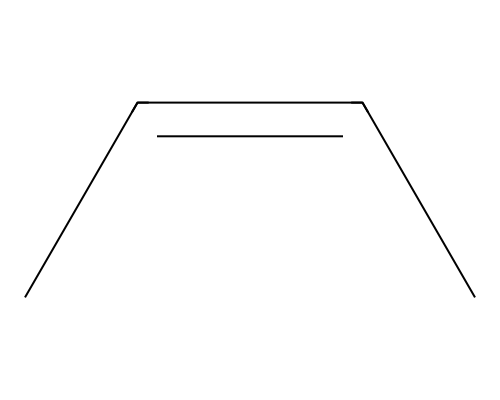
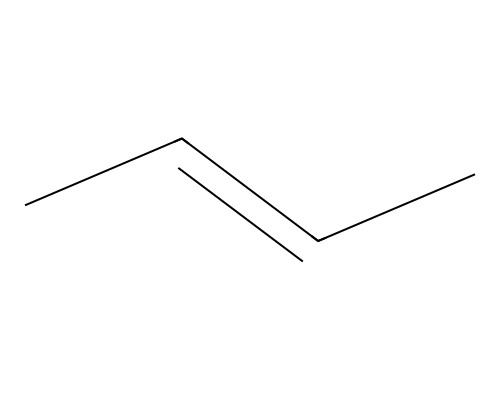
Example 2: 1,2-Dichloroethene (ClCH=CHCl)
- Carbon 1: attached to Cl and H → different ✓
- Carbon 2: attached to Cl and H → different ✓
Result: cis and trans isomers exist.
Example 3: 1,1-Dichloroethene (Cl2C=CH2)
- Carbon 1: attached to Cl and Cl → identical ✗ …
Why this formula?
Geometrical Isomerism: Why the Conditions Hold
Geometrical isomerism (also called cis-trans or E-Z isomerism) arises when atoms or groups are arranged differently in space around a rigid part of a molecule — typically a double bond or a ring. The key is that rotation is restricted, so the spatial positions become fixed and distinct.
Let’s break down why the conditions are what they are.
1. The Core Requirement: Restricted Rotation
For two molecules to be geometrical isomers, they must have the same connectivity but different spatial arrangement due to a barrier to rotation.
- Double bonds (C=C): The π-bond locks the two carbons in place — rotation requires breaking the π-bond (energy ~250 kJ/mol), so it doesn’t happen at room temperature.
- Rings (e.g., cycloalkanes): The ring structure physically prevents free rotation about C–C single bonds within the ring.
Why this matters: Without restricted rotation, the molecule would freely interconvert between arrangements — no distinct isomers exist.
2. Condition 1: Two Different Groups on Each Carbon (for C=C)
Consider a general alkene:
C=C
Each carbon must have two different substituents (not counting the other carbon of the double bond).
Why?
- If one carbon has two identical groups (e.g., both H), then swapping the groups on that carbon produces the same molecule — no isomerism.
Example:
- 1,2-dichloroethene (ClHC=CHCl): Each carbon has H and Cl (different) → geometrical isomers exist.
- 1,1-dichloroethene (Cl2C=CH2): One carbon has two Cl (identical) → no geometrical isomers.
Formal condition:
For a C=C bond, geometrical isomerism is possible iff each doubly bonded carbon bears two different substituents.
3. Condition 2: For Rings — Similar Logic
In a ring (e.g., cyclopropane, cyclohexane), the ring itself restricts rotation. Here, geometrical isomerism occurs when two substituents on different ring carbons can be on the same side (cis) or opposite sides (trans).
Why?
- The ring is a closed loop — you cannot rotate one carbon relative to another without breaking bonds.
- If the two substituents are on different carbons, their relative orientation (same side / opposite sides) is fixed.
Condition:
- The ring must have at least two substituents (could be same or different) on different carbons.
- If both substituents are on the same carbon, swapping them doesn’t change the molecule (no isomerism).
Example:
- 1,2-dimethylcyclopropane: Two methyl groups on adjacent carbons → cis and trans isomers exist.
- 1,1-dimethylcyclopropane: Both methyls on same carbon → no geometrical isomerism.
4. The E-Z Notation (Why It’s Needed)
When the four substituents on a C=C are all different, cis-trans naming fails. The Cahn-Ingold-Prelog priority rules assign E (opposite sides) or Z (same side).
Why this works:
- Priority is based on atomic number (higher = higher priority). …
The key idea is that geometrical isomerism in square planar complexes arises from different spatial arrangements of four different ligands around the metal centre.
Reasoning:
- The complex [Pt(NH3)(Br)(Cl)(py)] is square planar with four different monodentate ligands. This gives the general formula [M(ABCD)].
- For a square planar [M(ABCD)] complex, three geometrical isomers exist, each defined by which pair of ligands sits trans to each other: NH3 trans to Br, NH3 trans to Cl, and NH3 trans to py. …
The key idea is that a square planar complex with four different ligands (like [Pt(NH3)(Br)(Cl)(py)]) can form exactly three geometrical isomers, and none of them are optically active because the square planar geometry has a plane of symmetry in each case.
Why This Problem Matters
Geometrical isomerism in square planar complexes is a classic exam topic — it tests your ability to visualise spatial arrangements. The complex [Pt(NH3)(Br)(Cl)(py)] has four different monodentate ligands around a platinum(II) centre. Since all four ligands are distinct, the only way to get isomers is by changing which ligands sit opposite (trans) to each other.
For a square planar complex [M(ABCD)] with four different ligands, the number of geometrical isomers is always 3. This is because there are exactly three distinct ways to choose which ligand is trans to a given reference ligand.
Step-by-Step Reasoning
1. Identify the ligands and the geometry.
The complex is [Pt(NH3)(Br)(Cl)(py)]. Platinum(II) is d8, which almost always forms square planar complexes. The four ligands — ammonia (NH3), bromide (Br−), chloride (Cl−), and pyridine (py) — are all different.
2. Fix one ligand and vary the trans partner.
A common systematic method: pick one ligand (say NH3) and consider what can be placed opposite it (trans). The other two ligands then occupy the remaining cis positions.
-
Case 1: NH3 trans to Br
Then Cl and py are cis to each other (and cis to both NH3 and Br). This gives one isomer.
-
Case 2: NH3 trans to Cl
Then Br and py are cis to each other. This is a second distinct isomer.
-
Case 3: NH3 trans to py
Then Br and Cl are cis to each other. This is the third isomer.
You don't need to draw all 4! = 24 permutations. Because the square is planar, swapping two cis ligands doesn't change the isomer — only the trans pair matters. So the number of isomers equals the number of ways to pair up the four ligands into two trans pairs, which is 2!⋅2!⋅2!4!=3 (the division accounts for the two pairs being unordered and each pair's internal order not mattering).
3. Check for duplicates.
Could any of these three be the same? No — because in each case the trans pair is different (NH3–Br, NH3–Cl, NH3–py). They are all distinct geometrical isomers.
4. Now consider optical isomerism. …
Method: Square Planar Complex Isomerism Analysis
This problem uses the systematic substitution method for square planar complexes of type [M(ABCD)] — four different monodentate ligands around a d8 metal centre.
Step 1: Identify the geometry and ligand set
- Metal: Pt2+ (square planar, d8)
- Ligands: NH3, Br, Cl, py — all four are different
- General formula: [M(a)(b)(c)(d)]
Step 2: Draw all possible geometrical isomers
In a square planar complex with four different ligands, there are 3 geometrical isomers. Each isomer is defined by which pair of ligands are trans to each other.
Isomer 1: NH3 trans to Br; Cl trans to py
    NH₃
    |
Br—Pt—Cl
    |
    py
Isomer 2: NH3 trans to Cl; Br trans to py
    NH₃
    |
Cl—Pt—Br
    |
    py
Isomer 3: NH3 trans to py; Br trans to Cl
    NH₃
    |
py—Pt—Br
    |
    Cl
``` …
1. The Core Concept First
Geometrical isomerism in square planar complexes arises when the arrangement of ligands around the metal can be changed without breaking bonds — specifically, cis (same side) and trans (opposite side) arrangements.
For a complex like [Pt(NH3)(Br)(Cl)(py)]:
- Pt(II) is square planar (d⁸, low-spin).
- Four different monodentate ligands: NH₃, Br, Cl, py (pyridine).
Key rule:
With four different ligands, a square planar complex can have 3 geometrical isomers — because any two ligands can be placed trans to each other, and the other two automatically become trans to each other.
2. Common Mistakes & How to Avoid Them
✗ Mistake 1: Thinking only 2 isomers exist (cis/trans)
Why it happens:
Students apply the logic of square planar complexes with two identical ligands (like [PtCl2(NH3)2]) — which has only cis and trans.
How to avoid:
Remember: Number of geometrical isomers = number of ways to choose which two ligands are trans.
For 4 different ligands, number of ways = (24)/2=3 (since trans pairs are unordered).
So always 3 for [M(abcd)] square planar.
✗ Mistake 2: Drawing the same isomer twice
Why it happens:
When listing isomers, students often draw the same arrangement rotated 90° and think it’s different.
How to avoid:
Fix one ligand (say NH₃) at the top. Then systematically place the trans partner.
Example:
- Isomer 1: NH₃ trans to Br → Cl and py are cis to each other.
- Isomer 2: NH₃ trans to Cl → Br and py are cis.
- Isomer 3: NH₃ trans to py → Br and Cl are cis.
Check: No two are the same by rotation.
✗ Mistake 3: Thinking optical isomerism is still possible in a square planar complex
Why it happens:
Students remember that “chirality needs no plane of symmetry” but forget to check whether square planar geometry itself already guarantees one.
How to avoid:
For square planar complexes, all four ligands and the metal lie in one plane — that plane itself is always a mirror plane (σh) of the molecule, no matter how many different ligands are attached.
For [Pt(abcd)], check each geometrical isomer:
- Every one of the 3 isomers still lies flat in the molecular plane, so every one is superimposable on its own mirror image. …
- GUJCET 2025Set 031 markMCQQ.If [Co(NH3)x(NO2)y] shows facial and meridional isomers, identify values of x and y. (A) x=4,y=2 (B) x=2,y=2 (C) x=2,y=4 (D) x=3,y=3
›Reveal solutionSolution
[!TLDR]
fac-mer isomerism requires an MA3B3 octahedral complex, so x=3 and y=3.
Concept
In an octahedral complex, facial-meridional (geometrical) isomerism arises specifically for the MA3B3 stoichiometry: the three identical ligands either share a common face (fac) or lie along a meridian (mer).
Solution …
- GUJCET 2025Set 031 markMCQQ.How many minimum numbers of C-atom containing monohaloalkane shows Optical Isomerism? (A) 6 (B) 4 (C) 3 (D) 5
›Reveal solutionSolution
Optical isomerism needs an asymmetric carbon (four different groups); the smallest such monohaloalkane has 4 carbons.
Concept — chirality. A carbon bonded to four different groups is a stereocentre.
Steps.
- 1, 2, 3 carbons cannot give four different groups on one carbon (e.g. 2-chloropropane's central C has two identical CH3). …
- GUJCET 2024Set 131 markMCQQ.Identify the optically active compound from the following. (A) [Pt(NH3)2Cl2] (B) [Co(NH3)6]Cl2 (C) [Co(en)3]Cl3 (D) [Co(NH3)5Cl]Cl
›Reveal solutionSolution
A tris(bidentate) octahedral complex like [Co(en)3]3+ is chiral (has Δ and Λ enantiomers), so it is optically active.
Concept: Optical activity requires the absence of any symmetry plane/centre.
- [Pt(NH3)2Cl2] (square planar) has a plane of symmetry — optically inactive.
- [Co(NH3)6]2+ and [Co(NH3)5Cl]2+ are symmetric — inactive. …
- GUJCET 2023Set 091 markMCQQ.What kind of isomerism exists between [Cr(H2O)6]Cl3 and [Cr(H2O)5Cl]Cl2⋅H2O? (A) Ionisation (B) Solvate (C) Coordination (D) Linkage
›Reveal solutionSolution
[!TLDR]
Water shifting between the coordination sphere and the lattice makes these solvate (hydrate) isomers.
Concept
Solvate (hydrate) isomerism arises when the number of solvent molecules inside the coordination sphere differs, the extra solvent instead being present as molecules of crystallisation.
Solution …
- GSEB Higher Secondary Certificate (HSC) Examination 2023Set ANNUAL1 markMCQQ.Number of possible isomers for [Cr(H2O)2(C2O4)2]^- are ___.(a) 6(b) 4(c) 2(d) 3
›Reveal solutionSolution
[M(AA)2B2] type: trans (1) + cis (optically active, 2 enantiomers) = 3 isomers.
[Cr(H2O)2(C2O4)2]^- has two bidentate oxalate ligands (AA) and two monodentate water ligands (B), i.e. type [M(AA)2B2].
- Geometric isomers: cis (the two H2O adjacent) and trans (the two H2O opposite). …
- GUJCET 2022Set 171 markMCQQ.How many numbers of Geometrical Isomers of [Pt (NH3) (Br) (Cl) (Py)] will have? (A) 3 (B) 2 (C) 1 (D) 4
›Reveal solutionSolution
Square-planar Mabcd gives exactly 3 geometrical isomers.
Concept. Pt(II) complexes are square planar. For a square-planar complex with four different monodentate ligands (Mabcd), the number of geometrical isomers equals 3 — determined by which ligand sits trans to a chosen reference ligand (the other three each in turn). …
- GSEB Higher Secondary Certificate (HSC) Examination 2022Set ANNUAL1 markMCQQ.For [PtCl2(NH3)2], which type of isomerism is (correctly) possible? (Source scan of the options is severely degraded/illegible even after re-rendering at 6x native resolution with contrast enhancement - see transcriber note.)(a) [illegible in source scan](b) [illegible in source scan](c) [illegible in source scan](d) [illegible in source scan]
›Reveal solutionSolution
The options for this MCQ could not be transcribed from the source scan even at 6x re-render, so the specific correct letter cannot be determined honestly - but the underlying chemistry is answerable.
[PtCl2(NH3)2] is a square planar complex of the type [MA2B2]. This class of complex characteristically exhibits geometrical (cis-trans) isomerism: the cis isomer has the two identical ligands (Cl) adjacent (90° apart) and the trans isomer has them opposite (180° apart). Square planar MA2B2 complexes do NOT show optical isomerism (they have a plane of symmetry in both cis and trans forms), so if the options include 'optical isomerism' that would be the incorrect choice, while 'geometrical (cis …
- GUJCET 2020Set 071 markMCQQ.Which isomerism is possible in hexa ammine cobalt (III) hexa cyanido chromate (III) complex? (A) Ionisation isomerism (B) Co-ordination isomerism (C) Linkage isomerism (D) Solvate isomerism
›Reveal solutionSolution
[Co(NH3)6][Cr(CN)6] has complex cation and complex anion ⇒ coordination isomerism. …
- GUJCET 2019Set 131 markMCQQ.Which of the following complex possess meridional isomer? (A) [Co(NH3)5Cl] (B) [Co(NH3)2Cl4] (C) [Co(NH3)4Cl2] (D) [Co(NH3)3Cl3]
›Reveal solutionSolution
Meridional (mer) and facial (fac) isomers occur only for an octahedral MA3B3 type, i.e. [Co(NH3)3Cl3].
Concept: In an octahedral MA3B3 complex the three identical ligands can occupy three positions around a meridian (mer) or three positions forming a triangular face (fac). This isomerism is unique to the A3B3 pattern.
Steps:
- [Co(NH3)5Cl] = MA5B: no such isomerism. …
- GSEB Higher Secondary Certificate (HSC) Examination 2018Set ANNUAL1 markMCQQ.Which of the following complex ions does not possess optical isomerism?(a) [Co(en)2(NH3)2]^2+(b) [Co(CO)4(en)]^3+(c) [Co(en)(H2O)4]^2+(d) [Co(H2O)3Br3]^3+
›Reveal solutionSolution
[Co(H2O)3Br3] is type MA3B3 (all monodentate); its geometric isomers are achiral, so it has no optical isomerism.
Optical isomerism in octahedral complexes needs a non-superimposable mirror image (no plane of symmetry).
- (a) [Co(en)2(NH3)2]^2+ , type M(AA)2B2: the cis form is chiral -> DOES show optical isomerism.
- (d) [Co(H2O)3Br3]^3+ , type MA3B3 with only monodentate ligands: both the facial (fac) and meridional (mer) arrangements possess a plane of symmetry and are superimposable on their mirror images -> NO optical isomerism. …
- GUJCET 2014Set A1 markMCQQ.Which of the following complex does not show optical isomerism? (A) [Cr(C2O4)3]3− (B) Cis [Pt(Br)2(en)2]2+ (C) [CrCl2(NH3)2en]+ (D) [Cr(NH3)4SO4]+
›Reveal solutionSolution
[!TLDR] [Cr(NH3)4(SO4)]+ has a symmetry plane and is achiral; the other three (tris-oxalato, cis-bis-en, and the en/2NH3/2Cl complex) can be resolved into enantiomers.
Concept
Optical isomerism requires a chiral (dissymmetric) complex — one with no plane and no centre of symmetry. Tris-chelate complexes [M(AA)3] and cis-[M(AA)2X2] / cis-[M(AA)2XY] arrangements are classic chiral octahedral species.
Solution
- (A) [Cr(C2O4)3]3−: tris(oxalato) — chiral, shows optical isomerism.
- (B) cis-[Pt(Br)2(en)2]2+: cis-bis(en) — chiral, shows optical isomerism. …
🎓Unlock everything free for 14 days
- ✓Full step-by-step solutions
- ✓Concept-first explanations
- ✓Methods, shortcuts & mistakes
- ✓PYQ mapping + timed mock tests
Full access for 14 days. No credit card required.