Q.Give the uses of freon 12, DDT, carbon tetrachloride and iodoform.
🔒You're viewing a preview — the full solution, concept, methods & PYQ mapping are locked.
🔒 Start your 14-day free trial to unlock the full solution →Concept understanding — Organic Compound Applications
Organic Compound Applications: From Everyday Life to Industry
Imagine you wake up in the morning. The plastic of your toothbrush, the polyester in your shirt, the paracetamol you take for a headache, the LPG that cooks your breakfast, the soap you wash your hands with — every single one of these is an organic compound. You are literally surrounded by them.
The word "organic" here has nothing to do with food labels. In chemistry, an organic compound is any compound whose molecules contain carbon, almost always bonded to hydrogen, and often to oxygen, nitrogen, and other elements. The reason carbon is special is that it can form four stable bonds, allowing it to build chains, rings, and complex structures — millions of them. This is why organic compounds are the basis of life and of modern materials.
The Core Idea: Structure Determines Function
The entire field of organic chemistry rests on one principle: the way atoms are arranged in a molecule determines what that molecule does.
A small change in structure can completely change a compound's properties. For example:
- Ethanol (C2H5OH) — the alcohol in drinks — is a liquid that mixes with water and is consumed by humans.
- Dimethyl ether (CH3OCH3) — same atoms, same formula (C2H6O), but arranged differently — is a gas used as a refrigerant and is toxic if inhaled.
This is called structural isomerism, and it's why organic chemistry is so rich and why applications are so diverse.
The Precise Statement
Organic compounds are carbon-based molecules (excluding simple oxides, carbonates, and carbides) whose applications arise directly from their molecular structure — specifically, the functional groups they contain and the size/shape of their carbon skeleton.
A functional group is a specific atom or group of atoms within a molecule that gives it characteristic chemical behaviour. For instance:
- The –OH group (alcohol) makes a compound able to dissolve in water and act as a disinfectant.
- The –COOH group (carboxylic acid) makes it acidic and able to form esters (fragrances, plastics).
- The –NH₂ group (amine) makes it basic and crucial for dyes and medicines.
How Applications Flow from Structure
Let's see this in action with real examples you'll encounter in exams:
| Functional Group | Example Compound | Application | Why? |
|---|---|---|---|
| –OH (alcohol) | Ethanol | Fuel, solvent, antiseptic | Small polar molecule; burns cleanly; kills bacteria by denaturing proteins |
| –COOH (carboxylic acid) | Acetic acid | Vinegar (food preservative) | Weak acid kills microbes; sour taste |
| –COO– (ester) | Ethyl acetate | Nail polish remover, fruit flavour | Pleasant smell; volatile (evaporates quickly) |
| –CONH– (amide) | Nylon-66 | Fibres for clothing, ropes | Strong hydrogen bonds between chains give tensile strength |
| –C₆H₅ (benzene ring) | Paracetamol | Pain reliever | Ring structure fits into enzyme active sites in the body |
In Indian exams (JEE, NEET, board exams), you are often asked to match a compound with its application or explain why a particular functional group leads to a specific use. The key is to connect the functional group's chemical property (polarity, acidity, reactivity) to the real-world need.
The Three Big Application Domains
1. Pharmaceuticals and Medicine
Most drugs are organic compounds. The structure is designed to interact with a specific biological target (enzyme, receptor) in your body. For example:
- Aspirin (acetylsalicylic acid) has an ester and a carboxylic acid group — the ester is hydrolysed in the body to release the active salicylic acid.
- Chloroquine (antimalarial) has a quinoline ring and an amine side chain — the ring mimics natural molecules, allowing it to enter cells.
2. Polymers and Plastics
Long chains of repeating organic units (monomers) give materials with specific properties:
- Polyethylene (−CH2−CH2−)n — simple chain, flexible, used in bags and bottles.
- Teflon (−CF2−CF2−)n — fluorine atoms replace hydrogen, making it non-stick and chemically inert.
3. Fuels and Energy
Hydrocarbons (only C and H) are the simplest organic compounds. Their combustion releases energy:
- Methane (CH4) — natural gas, cleanest burning. …
Why this formula?
Organic Compound Applications: Understanding the Why Behind the Key Ideas
In organic chemistry, applications often revolve around reaction mechanisms, functional group transformations, and physical property trends. The "formulae" here are not always mathematical — they are conceptual frameworks and reaction patterns that explain why a compound behaves a certain way.
Let’s break down the core reasoning behind the most important applications.
1. Why Do Functional Groups Determine Reactivity?
Key idea: The functional group is the reactive site — the rest of the molecule (the carbon skeleton) is mostly a spectator.
Reasoning:
- Electron density distribution is uneven in a functional group.
- Example: In a carbonyl group (C=O), oxygen is more electronegative than carbon.
- This creates a partial positive charge on carbon (δ+) and a partial negative charge on oxygen (δ−).
- Nucleophiles (electron-rich species) attack the δ+ carbon.
- Electrophiles (electron-deficient species) attack the δ− oxygen or lone pairs.
Why this matters: This explains why aldehydes undergo nucleophilic addition, while alkenes undergo electrophilic addition — the type of charge separation dictates the reaction.
2. Why Do Boiling Points Follow a Trend?
Key formula (conceptual):
Boiling point ∝ (molecular mass) + (intermolecular force strength)
Reasoning:
- Van der Waals forces increase with molecular size (more electrons → more temporary dipoles).
- Hydrogen bonding (in alcohols, carboxylic acids, amines) adds a strong intermolecular force — much stronger than dipole-dipole or London forces.
- Branching reduces surface area → weaker London forces → lower boiling point.
Example comparison:
| Compound | Type | Boiling point (°C) | Why? |
|---|---|---|---|
| Butane (CX4HX10) | Alkane | -0.5 | Only London forces |
| Propanol (CX3HX7OH) | Alcohol | 97 | H-bonding dominates |
| Acetone (CX3HX6O) | Ketone | 56 | Dipole-dipole only |
Takeaway: The type of intermolecular force matters more than molecular mass alone.
3. Why Do Substitution Reactions Follow SN1 or SN2?
Key formula (rate law):
- SN2: Rate =k[RX][Nu−]
- SN1: Rate =k[RX]
Reasoning (the why):
- SN2 is a one-step process: nucleophile attacks from the back while the leaving group departs.
- Requires no carbocation intermediate.
- Favored by primary alkyl halides (less steric hindrance).
- SN1 is a two-step process:
- Leaving group leaves → forms a carbocation (slow, rate-determining step).
- Nucleophile attacks the carbocation (fast).
- Favored by tertiary alkyl halides (carbocation is more stable due to hyperconjugation and inductive effects).
Why this matters: The structure of the alkyl halide determines which pathway dominates — this is why tertiary halides react via SN1 (no backside attack possible) and primary halides via SN2.
4. Why Do Aromatic Compounds Resist Addition?
Key concept: Aromaticity — the delocalized π-electron cloud stabilizes the ring.
Reasoning:
- Benzene (CX6HX6) has 6 π-electrons in a cyclic, planar, conjugated system.
- Hückel's rule: Aromatic if 4n+2 π-electrons (here n=1).
- Addition would break the aromatic ring → lose the resonance stabilization energy (~150 kJ/mol for benzene).
- Instead, electrophilic substitution occurs — the ring keeps its aromaticity.
Why this matters: This explains why benzene undergoes nitration, halogenation, etc., but not addition reactions like alkenes do.
5. Why Do Carboxylic Acids Have Higher Acidity Than Alcohols? …
Concept: Organic Compound Applications — each compound has a specific use tied to its chemical properties (stability, toxicity, reactivity).
Reasoning:
- Freon 12 (CCl2F2) is a non-toxic, non-flammable chlorofluorocarbon with a low boiling point, making it ideal as a refrigerant in air conditioners and refrigerators.
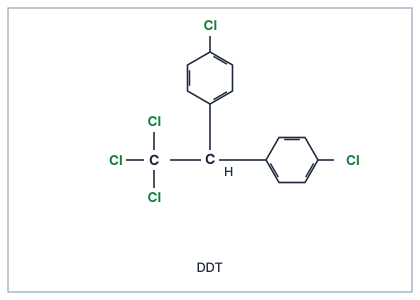
- DDT (C14H9Cl5) is a persistent insecticide that disrupts nerve function in insects; it was widely used in agriculture and for malaria control.
- Carbon tetrachloride (CCl4) is a dense, non-flammable solvent that dissolves oils and fats, used in dry cleaning and as a fire extinguisher (now restricted due to toxicity). …
This question asks for the uses of four important organic compounds — freon 12, DDT, carbon tetrachloride, and iodoform. Each has a distinct application: freon 12 as a refrigerant, DDT as an insecticide, carbon tetrachloride as a solvent and fire extinguisher, and iodoform as an antiseptic.
The key to answering such questions in exams is to recall the specific, well-known uses of each compound — not just general properties. Let's go through them one by one, with the reasoning behind each use.
1. Freon 12 (Dichlorodifluoromethane, CCl2F2)
Freon 12 is a chlorofluorocarbon (CFC). Its uses stem from its unique physical properties: it is a gas at room temperature but easily liquefies under pressure, it is non-toxic, non-flammable, and chemically stable.
- Refrigerant in air conditioners and refrigerators: Because it can absorb heat when it evaporates and release it when compressed, it was widely used in cooling systems.
- Propellant in aerosol sprays: Its low boiling point and inertness made it ideal for dispensing products like deodorants and paints.
- Foam-blowing agent: Used in manufacturing insulating foams.
Freon 12 is now banned under the Montreal Protocol because it depletes the ozone layer. In modern exams, you may be asked about its environmental impact alongside its uses.
2. DDT (Dichlorodiphenyltrichloroethane, C14H9Cl5)
DDT is an organochlorine compound. Its primary use is as an insecticide, but its story is complex.
- Insecticide in agriculture: It was massively used after World War II to control crop pests like mosquitoes, beetles, and moths.
- Disease vector control: It was sprayed to kill mosquitoes that transmit malaria and typhus, saving millions of lives.
- Household pest control: Used in powders and sprays for flies, cockroaches, and lice.
DDT is persistent in the environment and accumulates in food chains, causing harm to wildlife (especially birds). It is now banned in most countries, but is still used in some regions for malaria control under strict guidelines.
3. Carbon Tetrachloride (CCl4)
Carbon tetrachloride is a dense, non-flammable liquid. Its uses are based on its ability to dissolve oils and fats, and its fire-suppressing property.
- Solvent for oils, fats, and greases: Used in dry cleaning and as a degreasing agent in industries.
- Fire extinguisher (under the name Pyrene): Its non-flammable nature and ability to form a heavy vapour that smothers flames made it a common fire extinguisher for electrical fires. …
Here is a clear, concept-first solution method for this type of question.
Method: Functional Group & Property Mapping
This method works by linking the chemical structure (specifically the functional group or key element) of a compound to its physical/chemical properties, and then mapping those properties to a real-world application.
Core Concept: A compound's use is almost always a direct consequence of one of its dominant properties (e.g., non-flammability, toxicity to insects, antiseptic action).
Steps to Solve
Step 1: Identify the Key Structural Feature
Look at the compound's formula or name and identify the atom or group that makes it special.
- Freon 12 (CCl2F2): Contains Chlorine (Cl) and Fluorine (F) atoms. It is a halogenated hydrocarbon (a CFC).
- DDT (C14H9Cl5): Contains multiple Chlorine (Cl) atoms attached to two benzene rings. It is a polychlorinated hydrocarbon.
- Carbon tetrachloride (CCl4): Contains four Chlorine (Cl) atoms. It is a non-polar, dense liquid.
- Iodoform (CHI3): Contains Iodine (I) atoms. It is a trihalomethane.
Step 2: Link Structure to a Dominant Property
Connect the structural feature to its most important chemical or physical behavior.
- Freon 12: The C-F and C-Cl bonds are very strong and stable. This makes the compound non-toxic, non-flammable, and a good heat transfer agent (it evaporates easily, absorbing heat).
- DDT: The chlorine atoms make the molecule highly stable (persistent) and toxic to the nervous system of insects.
- Carbon tetrachloride: It is a non-polar solvent (dissolves oils, fats, grease) and is non-flammable. It is also denser than water.
- Iodoform: The iodine atom is easily released. Iodine is a powerful antiseptic (kills bacteria).
Step 3: Map Property to Application
Match the dominant property to a real-world need.
- Freon 12 (Property: Non-toxic, non-flammable, good heat transfer) …
Here are the common mistakes students make when answering questions on the applications of freon 12, DDT, carbon tetrachloride, and iodoform, along with clear strategies to avoid them.
1. Freon 12 (Dichlorodifluoromethane, CCl2F2)
Common Mistake:
- Writing that Freon 12 is used as a fuel or solvent.
- Confusing it with Freon 11 or other CFCs.
Why it happens:
Students often memorise "CFCs are refrigerants" but don't distinguish between specific numbers. They also confuse "refrigerant" with "fuel" because both involve gases.
How to avoid:
- Remember: Freon 12 is a chlorofluorocarbon (CFC). Its primary use is as a refrigerant in air conditioners and refrigerators.
- It is non-flammable and non-toxic, so it was ideal for cooling — never a fuel.
- Key exam point: It is also used as a propellant in aerosol sprays (though now banned in many countries due to ozone depletion).
Correct use: Refrigerant and aerosol propellant.
2. DDT (Dichlorodiphenyltrichloroethane)
Common Mistake:
- Writing that DDT is used as a medicine or insecticide for crops (without mentioning its ban).
- Forgetting to mention its environmental impact (bioaccumulation).
Why it happens:
Students recall "DDT kills insects" but don't read the question carefully — many exam questions expect you to note its historical use and current status.
How to avoid:
- Always mention: DDT is an insecticide used to control malaria-carrying mosquitoes and agricultural pests.
- Crucial addition: It is banned in many countries because it is non-biodegradable and causes bioaccumulation in food chains.
- Do not say it is used as a medicine — it is not a drug.
Correct use: Insecticide (now restricted/banned due to environmental persistence).
3. Carbon Tetrachloride (CCl4)
Common Mistake:
- Writing that it is used as a fire extinguisher (without noting the danger).
- Saying it is used as a cleaning agent without mentioning toxicity.
Why it happens:
Students remember "carbon tetrachloride puts out fires" but forget that it produces phosgene gas (COCl2) when heated, which is highly toxic.
How to avoid:
- Correct use: It was used as a solvent for oils, fats, and as a dry cleaning agent.
- Fire extinguisher use: Mention it was formerly used in fire extinguishers, but now avoided because it forms toxic phosgene gas on contact with hot surfaces.
- Key exam point: It is non-flammable but toxic — never say it is safe.
Correct use: Solvent, dry cleaning agent, formerly in fire extinguishers (now discontinued due to toxicity).
4. Iodoform (CHI3)
Common Mistake:
- Writing that it is used as a general antiseptic (without specifying its limited use).
- Confusing it with iodine (I2) or tincture of iodine.
Why it happens:
Students know "iodoform is an antiseptic" but don't realise it is not used on open wounds because it is irritating and stains.
How to avoid: …
- GSEB Higher Secondary Certificate (HSC) Examination 2026Set ANNUAL1 markMCQQ.Which of the following compounds, when released into the atmosphere, is responsible for depletion of the ozone layer?(a) CHCl3(b) CH2Cl2(c) CCl4(d) CHI3
›Reveal solutionSolution
CCl4 (and related chlorinated/chlorofluorocarbon compounds) release chlorine free radicals in the stratosphere under UV light, which catalytically destroy ozone.
Halogenated compounds like chlorofluorocarbons (CFCs, freons) and carbon tetrachloride (CCl4) are chemically inert and unreactive in the lower atmosphere, so they persist and slowly diffuse up to the stratosphere. There, high-energy UV radiation photolyses the C–Cl bond, releasing chlorine free radicals:
CCl4 --UV--> •CCl3 + Cl•
These Cl radicals then catalytically destroy ozone in a chain reaction:
Cl• + O3 → ClO• + O2
ClO• + O → Cl• + O2
…
- GUJCET 2025Set 031 markMCQQ.______ compound is slowly oxidised by air in presence of light to an extremely poisonous gas, carbonyl chloride. (A) Trichloromethane (B) Methylene chloride (C) Chlorobenzene (D) Chloromethane
›Reveal solutionSolution
[!TLDR]
Chloroform (trichloromethane) is air-oxidised in light to phosgene, so the answer is trichloromethane.
Concept
CHCl3 undergoes slow atmospheric oxidation in sunlight to form the highly toxic gas carbonyl chloride (phosgene).
Solution
The reaction is: 2CHCl3+O2light2COCl2+2HCl …
- GSEB Higher Secondary Certificate (HSC) Examination 2025Set ANNUAL1 markMCQQ.Which polyhalogen compound is used in production of the Freon Refrigerant R - 22(a) CHCl3(b) CH3Cl(c) CHI3(d) CH2Cl2
›Reveal solutionSolution
Freon-22 (CHClF2) is manufactured industrially by treating chloroform with anhydrous HF in the presence of a catalyst.
Freon R-22 is chlorodifluoromethane, CHClF2, used as a refrigerant.
It is manufactured by reacting chloroform (CHCl3) with HF (hydrogen fluoride) in the presence of a catalyst such as SbF3/SbCl5 (Swarts-type halogen exchange), progressively replacing Cl atoms with F: …
- GUJCET 2023Set 091 markMCQQ.Which polymer is used in making non-stick surface coated Utensils? (A) PHBV (B) Nylon 6,6 (C) Teflon (D) Buna - N
›Reveal solutionSolution
[!TLDR]
Teflon (PTFE) is the polymer used to coat non-stick utensils.
Concept
Different polymers have characteristic uses based on their structure. Teflon, made from tetrafluoroethylene, has an inert, low-friction fluorocarbon surface ideal for non-stick coatings.
Solution
Evaluate each polymer:
- (A) PHBV — a biodegradable polyester used in packaging/medical implants, not cookware.
- (B) Nylon 6,6 — a polyamide used for fibres, ropes, textiles. …
- GUJCET 2022Set 171 markMCQQ.Which polymer is used in manufacture of paints and lacquers? (A) Glyptal (B) Teflon (C) Neoprene (D) Melamine
›Reveal solutionSolution
Glyptal — the glycerol + phthalic anhydride polyester — is the paints-and-lacquers polymer.
Concept. Glyptal is an alkyd resin made by condensing glycerol with phthalic acid (anhydride); its film-forming property makes it a base for paints and lacquers. …
- GSEB Higher Secondary Certificate (HSC) Examination 2022Set ANNUAL1 markMCQQ.What is the correct formula of mustard gas?(a) CCl3NO2(b) ClCH2CH2SCH2CH2Cl(c) CCl3NH2(d) COCl2
›Reveal solutionSolution
Mustard gas is an organosulfur polyhalogen compound: bis(2-chloroethyl) sulphide.
It consists of a central sulfur atom bonded to two -CH2CH2Cl (2-chloroethyl) groups: Cl-CH2-CH2-S-CH2-CH2-Cl. The other options represent different chemical warfare/toxic agents ( …
- GSEB Higher Secondary Certificate (HSC) Examination 2022Set ANNUAL1 markMCQQ.In DDT, what are the numbers of sigma and pi bonds, respectively?(a) 29, 6(b) 28, 5(c) 27, 6(d) 27, 5
›Reveal solutionSolution
DDT, (4-ClC6H4)2CH-CCl3, has molecular formula C14H9Cl5; count all single bonds as sigma and the ring double bonds as pi.
Each benzene ring contributes: 6 ring C-C sigma bonds, 3 ring pi bonds (aromatic), 4 C-H sigma bonds (unsubstituted positions), 1 C-Cl sigma bond, and 1 C-C sigma bond linking to the central CH carbon. That is 12 sigma + 3 pi PER ring, so 24 sigma + 6 pi for both rings.
The central CH carbon adds: 1 C-H sigma bond and 1 C-C sigma bond to the CCl3 carbon (2 more sigma bonds). …
- GUJCET 2019Set 131 markMCQQ.Which of the following group of compounds are extinguisher, antiseptic, insecticide and anesthetic respectively? (A) CCl4,CHI3,CHCl,DDT (B) CCl4,CHI3,DDT,CHCl3 (C) DDT,CHCl3,CCl4,CHI3 (D) CHCl3,CHI3,DDT,CCl4
›Reveal solutionSolution
Matching uses: CCl4 fire extinguisher, CHI3 (iodoform) antiseptic, DDT insecticide, CHCl3 (chloroform) anesthetic.
Concept — uses of haloalkanes.
- Extinguisher → CCl4 (pyrene)
- Antiseptic → CHI3 (iodoform)
- Insecticide → DDT
- Anesthetic → CHCl3 (chloroform) …
- GSEB Higher Secondary Certificate (HSC) Examination 2019Set ANNUAL1 markMCQQ.Which substance is added in chloroform before the use of it as anesthetic?(a) Ethyl alcohol(b) Acetone(c) Methyl Ethyl ketone(d) Methylene chloride
›Reveal solutionSolution
Chloroform slowly oxidises in air and light to the highly toxic gas phosgene (COCl2); a small amount of ethanol is added as a stabiliser to intercept and destroy any phosgene formed.
Chloroform (CHCl3), when exposed to air and sunlight, undergoes slow aerial oxidation:
2CHCl3 + O2 -> 2COCl2 (phosgene, a poisonous gas) + 2HCl
To prevent this, chloroform bottles are stored with about 1% ethyl alcohol added. Ethanol reacts with any phosgene that does form, converting it to a harmless product (diethyl carbonate): …
- GSEB Higher Secondary Certificate (HSC) Examination 2018Set ANNUAL1 markMCQQ.How many sigma and pi bonds are present in the structure of D.D.T respectively?(a) 17, 6(b) 20, 6(c) 21, 6(d) 29, 6
›Reveal solutionSolution
DDT has 29 sigma and 6 pi bonds.
DDT is 1,1,1-trichloro-2,2-bis(4-chlorophenyl)ethane: CCl3-CH(-C6H4Cl)2.
Count sigma bonds:
- Central CH carbon: bonds to CCl3, to two aryl rings, and to H = 4 sigma.
- CCl3 carbon: three C-Cl = 3 sigma. …
- GSEB Higher Secondary Certificate (HSC) Examination 2018Set ANNUAL1 markMCQQ.Which substance is used to extinguish fire in substances like oil, fat and petrol?(a) CHCl3(b) CH2Cl2(c) CH3Cl(d) CCl4
›Reveal solutionSolution
CCl4 (pyrene) is used to put out oil, fat and petrol fires.
Carbon tetrachloride vapour is heavy and non-flammable. When sprayed on a fire it forms a dense blanket over the burning material, cutting off the oxygen supply and extinguishing the flames. It is especially useful for oil, …
- GUJCET 2015Set C1 markMCQQ.The molecular formulae for phosgene and tear gas are _____ and _____ respectively. (A) COCl2 and CCl2NO2 (B) SOCl2 and CCl2NO2 (C) COCl2 and CCl3NO2 (D) SOCl2 and CCl3NO2
›Reveal solutionSolution
[!TLDR]
Phosgene = COCl2; tear gas (chloropicrin) = CCl3NO2.
Concept
Phosgene (carbonyl chloride) is a well-known toxic gas of formula COCl2. 'Tear gas' in this context refers to chloropicrin, CCl3NO2 (trichloronitromethane), an irritant/lachrymator.
Solution …
🎓Unlock everything free for 14 days
- ✓Full step-by-step solutions
- ✓Concept-first explanations
- ✓Methods, shortcuts & mistakes
- ✓PYQ mapping + timed mock tests
Full access for 14 days. No credit card required.