Q.Solve the following linear programming problem graphically: Minimise Z=200x+500y subject to the constraints: x+2y≥10, 3x+4y≤24, x≥0, y≥0.
Concept understanding — Linear Programming Graphical Method
The Graphical Method for Linear Programming
When a linear programming problem has just two decision variables, x and y, you can solve it by drawing a picture. This is the graphical method, and it is the technique the CBSE Class-12 course expects you to use.
The idea
Each constraint is a linear inequality such as 2x+3y≤100. On the xy-plane its boundary is a straight line, and the inequality picks one side of that line (a half-plane). The points that satisfy all the constraints at once form a single region — the feasible region. Your job is to find the point inside this region that makes the objective function Z=ax+by largest or smallest.
The step-by-step procedure
- Draw each constraint line. Replace every inequality by an equation and plot the line, usually by finding where it meets the axes.
- Shade the correct side. Test a simple point (often the origin (0,0)) in the inequality. If it holds, the origin's side is the wanted half-plane; if not, take the other side. Always include the non-negativity conditions x≥0, y≥0, which keep you in the first quadrant.
- Identify the feasible region. It is the overlap of all the shaded half-planes — the region satisfying every constraint together.
- Find the corner (vertex) points. These are the points where the boundary lines cross. Read them off the graph or solve the two relevant lines simultaneously.
- Evaluate Z at every corner and pick the largest value (for a maximum) or the smallest (for a minimum).
The whole method rests on the Corner-Point Theorem: if an optimum exists, it occurs at a vertex of the feasible region. So you never test interior points — only the corners.
Bounded vs unbounded
If the feasible region is a closed polygon (bounded), both the maximum and minimum are guaranteed and are found among the corners. If the region stretches to infinity (unbounded), a maximum or minimum may fail to exist — you then check whether Z can be pushed indefinitely large or small in the open direction before concluding.
The bottom line
Graph the constraints, find the feasible region, list its corner points, and compare Z=ax+by at each. The best corner is your optimal solution — a clean, visual route to the answer for any two-variable LP problem.
The graphical method for solving linear programming problems is the entire method taught in the NCERT Class 12 Linear Programming chapter, and "linear programming graphical method examples class 12" is one of the most searched topics ahead of CBSE board exams. This corner-point approach is also occasionally tested in JEE Main and select state CET papers involving optimization.
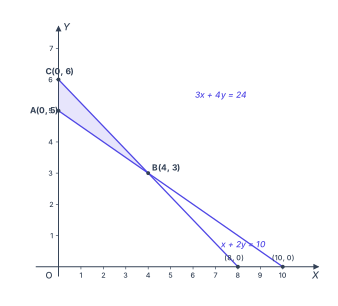
Minimise Z=200x+500y subject to x+2y≥10, 3x+4y≤24, x,y≥0.
The feasible region is the triangle with corners:
- x+2y=10 ∩ x=0: (0,5)
- 3x+4y=24 ∩ x=0: (0,6)
- x+2y=10 ∩ 3x+4y=24: (4,3)
Evaluate Z: Z(0,5)=2500, Z(0,6)=3000, Z(4,3)=800+1500=2300.
(The axis points (10,0) and (8,0) are not feasible: e.g. (8,0) fails x+2y≥10 since 8<10.)
Minimum value Z=2300, at (4, 3).
The feasible region is a triangle with vertices (0,5),(0,6),(4,3); the minimum of Z=200x+500y is 2300 at (4,3).
Set up
Minimise Z=200x+500y subject to
x+2y≥10,3x+4y≤24,x,y≥0.
The region must lie above x+2y=10 and below 3x+4y=24, in the first quadrant.
Plot the boundary lines
- x+2y=10 passes through (10,0) and (0,5).
- 3x+4y=24 passes through (8,0) and (0,6).
Find the feasible corner points
- On the y-axis (x=0): the two constraints give 2y≥10 (so y≥5) and 4y≤24 (so y≤6). This gives the vertices (0,5) and (0,6).
- Intersection of the two lines: from x+2y=10, multiply by 2: 2x+4y=20. Subtract from 3x+4y=24: x=4, then 2y=6⇒y=3 → (4,3).
- The x-axis gives no feasible point: y=0 needs x≥10 (first constraint) and x≤8 (second) at once, which is impossible. So (8,0) and (10,0) are both outside the region.
Hence the feasible region is the triangle (0,5),(0,6),(4,3).
Evaluate Z at the corners
| Corner | Z=200x+500y |
|---|---|
| (0,5) | 2500 |
| (0,6) | 3000 |
| (4,3) | 800+1500=2300 |
The smallest value is 2300 at (4,3). The region is bounded, so this is the true minimum.
Minimum value Z=2300, at (4, 3).
Method: Corner-Point (Graphical) Method for a Minimum
Use this to minimise a linear objective Z=ax+by of two variables subject to a mix of ≥ and ≤ linear constraints. The mechanics are identical to the maximisation case — only the final selection changes.
Steps
Step 1: Plot each constraint line.
Turn each inequality into an equation and draw it from its intercepts, keeping x≥0, y≥0.
Step 2: Shade each half-plane and take the overlap.
Test the origin in each inequality. Note that a ≥ constraint (e.g. x+2y≥10) typically keeps the side away from the origin, while a ≤ constraint keeps the side containing the origin. The feasible region is where all kept half-planes overlap.
Step 3: Locate the feasible corner points.
Solve intersecting boundary lines pairwise. Crucially, discard any intersection that violates another constraint — for a mixed ≥/≤ system an axis intercept often lies outside the region (e.g. it satisfies one constraint but not the other).
Step 4: Evaluate Z at each valid corner and take the smallest.
Zmin=mincorners(ax+by)
Step 5: Confirm the region is bounded.
If the feasible region is a closed polygon, the smallest corner value is the true minimum. (If it were unbounded, you would additionally have to check whether Z can be driven still lower — see the unbounded-region method.) A bounded region guarantees the corner minimum is genuine.
Common Mistakes
Mistake 1: Treating the axis intercepts (10,0) and (8,0) as feasible corners.
Why it's wrong: (8,0) fails x+2y≥10 since 8<10, and (10,0) fails 3x+4y≤24 since 30>24. Neither lies in the region. Correct approach: check every candidate corner against all constraints before evaluating Z.
Mistake 2: Shading x+2y≥10 toward the origin.
Why it's wrong: the origin gives 0≥10, which is false, so the ≥ constraint keeps the side away from the origin. Shading toward it inverts the whole region. Correct approach: for a ≥ constraint that fails the origin test, keep the far side.
Mistake 3: Miscomputing the intersection (4,3).
Why it's wrong: solving x+2y=10 and 3x+4y=24 needs elimination — double the first to 2x+4y=20, subtract to get x=4, then y=3. A sign slip here changes the minimum. Correct approach: substitute the found point back into both equations to verify.
Mistake 4: Evaluating Z=200x+500y with the coefficients swapped.
Why it's wrong: writing 500x+200y gives the wrong values and can flip which corner is smallest. Correct approach: keep each variable with its own coefficient — Z(4,3)=200(4)+500(3)=2300.
- GUJCET 2021Set 151 markMCQQ.Minimise : Z=2x+3y, subject to constraints 2x+4y≤12, x+y≤3, x≥0 and y≥0. (A) 12 (B) 9 (C) 0 (D) 6
›Reveal solutionSolution
With all constraints of <= type and x,y>=0, the origin is feasible and minimises Z = 2x+3y.
Concept. For Z=2x+3y with x,y≥0, the smallest value comes from the corner nearest the origin.
Solution. (0,0) satisfies 2x+4y≤12 and x+y≤3, giving Z=0, which is the minimum.
✓Final answer(C) 0
ANSWER: (C)
- GUJCET 2023Set 091 markMCQQ.Minimise objective function z=3x+2y subject to the constraints : x+y≥8, x+y≤5, x≥0, y≥0 is : (A) 15 (B) 6 (C) 24 (D) No feasible region and hence no feasible solution
›Reveal solutionSolution
Incompatible constraints leave no feasible region.
Concept: The constraints require x+y≥8 and simultaneously x+y≤5. No point can satisfy x+y≥8 and x+y≤5 at once, so the feasible region is empty and there is no feasible solution.
✓Final answer(D) No feasible region and hence no feasible solution
ANSWER: (D)
- GUJCET 2024Set 131 markMCQQ.Minimise objective function z=7x+3y subject to the constraints : x+y≤5,x+y≥10,x≥0,y≥0 is : (A) No feasible region and hence no feasible solution (B) 15 (C) 70 (D) 35
›Reveal solutionSolution
The constraints x+y≤5 and x+y≥10 are contradictory.
Reasoning. No point can satisfy x+y≤5 and x+y≥10 simultaneously (a sum cannot be both ≤5 and ≥10). Hence the feasible region is empty and the LPP has no feasible solution.
✓Final answerOption (A) No feasible region and hence no feasible solution
ANSWER: (A)
- GUJCET 2025Set 031 markMCQQ.The maximum value of z=5x+3y subject to constraints 3x+5y≤15, x≥0, y≥0 is : (A) 10 (B) 25 (C) 0 (D) 9
›Reveal solutionSolution
Feasible region is the triangle bounded by 3x+5y≤15, x,y≥0.
Corner points: (0,0), (5,0), (0,3).
- (0,0)→0
- (5,0)→25
- (0,3)→9
Maximum is 25 at (5,0).
✓Final answer(B) 25
ANSWER: (B)
- GUJCET 2020Set 071 markMCQQ.The maximum value of Z=3x+4y subject to constraints x+y≤4, x≥0, y≥0 is ________. (A) 16 (B) 12 (C) 0 (D) not possible
›Reveal solutionSolution
Evaluate Z at the corners of the feasible region; the max is at (0,4).
Concept: Feasible region: x+y≤4, x≥0, y≥0 — a triangle with corners (0,0),(4,0),(0,4).
Z(0,0)=0,Z(4,0)=12,Z(0,4)=16.
Maximum Z=16 at (0,4).
✓Final answer(A) 16
ANSWER: (A)
🎓Unlock everything free for 14 days
- ✓Full step-by-step solutions
- ✓Concept-first explanations
- ✓Methods, shortcuts & mistakes
- ✓PYQ mapping + timed mock tests
Full access for 14 days. No credit card required.