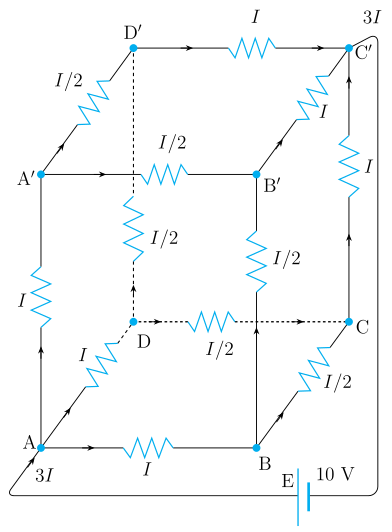
Q.A battery of 10 V and negligible internal resistance is connected across the diagonally opposite corners of a cubical network consisting of 12 resistors each of resistance 1 Ω (Fig. 3.16). Determine the equivalent resistance of the network and the current along each edge of the cube.
Concept understanding — Wheatstone Bridge Symmetry
Wheatstone Bridge Symmetry
Four resistors are arranged in a diamond. A battery sits across the top and bottom points; a sensitive galvanometer bridges the left and right points. The question is: when does no current flow through the galvanometer? The answer is symmetry.
The Intuition
Treat the bridge as two parallel voltage dividers — two resistors in series on the left, two in series on the right — with the galvanometer joining their midpoints. If both dividers produce the same midpoint voltage, there is no potential difference across the galvanometer and no current flows: the bridge is balanced. This happens when the resistance ratio on the left arm equals the ratio on the right arm.
Symmetry here means equal ratios, not equal resistances. 1 Ω with 2 Ω on one side balances 100 Ω with 200 Ω on the other.
The Precise Statement
Label the four resistors: R1 top-left, R2 bottom-left, R3 top-right, R4 bottom-right. The battery connects the top junction (between R1, R3) to the bottom junction (between R2, R4); the galvanometer connects the two midpoints. The bridge is balanced when
R2R1=R4R3
The balance condition is independent of the battery voltage and of the galvanometer's resistance — it depends only on the four resistor values.
Why This Matters
- Unknown resistance: put the unknown in place of R4, adjust the others until balanced, then R4=R3R1R2.
- Strain gauges: stretching slightly changes a resistance, unbalancing the bridge; the deflection measures the strain.
- Temperature sensors: a temperature-dependent resistor unbalances the bridge in proportion to the change.
Do not memorise "opposite resistors are equal." That is only the special case where both ratios equal 1. Memorise the ratio condition R2R1=R4R3.
Quick Check
If R1=4 Ω, R2=6 Ω, R3=2 Ω, find R4 for balance:
64=R42⇒R4=3 Ω
No two resistors are equal, yet the ratios match — so the bridge balances. That proportionality of the two voltage dividers is the whole idea of Wheatstone-bridge symmetry.
The Wheatstone bridge balance condition is a well-established part of the NCERT Class 12 Physics chapter on current electricity, and "Wheatstone bridge balance condition derivation class 12 physics" is a frequently asked CBSE board and JEE Main question. This ratio-based reasoning, rather than assuming equal resistors, is exactly what NCERT-aligned answer keys expect.
Why this formula?
Wheatstone Bridge Symmetry — Why the Formula Holds
The Wheatstone bridge is a circuit used to measure an unknown resistance by balancing two legs of a bridge. The key result is:
When the bridge is balanced, no current flows through the galvanometer, and:
R2R1=R4R3
Let's understand why this is true — not just memorize it.
1. The Circuit Setup
A Wheatstone bridge has four resistors arranged in a diamond:
- R1 and R2 in series on the left branch
- R3 and R4 in series on the right branch
- A galvanometer (sensitive current detector) connects the midpoints of the two branches
- A battery connects across the top and bottom
        A
       / \
      /   \
     R1    R3
     |     |
     G-----|   (G = galvanometer)
     |     |
     R2    R4
      \   /
       \ /
        B
2. The Condition for Balance — "No Current Through G"
Balance means the galvanometer shows zero deflection — no current flows through it. This implies points C (between R1 and R2) and D (between R3 and R4) are at the same electric potential. If VC=VD, no potential difference exists across the galvanometer, so no current flows.
3. Deriving the Ratio — Step by Step
Step 1: Branch currents
With no current through G, the left branch carries a single current I1 and the right branch a single current I2.
Step 2: Equal potentials at the midpoints
From A (common top) to the midpoints, since VC=VD:
I1R1=I2R3(1)
From the midpoints to B (common bottom), since VC=VD:
I1R2=I2R4(2)
Step 3: Divide (1) by (2)
I1R2I1R1=I2R4I2R3
The currents I1 and I2 cancel:
R2R1=R4R3
4. Why This Makes Physical Sense
The bridge is essentially two voltage dividers sharing the same input voltage. Balance occurs when both dividers produce the same output voltage at their midpoints. Notice that I1 and I2 need not be equal — the balance condition fixes only the ratio of resistances in each branch, not their individual values.
5. Key Exam Takeaways
| Concept | Why it matters |
|---|---|
| No current through G | Implies VC=VD |
| Voltage division | Each branch acts as an independent divider |
| Ratio equality | Direct consequence of equal potentials |
Balance = equal potentials → equal voltage ratios → R2R1=R4R3
The network is symmetric about the body diagonal from the entry corner A to the opposite corner G, and all 12 edges are 1 Ω.
Symmetry currents. Let the total current be I. It splits equally among the three edges at A (current I/3 each). Each of these reaches a vertex where it divides into two of the six middle edges (I/6 each). At the far end three middle edges feed each of the three edges into G (I/3 each).
Equivalent resistance. Add the potential drops along a path A→(adjacent)→(middle)→G:
V=3I(1)+6I(1)+3I(1)=I(31+61+31)=65I.
With V=10 V: 65I=10⇒I=12 A, so
Req=IV=1210=65 Ω.
Edge currents. I/3=4 A on each of the three edges at A and the three at G; I/6=2 A on each of the six middle edges.
Equivalent resistance Req=65 Ω≈0.83 Ω; total current 12 A. Each of the six edges touching the entry and exit corners carries 4 A, and each of the six middle edges carries 2 A.
Using the three-fold symmetry of a cube fed across its body diagonal, the twelve 1 Ω edges reduce to Req=65 Ω; the 10 V cell drives 12 A, giving 4 A in each of the six edges at the two corners and 2 A in each of the six middle edges.
Setting up the symmetry. The battery is across the body diagonal, from corner A (entry) to the opposite corner G (exit). Three edges leave A; by symmetry they are indistinguishable, so the total current I splits equally: I/3 in each. Each such edge ends on a vertex adjacent to A; from there two edges continue toward G, so by symmetry the I/3 splits into I/6 in each of these six 'middle' edges. Finally three edges arrive at G, each carrying I/3 (pairs of middle edges of I/6 merging).
Potential drop along a diagonal path. Follow A→B→F→G (adjacent → middle → exit):
VA−VG=3I×1+6I×1+3I×1=I(31+61+31)=65I.
Equivalent resistance. This drop equals the battery voltage, 65I=10 V, and by definition V=IReq, so
Req=65 Ω≈0.83 Ω.
Total and branch currents.
I=ReqV=5/610=12 A.
- Three edges at A and three at G: I/3=4 A each.
- Six middle edges: I/6=2 A each.
Req=65 Ω≈0.83 Ω; total current =12 A. Current =4 A in each of the six edges meeting the entry and exit corners, and 2 A in each of the six middle edges.
Method: Exploiting Symmetry to Reduce Resistor Networks
This method solves resistor networks with multiple identical branches (e.g. a cube, wire mesh, or ladder network) fed between two symmetric terminals, without writing individual Kirchhoff equations for every branch.
Steps
Step 1: Identify equivalent points via symmetry
Look at the geometry of the network relative to the entry and exit terminals. If several branches are indistinguishable from the source's point of view (same distance, same connectivity, mirror images of one another), by symmetry they must carry equal currents and their far ends must sit at equal potentials.
Step 2: Group vertices into equipotential "shells"
Points that are equidistant from the entry terminal along equivalent paths are at the same potential. This lets you assign a single current variable to each symmetric group of edges, rather than one variable per edge.
Step 3: Distribute the total current using symmetry counts
If n identical edges leave a junction and, by symmetry, must carry equal current, each carries I/n of whatever current arrives there. Track how the current I from the source splits and recombines through each successive shell of the network.
Step 4: Sum potential drops along ONE representative path
Every direct path from the entry to the exit terminal must produce the same total potential drop V (the applied voltage). Pick the simplest such path and add up the IR drop across each segment along it:
V=∑iIiRi(along one representative path, entry to exit)
Solve this single equation for the overall current I.
Step 5: Applying to this problem
Once I is known, Req=V/I, and the current in any individual edge follows directly from the symmetry grouping set up in Step 2 — e.g. edges nearest the entry/exit terminals carry a larger fractional share of I than the "equatorial" edges further from either terminal.
- GUJCET 2026Set x1 markMCQQ.The Wheatstone bridge is in balanced condition in the given figure (assume branches are 2Ω, 6Ω, X, and 12Ω in order), then X = ______. [FIGURE] (A) 12 Ω (B) 4 Ω (C) 6 Ω (D) 3 Ω
›Reveal solutionSolution
[!TLDR] 62=12X⇒X=4Ω → (B).
Concept
A Wheatstone bridge is balanced when the ratios of its adjacent arms are equal, QP=SR, so that no current flows through the galvanometer. (NCERT Current Electricity.)
Solution
With the 2Ω and 6Ω arms forming one ratio and the X and 12Ω arms the other, balance requires 62=12X. Hence X=62×12=4Ω.
[!ANSWER] (B)
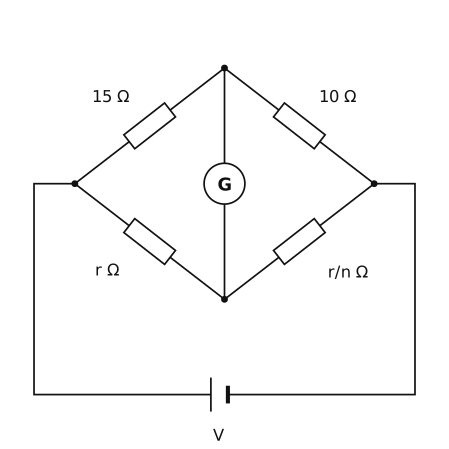
- GUJCET 2025Set 031 markMCQQ.As shown in the figure, balanced condition of Wheatstone Bridge is n= ______. [FIGURE: a Wheatstone bridge with a galvanometer G in the central arm; the four bridge arms carry resistances 15 Ω, 10 Ω, rΩ and 2rΩ, powered by a cell V.] (A) 23 (B) 52 (C) 21 (D) 25
›Reveal solutionSolution
[!TLDR]
Balance condition 1015=n gives n=23; option (A).
Concept
A Wheatstone bridge is balanced (no galvanometer current) when the potentials at the galvanometer nodes are equal, which means the four arms satisfy QP=SR′ for the two branches sharing the source. Equivalently, the ratio of the two arms in one branch equals the ratio of the corresponding two arms in the other.
Solution
One branch has arms 15Ω and 10Ω; the other has r and nr. At balance:
1015=r/nr=n.
So
n=1015=23.
Hence option (A). (The cell V and galvanometer positions only set which ratios must match; they do not change the numerical result.)
[!ANSWER]
(A) 23
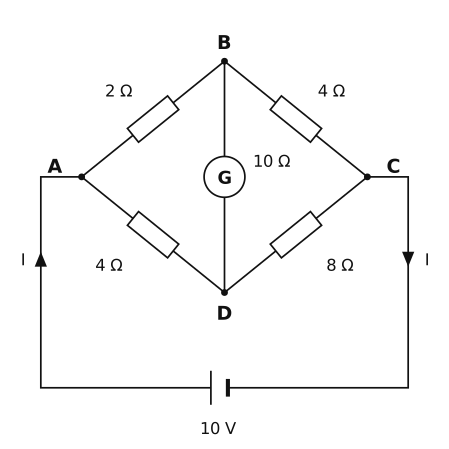
A Wheatstone-bridge diamond. Upper-left arm 15\,\Omega, upper-right arm 10\,\Omega, lo - GUJCET 2024Set 131 markMCQQ.As shown in the circuit diagram find the value of I ________. [FIGURE: Wheatstone-bridge circuit with nodes A (left), B (top), C (right), D (bottom). Arm A-B = 2Ω, arm B-C = 4Ω, arm A-D = 5Ω, arm D-C = 8Ω. A galvanometer G of 10Ω is connected between B and D. A 10 V cell drives the current I into node A and out of node C.] (A) 2.8 A (B) 0.4 A (C) 1.8 A (D) 2.5 A
›Reveal solutionSolution
The bridge is balanced (2/4=4/8), so G carries no current; Req=(2+4)∥(4+8)=4Ω and I=10/4=2.5 A.
Balance check: BCAB=42=21 and DCAD=84=21 - equal, so the bridge is balanced and no current flows through the 10Ω galvanometer. The circuit reduces to two branches in parallel between A and C: (2+4)=6Ω and (4+8)=12Ω.
Req=6+126×12=1872=4Ω,I=ReqV=410=2.5 A.
✓Final answerI=2.5 A.
ANSWER: (D)
A Wheatstone-bridge circuit ABCD fed by a 10 V cell (current I in at A, out at C). Arm A-B - GUJCET 2019Set 131 markMCQQ.In the network shown in the figure the equivalent resistance between points X & Y will be ............... Ω. Value of each resitance is 2Ω. [FIGURE] (A) 32 (B) 1 (C) 4 (D) 2
›Reveal solutionSolution
[!TLDR] The network of 2Ω resistors reduces to 1Ω between X and Y.
Concept
Equivalent resistance is obtained by combining resistors in series (R=R1+R2) and parallel (R1=R11+R21) step by step until a single resistance remains between the two terminals.
Solution
With every resistor =2Ω, systematic series-parallel reduction of the shown network collapses to two equal effective paths in parallel between X and Y, giving
RXY=2+22×2=1Ω.
[!ANSWER]
(B) 1
- GUJCET 2015Set C1 markMCQQ.A and B are two points on a uniform ring of radius r. The resistance of the ring is R. ∠AOB=θ as shown in the figure. The equivalent resistance between points A & B is _____. [FIGURE: ring with points A and B, centre O, angle theta between OA and OB] (A) 4πR(2π−θ) (B) 2πRθ (C) R(1−2πθ) (D) 4π2R(2π−θ)θ
›Reveal solutionSolution
[!TLDR]
The ring splits into two arcs in parallel; the equivalent resistance is 4π2Rθ(2π−θ); option (D).
Concept
Resistance of an arc is proportional to its angle. The full ring (2π) has resistance R, so an arc of angle α has resistance R2πα. Between two points A and B the two arcs form parallel paths.
Solution
Let the arc AB subtend angle θ:
R1=R2πθ,R2=R2π2π−θ.
Note R1+R2=R. In parallel,
Req=R1+R2R1R2=R(R2πθ)(R2π2π−θ)=4π2Rθ(2π−θ).
This is option (D).
[!ANSWER]
(D) 4π2R(2π−θ)θ
- GUJCET 2014Set A1 markMCQQ.A wire is bent in the form of circle of radius 2m. Resistance per unit length of wire is 1/π Ω/m. Battery of 6V is connected between A & B. ∠AOB=90°. Find the current through the battery. [FIGURE] (A) 8 A (B) 4 A (C) 3 A (D) 9 A
›Reveal solutionSolution
[!TLDR] Two arcs of 1 Ω and 3 Ω in parallel =0.75 Ω; I=6/0.75=8 A.
Concept
A circular wire connected at two points A and B forms two arcs in parallel between those points. Each arc's resistance is proportional to its length (NCERT Current Electricity).
Solution
Circumference =2πr=2π(2)=4π m. Total resistance =4π×π1=4 Ω.
∠AOB=90∘, so the minor arc is 41 of the ring: length π m, resistance π×π1=1 Ω.
The major arc is 43: length 3π m, resistance 3 Ω.
Parallel combination: 1+31×3=43=0.75 Ω.
I=RV=0.756=8 A.
[!ANSWER] (A)
🎓Unlock everything free for 14 days
- ✓Full step-by-step solutions
- ✓Concept-first explanations
- ✓Methods, shortcuts & mistakes
- ✓PYQ mapping + timed mock tests
Full access for 14 days. No credit card required.