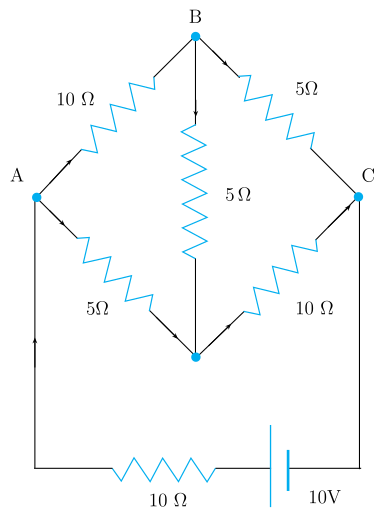
Q.Determine the current in each branch of the network shown in Fig. 3.20.
🔒You're viewing a preview — the full solution, concept, methods & PYQ mapping are locked.
🔒 Start your 14-day free trial to unlock the full solution →Concept understanding — Wheatstone Bridge Symmetry
Wheatstone Bridge Symmetry
Four resistors are arranged in a diamond. A battery sits across the top and bottom points; a sensitive galvanometer bridges the left and right points. The question is: when does no current flow through the galvanometer? The answer is symmetry.
The Intuition
Treat the bridge as two parallel voltage dividers — two resistors in series on the left, two in series on the right — with the galvanometer joining their midpoints. If both dividers produce the same midpoint voltage, there is no potential difference across the galvanometer and no current flows: the bridge is balanced. This happens when the resistance ratio on the left arm equals the ratio on the right arm.
Symmetry here means equal ratios, not equal resistances. 1 Ω with 2 Ω on one side balances 100 Ω with 200 Ω on the other.
The Precise Statement
Label the four resistors: R1 top-left, R2 bottom-left, R3 top-right, R4 bottom-right. The battery connects the top junction (between R1, R3) to the bottom junction (between R2, R4); the galvanometer connects the two midpoints. The bridge is balanced when
R2R1=R4R3
The balance condition is independent of the battery voltage and of the galvanometer's resistance — it depends only on the four resistor values.
Why This Matters
- Unknown resistance: put the unknown in place of R4, adjust the others until balanced, then R4=R3R1R2.
- Strain gauges: stretching slightly changes a resistance, unbalancing the bridge; the deflection measures the strain.
- Temperature sensors: a temperature-dependent resistor unbalances the bridge in proportion to the change. …
Why this formula?
Wheatstone Bridge Symmetry — Why the Formula Holds
The Wheatstone bridge is a circuit used to measure an unknown resistance by balancing two legs of a bridge. The key result is:
When the bridge is balanced, no current flows through the galvanometer, and:
R2R1=R4R3
Let's understand why this is true — not just memorize it.
1. The Circuit Setup
A Wheatstone bridge has four resistors arranged in a diamond:
- R1 and R2 in series on the left branch
- R3 and R4 in series on the right branch
- A galvanometer (sensitive current detector) connects the midpoints of the two branches
- A battery connects across the top and bottom
        A
       / \
      /   \
     R1    R3
     |     |
     G-----|   (G = galvanometer)
     |     |
     R2    R4
      \   /
       \ /
        B
2. The Condition for Balance — "No Current Through G"
Balance means the galvanometer shows zero deflection — no current flows through it. This implies points C (between R1 and R2) and D (between R3 and R4) are at the same electric potential. If VC=VD, no potential difference exists across the galvanometer, so no current flows.
3. Deriving the Ratio — Step by Step
Step 1: Branch currents
With no current through G, the left branch carries a single current I1 and the right branch a single current I2.
Step 2: Equal potentials at the midpoints
From A (common top) to the midpoints, since VC=VD:
I1R1=I2R3(1)
From the midpoints to B (common bottom), since VC=VD:
I1R2=I2R4(2)
Step 3: Divide (1) by (2)
I1R2I1R1=I2R4I2R3
The currents I1 and I2 cancel: …
Check the balance condition first. With arms AB=10 Ω, BC=5 Ω, AD=5 Ω, DC=10 Ω:
BCAB=510=2,DCAD=105=0.5.
These are unequal, so the bridge is unbalanced and current does flow through the 5 Ω bridge arm BD — the 'no current in the middle' shortcut does not apply.
Solving with mesh/Kirchhoff equations (the 10 V cell is in series with a 10 Ω resistor across A–C): a star–delta reduction of the bridge gives 7 Ω between A and C, so the total current is …
The network is an unbalanced Wheatstone bridge (arms AB=10 Ω, BC=5 Ω, AD=5 Ω, DC=10 Ω, bridge BD=5 Ω) fed by a 10 V cell in series with 10 Ω across A–C. The bridge presents 7 Ω, so the battery drives 1710 A≈0.59 A; the branch currents are 174,176,176,174 and 172 A.
The network. Nodes A (left), B (top), C (right), D (bottom) form a bridge: AB=10 Ω, BC=5 Ω, AD=5 Ω, DC=10 Ω, with a 5 Ω bridge arm BD. The supply is a 10 V cell in series with a 10 Ω resistor across A and C.
Is it balanced? BCAB=510=2 while DCAD=105=0.5; unequal, so the bridge is unbalanced and current flows in BD. We use mesh (loop) analysis.
Mesh equations. With clockwise mesh currents i1 (loop ABD), i2 (loop BCD), i3 (loop A-D-C-battery):
4i1−i2−i3=0,−i1+4i2−2i3=0,−i1−2i2+5i3=2.
Solving: i1=174, i2=176, i3=1710 A.
Branch currents.
| Branch | Element | Current |
|---|---|---|
| AB | 10 Ω | 174≈0.235 A |
| BC | 5 Ω | 176≈0.353 A |
| AD | 5 Ω | 176≈0.353 A |
| DC | 10 Ω | 174≈0.235 A |
Method: Mesh (Loop) Analysis for a Multi-Branch Resistor Network
Use this general technique to find every branch current in ANY resistor network with more than one loop — bridges, ladders, or arbitrary meshes — once you've confirmed no shortcut (symmetry, or a balanced-bridge condition) is available.
Steps
Step 1: Check for a shortcut first
Always check whether the network has exploitable symmetry, or is a balanced bridge (equal arm ratios, no source in the bridging branch). If neither applies, fall back to full mesh analysis.
Step 2: Identify independent meshes and assign loop currents
Redraw the network as a set of non-overlapping closed loops ("windows") that together cover the whole circuit. Assign each loop a single circulating current variable, drawn in a consistent sense (e.g. all clockwise) — a branch shared between two loops then carries the difference of the two adjacent loop currents.
Step 3: Apply Kirchhoff's voltage law to each loop
For each loop, sum the IR drops around it — using the net current (own loop current minus any adjacent loop current, for a shared branch) — plus any EMF sources in that loop, and set the total to zero:
∑loopInetR−∑loopε=0
Step 4: Solve the resulting linear system …
- GUJCET 2026Set x1 markMCQQ.The Wheatstone bridge is in balanced condition in the given figure (assume branches are 2Ω, 6Ω, X, and 12Ω in order), then X = ______. [FIGURE] (A) 12 Ω (B) 4 Ω (C) 6 Ω (D) 3 Ω
›Reveal solutionSolution
[!TLDR] 62=12X⇒X=4Ω → (B).
Concept
A Wheatstone bridge is balanced when the ratios of its adjacent arms are equal, QP=SR, so that no current flows through the galvanometer. (NCERT Current Electricity.)
Solution …
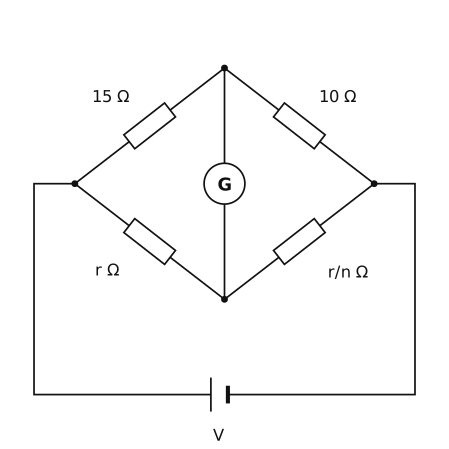
- GUJCET 2025Set 031 markMCQQ.As shown in the figure, balanced condition of Wheatstone Bridge is n= ______. [FIGURE: a Wheatstone bridge with a galvanometer G in the central arm; the four bridge arms carry resistances 15 Ω, 10 Ω, rΩ and 2rΩ, powered by a cell V.] (A) 23 (B) 52 (C) 21 (D) 25
›Reveal solutionSolution
[!TLDR]
Balance condition 1015=n gives n=23; option (A).
Concept
A Wheatstone bridge is balanced (no galvanometer current) when the potentials at the galvanometer nodes are equal, which means the four arms satisfy QP=SR′ for the two branches sharing the source. Equivalently, the ratio of the two arms in one branch equals the ratio of the corresponding two arms in the other.
Solution
One branch has arms 15Ω and 10Ω; the other has r and nr. At balance:
1015=r/nr=n.
So
n=1015=23. …
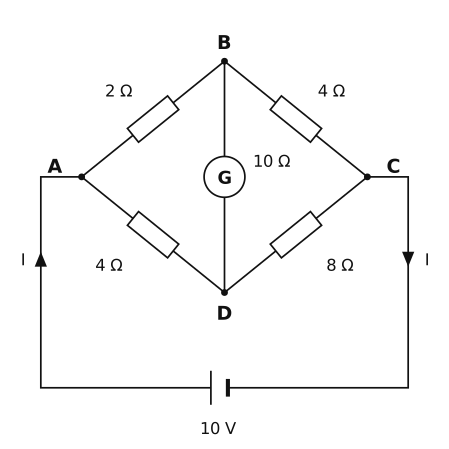
- GUJCET 2024Set 131 markMCQQ.As shown in the circuit diagram find the value of I ________. [FIGURE: Wheatstone-bridge circuit with nodes A (left), B (top), C (right), D (bottom). Arm A-B = 2Ω, arm B-C = 4Ω, arm A-D = 5Ω, arm D-C = 8Ω. A galvanometer G of 10Ω is connected between B and D. A 10 V cell drives the current I into node A and out of node C.] (A) 2.8 A (B) 0.4 A (C) 1.8 A (D) 2.5 A
›Reveal solutionSolution
The bridge is balanced (2/4=4/8), so G carries no current; Req=(2+4)∥(4+8)=4Ω and I=10/4=2.5 A.
Balance check: BCAB=42=21 and DCAD=84=21 - equal, so the bridge is balanced and no current flows through the 10Ω galvanometer. The circuit reduces to two branches in parallel between A and C: (2+4)=6Ω and (4+8)=12Ω. …
- GUJCET 2019Set 131 markMCQQ.In the network shown in the figure the equivalent resistance between points X & Y will be ............... Ω. Value of each resitance is 2Ω. [FIGURE] (A) 32 (B) 1 (C) 4 (D) 2
›Reveal solutionSolution
[!TLDR] The network of 2Ω resistors reduces to 1Ω between X and Y.
Concept
Equivalent resistance is obtained by combining resistors in series (R=R1+R2) and parallel (R1=R11+R21) step by step until a single resistance remains between the two terminals.
Solution …
- GUJCET 2015Set C1 markMCQQ.A and B are two points on a uniform ring of radius r. The resistance of the ring is R. ∠AOB=θ as shown in the figure. The equivalent resistance between points A & B is _____. [FIGURE: ring with points A and B, centre O, angle theta between OA and OB] (A) 4πR(2π−θ) (B) 2πRθ (C) R(1−2πθ) (D) 4π2R(2π−θ)θ
›Reveal solutionSolution
[!TLDR]
The ring splits into two arcs in parallel; the equivalent resistance is 4π2Rθ(2π−θ); option (D).
Concept
Resistance of an arc is proportional to its angle. The full ring (2π) has resistance R, so an arc of angle α has resistance R2πα. Between two points A and B the two arcs form parallel paths.
Solution
Let the arc AB subtend angle θ:
R1=R2πθ,R2=R2π2π−θ.
Note R1+R2=R. In parallel, …
- GUJCET 2014Set A1 markMCQQ.A wire is bent in the form of circle of radius 2m. Resistance per unit length of wire is 1/π Ω/m. Battery of 6V is connected between A & B. ∠AOB=90°. Find the current through the battery. [FIGURE] (A) 8 A (B) 4 A (C) 3 A (D) 9 A
›Reveal solutionSolution
[!TLDR] Two arcs of 1 Ω and 3 Ω in parallel =0.75 Ω; I=6/0.75=8 A.
Concept
A circular wire connected at two points A and B forms two arcs in parallel between those points. Each arc's resistance is proportional to its length (NCERT Current Electricity).
Solution
Circumference =2πr=2π(2)=4π m. Total resistance =4π×π1=4 Ω. …
🎓Unlock everything free for 14 days
- ✓Full step-by-step solutions
- ✓Concept-first explanations
- ✓Methods, shortcuts & mistakes
- ✓PYQ mapping + timed mock tests
Full access for 14 days. No credit card required.