Q.Consider three charges q1, q2, q3 each equal to q at the vertices of an equilateral triangle of side l. What is the force on a charge Q (with the same sign as q) placed at the centroid of the triangle?
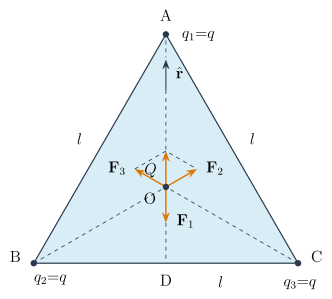
Concept understanding — Coulomb Force Superposition
Coulomb Force Superposition – From Intuition to Precision
Imagine you're in a room with three friends. Each friend can push or pull you. If two friends push you from the same side, you feel a stronger push — the combined effect. If one pushes from the left and another from the right, you feel the net effect, which might be smaller or even zero if they push equally hard.
This is exactly how electric forces work. When multiple charged particles are present, each one exerts its own force on a given charge. The total force that charge feels is simply the vector sum of all the individual forces — as if each other charge were acting alone, completely ignoring the presence of the rest.
That's the core idea: forces add like arrows, not like numbers.
The Precise Statement
Fnet on q0=∑i=1nFi→0=4πε01∑i=1nri02q0qir^i0
Where:
- q0 is the charge you're calculating the force on
- qi are all other charges (excluding q0 itself)
- ri0 is the distance between qi and q0
- r^i0 is a unit vector pointing from qi to q0 (or away, depending on sign convention — be consistent)
The key point: Each pair of charges interacts independently. The presence of a third charge does not alter the force between the first two. This is what "superposition" means — the forces simply layer on top of each other.
Why This Matters (and a Common Trap)
Never add the magnitudes of forces directly unless all forces are along the same line and in the same direction. Force is a vector — direction matters.
If two forces point in opposite directions, they partially cancel. If they're at right angles, the net force is found using the Pythagorean theorem, not simple addition.
Example: Three charges on a line:
- q1=+2μC at x=0
- q2=−1μC at x=3cm
- q0=+1μC at x=1cm
Step 1: Force from q1 on q0 — both positive, so repulsive. q0 is pushed to the right.
Step 2: Force from q2 on q0 — opposite signs, so attractive. q0 is pulled to the right (toward q2).
Step 3: Both forces point right. Now you add magnitudes: Fnet=F1→0+F2→0.
If q2 were also positive, the force from q2 would push q0 left, and you'd subtract.
The Deeper Reason
Coulomb's law is a linear law — the force is proportional to each charge individually. If you double q1, the force from q1 doubles, but the force from q2 stays the same. This linearity is what makes superposition possible. It's not a coincidence — it's a fundamental property of electromagnetic interactions at the classical level.
Superposition works because electric forces obey a linear inverse-square law. If the force depended on products of three charges (like q0q1q2), superposition would fail. It doesn't — and that's why we can break down any multi-charge problem into a series of two-charge calculations.
How to Use It in Exams
- Draw all charges and label distances.
- For each other charge, sketch the direction of the force on your target charge (like charges repel, opposites attract).
- Write the magnitude of each force using Coulomb's law.
- Resolve into components if forces aren't along the same line.
- Add components separately: Fnet,x=∑Fi,x, same for y, z.
- Combine components to get the net force vector.
In symmetric arrangements (e.g., an equilateral triangle with equal charges), many components cancel. Always check for symmetry before diving into heavy algebra — it can save you minutes.
One Last Check
If you place a test charge q0 at a point and there are 10 other charges around it, you calculate 10 separate Coulomb forces and add them as vectors. That's it. No extra physics, no hidden interactions. The universe, at this level, is beautifully simple: each pair talks only to each other, and you just listen to all the conversations at once.
"Coulomb's law superposition principle examples" and "electrostatics class 12 physics important questions" are frequently searched, both grounded in the Electrostatics chapter of the NCERT/CBSE Class 12 Physics curriculum. Multi-charge force problems using superposition are a near-guaranteed topic in JEE Main and NEET.
Why this formula?
Coulomb Force Superposition — Why the Formula Holds
The principle of superposition for Coulomb forces states that the net electrostatic force on a given charge due to a collection of other charges is the vector sum of the individual forces from each charge, as if the others were absent.
The Key Formula
If we have a charge q0 at position r0, and N other point charges q1,q2,…,qN at positions r1,r2,…,rN, the net force on q0 is:
Fnet=4πε01∑i=1N∣r0−ri∣2q0qir^0i
where r^0i is the unit vector pointing from qi to q0.
Why This Works — The Physical Reasoning
1. Coulomb's Law is a Two-Body Interaction
Coulomb's law describes the force between exactly two point charges. It depends only on:
- The product of their charges (q0qi)
- The inverse square of the distance between them
- The direction along the line joining them
Crucially, the force between q0 and qi does not depend on the presence of any other charges qj.
2. Forces Add as Vectors (Newton's Third Law + Linearity)
Electrostatic forces are real physical forces — they obey Newton's laws. If multiple forces act on the same charge, the net effect is the vector sum of each individual force. This is a fundamental property of forces in classical mechanics.
3. The Electric Field is Linear
A deeper reason: the electric field E obeys superposition. Since F=q0E, and E from multiple sources adds linearly, the force automatically adds linearly.
The electric field at r0 due to qi is:
Ei(r0)=4πε01∣r0−ri∣2qir^0i
Then:
Fnet=q0∑iEi=∑iFi
The Crucial Assumption (Why It's Not Trivial)
Superposition holds because Maxwell's equations are linear in the electric field. If the equations were nonlinear (e.g., if the field depended on E2), then the force from two charges together would not be the sum of the individual forces.
In electrostatics, the electric field satisfies:
∇⋅E=ε0ρ,∇×E=0
Both equations are linear — if E1 and E2 are solutions, then E1+E2 is also a solution. This linearity is the mathematical reason superposition works.
Exam-Relevant Takeaway
| Concept | Why It Holds |
|---|---|
| Superposition of forces | Coulomb force is a two-body interaction; forces add as vectors |
| Superposition of fields | Maxwell's equations are linear in E |
| Net force formula | Fnet=∑Fi — vector sum of individual Coulomb forces |
Never forget: The unit vector r^0i points from the source charge to the test charge — this determines the correct direction of each term.
Quick Example (To Cement the "Why")
Suppose q0=+1μC at the origin, q1=+2μC at (1,0), q2=−2μC at (0,1).
- Force from q1: repulsive, along +x direction
- Force from q2: attractive, along +y direction
The net force is not just the sum of magnitudes — it's the vector sum:
Fnet=F1x^+F2y^
This works because the two forces are independent — q1 doesn't "know" about q2, and vice versa. The superposition principle is simply the statement that this independence holds.
Concept: Coulomb Force Superposition — the net force on Q is the vector sum of three individual repulsive forces from q1,q2,q3.
- Each side of the equilateral triangle is l. The distance from a vertex to the centroid is 3l. So each repulsive force has magnitude:
F=4πε01(l/3)2qQ=4πε03l2qQ
-
The three forces lie along the medians, pointing away from the vertices. At the centroid, the medians are separated by 120∘.
-
Three vectors of equal magnitude, spaced 120∘ apart, sum to zero. This is true regardless of the sign of Q and q (as long as they are the same sign, all forces are either all repulsive or all attractive).
The net force on Q is 0.
The three equal repulsive forces on Q from the three vertices are equal in magnitude and spaced 120∘ apart, so their vector sum is zero. The net force on Q is 0.
The key idea is Coulomb’s law with superposition. Each vertex charge q exerts a repulsive force on Q (since both have the same sign). Because the triangle is equilateral, the centroid is equidistant from all three vertices, so each force has the same magnitude. And because the three vertices are symmetrically placed around the centroid, the three force vectors point along the medians, 120∘ apart. When three equal vectors are arranged at 120∘ intervals, they cancel exactly.
Let’s work through it step by step.
- Distance from centroid to each vertex. In an equilateral triangle of side l, the centroid is also the circumcenter. The distance from the centroid to any vertex is the circumradius:
R=3l.
(Derivation: the altitude is 23l, and the centroid divides each median in the ratio 2:1, so the distance from centroid to vertex is 32 of the altitude: 32⋅23l=3l.)
- Magnitude of each force. By Coulomb’s law, the force on Q due to a single vertex charge q is
F=4πε01R2∣qQ∣=4πε01(l/3)2qQ=4πε01l23qQ.
Since q and Q have the same sign, the force is repulsive — it points directly away from that vertex.
-
Direction of each force.
The centroid lies at the intersection of the medians. The line from a vertex to the centroid is exactly along the median. So the force from vertex A points from O away from A (straight down in the textbook figure), from B away from B (up-right), and from C away from C (up-left). These three directions are separated by 120∘.
-
Vector addition.
Place the three force vectors tail-to-tail at O. They have equal magnitude F and are spaced 120∘ apart. Their resultant is zero.
TipA quick way to see this: the sum of three equal vectors at 120∘ is zero because they form the sides of an equilateral triangle when placed head-to-tail. Alternatively, resolve each into components: the horizontal components cancel pairwise, and the vertical components also sum to zero.
Explicitly, take the direction from O toward A as the negative y-axis. Then:
- FA=−Fj^
- FB=Fsin60∘i^+Fcos60∘j^=23Fi^+21Fj^
- FC=−Fsin60∘i^+Fcos60∘j^=−23Fi^+21Fj^
Adding:
Fnet=(23F−23F)i^+(−F+21F+21F)j^=0i^+0j^=0.
A common mistake is to think the forces cancel only if Q is at the center of the triangle — but that’s exactly the centroid. Another pitfall: forgetting that the forces are repulsive and pointing away from the vertices, not toward them. If you mistakenly draw them pointing inward, they’d add to a nonzero resultant.
The net force on Q is zero: 0.
Instead of resolving each force into components, use a pure symmetry argument: the charge configuration is unchanged by a 120∘ rotation about the centroid, so the net force there must be too — and the only vector unchanged by a 120∘ rotation is the zero vector. Net force =0.
Method: Rotational-Symmetry Argument
This problem can be solved without computing a single force magnitude, just by reasoning about symmetry — often faster and less error-prone than vector addition.
-
Set up the symmetry.
The three charges q1=q2=q3=q sit at the vertices of an equilateral triangle, with Q at the centroid. Rotate the entire triangle by 120∘ about the centroid: vertex 1 moves to where vertex 2 was, vertex 2 to where vertex 3 was, and vertex 3 to where vertex 1 was.
-
Observe that the configuration looks identical after rotation.
Because all three vertex charges are equal (q1=q2=q3=q), swapping their positions this way leaves the physical charge distribution completely unchanged. An observer at the centroid cannot tell the triangle was rotated.
-
The force on Q must obey the same symmetry.
Since the source charges look identical before and after the rotation, the electric force they produce on Q (sitting exactly at the centroid, the rotation axis) must also look identical before and after — i.e., the net force vector F must map onto itself when rotated by 120∘.
-
Ask what vectors are invariant under a 120∘ rotation.
Rotating any nonzero vector by 120∘ always produces a different vector (pointing in a different direction) — 120∘ is neither 0∘ nor a multiple of 360∘. The only vector that is unchanged by such a rotation is the zero vector.
-
Conclude.
Therefore F must equal the zero vector:
Fnet on Q=0
This symmetry method generalizes well: for any n equal charges arranged symmetrically (n≥3) around a central point, the net force or field at the center is zero by the same rotational argument — no need to redo the component algebra for a square, pentagon, or hexagon of equal charges.
The net force on Q is 0.
Here are the most common mistakes students make when solving this classic Coulomb force superposition problem, along with how to avoid each.
1. Forgetting the Vector Nature of Force
The Mistake:
Students often compute the magnitude of the force from each q on Q correctly, but then simply add them as scalars (e.g., Fnet=F1+F2+F3).
Why it’s wrong:
Coulomb force is a vector. Forces from different charges point in different directions. Adding magnitudes directly ignores direction and gives an incorrect (usually larger) result.
How to Avoid:
Always draw a clear diagram showing the direction of each force vector. Use vector addition (component method or symmetry) — never scalar addition.
2. Not Using Symmetry to Simplify
The Mistake:
Students calculate all three force vectors explicitly, resolve into components, and sum — a long, error-prone process.
Why it’s wrong:
It wastes time and increases the chance of algebraic mistakes. The problem has perfect symmetry.
How to Avoid:
Recognize that the three charges are identical and placed at vertices of an equilateral triangle. The centroid is equidistant from all vertices. By symmetry, the three force vectors are equal in magnitude and spaced 120∘ apart. Their vector sum is zero.
Key result: The net force on Q at the centroid is Fnet=0.
3. Incorrect Distance Calculation
The Mistake:
Using l (side length) as the distance between a vertex charge and the centroid.
Why it’s wrong:
The distance from a vertex to the centroid of an equilateral triangle is not l. It is 3l.
How to Avoid:
Memorize or derive:
- Centroid divides the median in ratio 2:1.
- Median length =23l.
- Distance from vertex to centroid =32×median=32⋅23l=3l.
Use r=3l in Coulomb’s law.
4. Sign Confusion in Force Direction
The Mistake:
If Q and q have the same sign, students sometimes draw forces as attractive.
Why it’s wrong:
Like charges repel. All three forces on Q are repulsive and point radially outward from each vertex.
How to Avoid:
Always check: same sign → repulsion (force away from the other charge). Opposite sign → attraction (force toward the other charge). Draw arrows accordingly.
5. Assuming the Net Force is Non-Zero Without Checking
The Mistake:
After computing magnitudes, students assume the forces don’t cancel and proceed to find a non-zero resultant.
Why it’s wrong:
Symmetry guarantees cancellation. The three equal-magnitude vectors at 120∘ to each other always sum to zero.
How to Avoid:
Before doing heavy algebra, pause and check for symmetry. If the configuration is symmetric and all charges are identical, the net force at the center is zero.
Quick Summary Checklist
| Mistake | How to Avoid |
|---|---|
| Scalar addition of forces | Always use vector addition |
| Ignoring symmetry | Use symmetry to simplify first |
| Wrong distance (l instead of l/3) | Derive or memorize centroid distance |
| Wrong force direction (attraction instead of repulsion) | Same sign → repulsion |
| Assuming net force is non-zero | Check symmetry — here it’s zero |
Final takeaway: For this exact problem, the answer is zero — but only if you handle vectors, distances, and directions correctly.
- GUJCET 2026Set x1 markMCQQ.Two infinitely long thin straight parallel wires are kept a perpendicular distance 2R having uniform linear charge densities +λ and −λ respectively. The magnitude of electric field at a mid point between two wires will be ______. (A) πε0Rλ (B) 2πε0Rλ (C) πε0R2λ (D) 4πε0Rλ
›Reveal solutionSolution
Fields of the +λ and −λ wires add at the midpoint: E=λ/πε0R.
Field of an infinite line at distance r: E=2πε0rλ. The midpoint is at r=R from each wire.
At the midpoint the field of the positive wire points away from it, and the field of the negative wire points toward it — both in the same direction, so they add:
E=2×2πε0Rλ=πε0Rλ.
✓Final answerOption (A) πε0Rλ
ANSWER: (A)
- GSEB Higher Secondary Certificate (HSC) Examination 2025Set ANNUAL1 markMCQQ.The electrostatic force on a small sphere of charge 0.4μC due to another small sphere of charge -0.8μC in air is 0.2 N. What is the distance between the two spheres?(a) 12 m(b) 0.12 m(c) 1.2 m(d) 0.012 m
›Reveal solutionSolution
Coulomb's law relates the electrostatic force between two point charges to their separation: F = kq1q2/r².
Given q1 = 0.4 μC = 4 × 10⁻⁷ C, q2 = 0.8 μC = 8 × 10⁻⁷ C (magnitudes), F = 0.2 N, k = 9 × 10⁹ N m²/C².
r² = kq1q2/F = (9 × 10⁹)(4 × 10⁻⁷)(8 × 10⁻⁷)/0.2 = (9 × 10⁹)(3.2 × 10⁻¹³)/0.2 = 2.88 × 10⁻³/0.2 = 1.44 × 10⁻².
r = √(1.44 × 10⁻²) = 0.12 m.
✓Final answer(b) 0.12 m.
- GSEB Higher Secondary Certificate (HSC) Examination 2024Set ANNUAL1 markMCQQ.Two identical conducting spheres A and B having charges +q and -q are kept at 'd' distance apart experience coulombian force F between them. If 50% of charge is transferred from sphere B to A then the new coulombian force between them is ___.(a) F(b) F/2(c) F/4(d) 2F/3
›Reveal solutionSolution
Coulomb's force is proportional to the product of the two charges; recompute the new charges after the transfer and rescale F accordingly.
Original force: F = k q (q)/d² (magnitude, using |+q| and |−q| = q each).
50% of sphere B's charge (−q) is transferred to A: transferred charge = −q/2.
New charge on B: −q − (−q/2) = −q/2.
New charge on A: q + (−q/2) = q/2.
New force F' = k |q/2| |q/2| / d² = k q²/(4d²) = F/4.
✓Final answer(c) F/4.
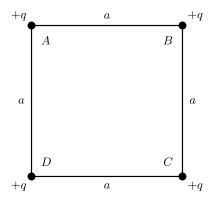
- GSEB Higher Secondary Certificate (HSC) Examination 2024Set ANNUAL1 markMCQQ.As shown in figure charges +q each are placed at the four vertices of a square. Then the coulombian force acting on charge placed at vertex D is ___.(a) (√2 + 1/2) kq^2/a^2(b) (√2 - 1/2) kq^2/a^2(c) √2 kq^2/a^2(d) kq^2/2a^2
›Reveal solutionSolution
The net force on a corner charge in a square of equal charges is the vector sum of two equal edge forces (perpendicular to each other) and one diagonal force.
Charge at D experiences:
- Force from A (distance a, along DA): magnitude kq²/a²
- Force from C (distance a, along DC): magnitude kq²/a², perpendicular to the A-force
- Force from B (diagonal, distance a√2): magnitude kq²/(a√2)² = kq²/(2a²), directed along the diagonal DB
The two equal perpendicular edge forces combine (Pythagoras) to give a resultant of magnitude √2 × kq²/a², directed exactly along the diagonal — the same direction as the diagonal force from B.
Total force = √2 kq²/a² + kq²/(2a²) = (√2 + 1/2) kq²/a².
✓Final answer(a) (√2 + 1/2) kq²/a².
- GSEB Higher Secondary Certificate (HSC) Examination 2023Set ANNUAL1 markMCQQ.The Coulombian repulsive force between two alpha particles kept at a distance of 3 cm in air is ___ N.(a) 1.024 x 10^-27(b) 1.024 x 10^-25(c) 1.024 x 10^-24(d) 1.024 x 10^-23
›Reveal solutionSolution
Alpha charge = 2e = 3.2x10^-19 C; Coulomb's law with r = 0.03 m gives F = 1.024 x 10^-24 N.
Each alpha particle has charge q = 2e = 3.2 x 10^-19 C. Separation r = 3 cm = 0.03 m.
Coulomb force: F = k q^2 / r^2 = (9 x 10^9)(3.2 x 10^-19)^2/(0.03)^2.
(3.2 x 10^-19)^2 = 1.024 x 10^-37; (0.03)^2 = 9 x 10^-4.
F = (9 x 10^9)(1.024 x 10^-37)/(9 x 10^-4) = (1.024 x 10^-37)(10^13) = 1.024 x 10^-24 N.
✓Final answer(c) 1.024 x 10^-24 N.
- GUJCET 2021Set 151 markMCQQ.Two large, thin metal plates are parallel and close to each other. On their inner faces, the plates have surface charge densities of same signs and of magnitude 17.7×10⁻²² C/m2. What is E in the outer region of the second plate? (A) 4×10⁻¹⁰ NC−1 (B) 2×10⁻¹⁰ NC−1 (C) 1×10⁻¹⁰ NC−1 (D) Zero
›Reveal solutionSolution
Same-sign charged plates give E=σ/ε0 in the outer region (fields add).
Concept: Each sheet produces 2ε0σ. In the region outside the second plate both fields point the same way and add:
E=2ε0σ+2ε0σ=ε0σ=8.85×10−1217.7×10−22≈2×10⁻¹⁰ N C−1.
✓Final answer(B) 2×10⁻¹⁰ NC−1
ANSWER: (B)
- GUJCET 2020Set 071 markMCQQ.Two point electric charges +10−8 C and −10−8 C are placed 0.1 m apart. Find the magnitude of Total Electric Field at the center of the line joining the two charges. (A) Zero (B) 3.6×10⁴NC−1 (C) 7.2×10⁴NC−1 (D) 12.96×10⁴NC−1
›Reveal solutionSolution
At the centre of a dipole-like pair, both fields point the same way and add.
Concept — superposition of fields. At the midpoint, the field of +q points away from it and the field of −q points toward it — both in the same direction, so they add.
Steps.
- Distance from each charge: r=0.05 m.
- Eone=r2kq=(0.05)29×109×10−8=0.002590=3.6×10⁴ NC−1.
- Total: E=2Eone=7.2×10⁴ NC−1.
✓Final answerOption (C) 7.2×10⁴NC−1
ANSWER: (C)
- GUJCET 2019Set 131 markMCQQ.When two sppheres having 4Q and −2Q charge are placed at a certain distance, the force acting between them is F. Now they are connected by a conducting wire and again separated from each other. Now they are kept at a distance half of the previous one. The force acting between them is .......... (A) 8F (B) 2F (C) 4F (D) F
›Reveal solutionSolution
Charges redistribute to Q each, and at half the separation the force is F/2.
Concept: When two conductors are joined by a wire the total charge shares equally. Coulomb force F=r2kq1q2.
Steps:
- Initial magnitude: F=d2k(4Q)(2Q)=d28kQ2.
- After connection each sphere has 24Q+(−2Q)=Q.
- New separation d/2: F′=(d/2)2kQ⋅Q=d24kQ2.
- Ratio: FF′=84=21, so F′=2F.
✓Final answerOption (B) — F/2
ANSWER: (B)
- GUJCET 2019Set 131 markMCQQ.Charge of 1μC each is placed on the five corners of a ragular hexagon of side 1m. The electric field at its centre is ...........N/C. (A) 10−6K (B) 56×10−6K (C) 5×10⁻⁶K (D) 65×10−6K
›Reveal solutionSolution
Missing one of six symmetric charges leaves a net field equal to a single charge's field, 10−6K.
Concept: By symmetry, six equal charges at the vertices of a regular hexagon produce zero field at the centre (each field cancels its diametric opposite). Removing one charge is equivalent to superposing the full symmetric set (field 0) with a single negative-of-that charge at that vertex, leaving the field of one charge.
Steps:
- For a regular hexagon, centre-to-vertex distance = side = 1 m.
- Field of one charge: E=r2kQ=12K(10−6)=10−6K N/C.
✓Final answerOption (A) — 10−6K
ANSWER: (A)
- GUJCET 2015Set C1 markMCQQ.A point charge q is situated at a distance r on axis from one end of a thin conducting rod of length L having a charge Q [Uniformly distributed along its length]. The magnitude of electric force between the two is _____. (A) r2KQq (B) r(r+L)2KQ (C) r(r−L)KQq (D) r(r+L)KQq
›Reveal solutionSolution
[!TLDR] Integrating the point-charge force over the uniformly charged rod gives F=r(r+L)KQq.
Concept
A charge distributed along a line is handled by integration: split it into elements dq, write the Coulomb force dF=x2Kqdq from each element at distance x, and integrate. Here all forces are collinear (rod on the axis), so they add as scalars.
Solution
Linear charge density λ=LQ, so dq=LQdx. The near end of the rod is at distance r, the far end at r+L.
F=∫rr+Lx2Kq⋅LQdx=LKqQ[−x1]rr+L=LKqQ(r1−r+L1).
=LKqQ⋅r(r+L)(r+L)−r=LKqQ⋅r(r+L)L=r(r+L)KqQ.
[!ANSWER] (D) r(r+L)KQq
🎓Unlock everything free for 14 days
- ✓Full step-by-step solutions
- ✓Concept-first explanations
- ✓Methods, shortcuts & mistakes
- ✓PYQ mapping + timed mock tests
Full access for 14 days. No credit card required.