Q.Draw a schematic diagram of Young's experiment and derive beta = lambda.D/d for the distance between two consecutive bright interference fringes.
🔒You're viewing a preview — the full solution, concept, methods & PYQ mapping are locked.
🔒 Start your 14-day free trial to unlock the full solution →Concept understanding — Fringe Width in Young's Double Slit Experiment
The bandwidth (fringe width) β is the distance between any two consecutive bright fringes, or equally, between any two consecutive dark fringes. Subtracting the position of the nth bright fringe from that of the (n+1)th, yn+1−yn=d(n+1)λD−dnλD=dλD, gives β=dλD; the identical result follows from consecutive dark fringes, confirming that bright and dark fringes are equally and uniformly spaced on either side of the central bright fringe. Fringe width therefore increases if the screen distance D is increased or if longer-wavelength light is used, and decreases if the slit separation d is increased; if the entire experimental setup is immersed in a medium of refractive index n (rather than air), the effective wavelength shortens to λ′=λ/n, shrinking the fringe width to β′=β/n. Because the central (zeroth-order) fringe corresponds to exactly zero path difference for every wavelength simultaneously, it stays sharply bright and white even under polychromatic (white light) illumination; away from the centre, each constitu …
In Young's double-slit setup, the path difference between light reaching a point on the screen from the two slits grows with the point's distance from the centre, and requiring that path difference to equal a whole number of wavelengths for constructive interference gives the spacing between successive bright fringes. …
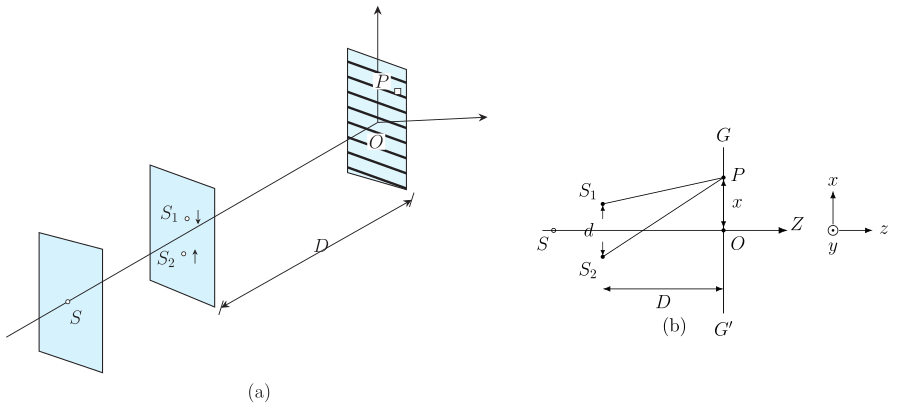
By approximating the path difference at a screen point as dy/D and requiring it to equal nλ (bright) or (n+½)λ (dark), successive bright fringes are found to be spaced by β = λD/d.
Schematic setup: a monochromatic source illuminates two narrow slits S1, S2 separated by distance d; a screen is placed a distance D (D >> d) away, parallel to the slit plane. Consider a point P on the screen at distance y from the central axis.
Step 1: Path difference. Since D >> d, the path difference between the two waves reaching P is approximately Δ=S2P−S1P≈Dyd.
Step 2: Condition for bright fringes (constructive interference): Δ=nλ⇒yn=dnλD, for n=0,±1,±2,…
…
Showing the 12 most recent of 17 on this concept.
- CBSE 2026Set ANNUAL1 markQ.Answer in one word/sentence: If red light source is used instead of blue light in Young's double slit experiment, what happens with Fringe width?
›Reveal solutionSolution
Fringe width is directly proportional to wavelength, and red light has a longer wavelength than blue, so the fringe width increases.
…
- CBSE 2026Set ANNUAL1 markQ.What is the fringe width in Young's double-slit experiment if a monochromatic ray of wavelength 5×10⁻⁵ cm falls on a double-slit separated by a distance of 0.025 mm and the screen is held at a distance of 5 cm?
›Reveal solutionSolution
Using the standard Young's double-slit fringe-width formula β=λD/d with the given wavelength, slit separation, and screen distance gives a fringe width of exactly 1 mm.
Formula
In Young's double-slit experiment, the fringe width (spacing between consecutive bright — or consecutive dark — fringes) is
β=dλD
where λ = wavelength of light, D = distance from the slits to the screen, and d = separation between the two slits.
Converting the given quantities to SI units
λ=5×10⁻⁵ cm=5×10⁻⁷ m
d=0.025 mm=2.5×10⁻⁵ m …
- CBSE 2026Set ANNUAL1 markMCQQ.In a Young's double-slit experiment, the slit separation is doubled. To maintain the same fringe spacing on the screen, the screen-to-slit distance D must be changed to :(a) 2D(b) 2D(c) 2D(d) 2D
›Reveal solutionSolution
Since fringe width β∝D/d, doubling the slit separation d requires doubling the screen distance D to keep the fringe spacing the same.
Working
Fringe width in Young's double-slit experiment: β=dλD.
Let d′=2d. For β′=β: …
- CBSE 2025Set ANNUAL1 markMCQQ.In Young's double slit experiment the fringe width is found to be β. If the entire apparatus is immersed in liquid of refractive index n, the new fringe width will be :(a) β(b) nβ(c) β/n(d) n²β
›Reveal solutionSolution
Immersing the YDSE setup in a liquid of refractive index n shrinks the wavelength of light inside the liquid, so the fringe width shrinks by the same factor n.
Fringe width in air is
β=dλD …
- CBSE 2025Set ANNUAL1 markMCQQ.How is interference pattern in double slit experiment affected, if a source of blue light is used in place of yellow light producing the same intensity ?(a) The fringe width will decrease(b) The fringe width will increase(c) The fringe width will become brighter(d) The fringe width will become fainter
›Reveal solutionSolution
Blue light has a shorter wavelength than yellow light, and fringe width is directly proportional to wavelength.
In Young's double slit experiment, fringe width is given by
β=dλD
…
- CBSE 2024Set 55/5/11 markMCQQ.Assertion (A): In Young's double slit experiment, when the two coherent sources are infinitely close to each other, the interference pattern cannot be observed. Reason (R): The fringe width is proportional to the separation between the two sources. (A) Both A and R are true and R is the correct explanation of A. (B) Both A and R are true but R is NOT the correct explanation of A. (C) A is true but R is false. (D) Both A and R are false.
›Reveal solutionSolution
As the two coherent sources are brought infinitely close (d→0), the fringe width β=λD/d→∞ -- the entire screen falls inside a single fringe, so no observable interference pattern forms. Assertion (A) is true. But Reason (R), as stated, claims fringe width is proportional to separation d -- the real relation β=λD/d makes β inversely proportional to d, so R (as worded) is false. Option (C).
Fringe width and source separation
In Young's double-slit experiment, the fringe width (spacing between consecutive bright or dark fringes) is
β=dλD,
where λ is the wavelength, D the screen distance, and d the separation between the two coherent sources.
β=dλD⇒β is INVERSELY proportional to d, not directly proportional.
Checking Assertion (A). As d→0, β=λD/d→∞: the fringes become infinitely wide, so within any real, finite screen only a single bright region is seen -- no distinguishable interference pattern (alternating bright/dark fringes) can be observed. So A is physically correct. …
- CBSE 2024Set A1 markMCQQ.The fringe width in interference of light due to two coherent sources is (A) proportional to wavelength (B) inversely proportional to wavelength (C) proportional to square of wavelength (D) inversely proportional to square of wavelength
›Reveal solutionSolution
In Young's double-slit experiment fringe width β = λD/d, hence β is directly proportional to wavelength → option (A).
The fringe width in a two-source interference pattern is given by
β=dλD
…
- CBSE 2024Set ANNUAL1 markMCQQ.In Young's double-slit experiment, a monochromatic ray of light of wavelength 5×10⁻⁵ cm falls on a double-slit of slit width 0.025 mm. If the phenomenon of interference is observed on the screen at a distance of 5 cm, the fringe width becomes(a) 0.1 mm(b) 1 mm(c) 0.01 mm(d) None of the above
›Reveal solutionSolution
In Young's double-slit experiment the fringe width is β=λD/d, where λ is the wavelength, D the slit-to-screen distance and d the slit separation. Substituting the given values directly gives the fringe width.
Convert every quantity to SI units
λ=5×10⁻⁵cm=5×10−5×10−2m=5×10⁻⁷m
d=0.025mm=0.025×10⁻³m=2.5×10⁻⁵m
D=5cm=5×10⁻²m
Apply the fringe-width formula
…
- CBSE 2023Set F1 markMCQQ.When the distance between source of light and screen is increased, then fringe width (A) increases (B) decreases (C) remains same (D) none of these
›Reveal solutionSolution
β=dλD; increasing D (screen distance) increases the fringe width.
In Young's double-slit experiment the fringe width is
β=dλD, …
- CBSE 2023Set ANNUAL1 markQ.In Young's double-slit experiment, what happens to the fringe width if the distance between the slits is increased? (Write the answer only)
›Reveal solutionSolution
In Young's double-slit experiment, fringe width β=λD/d is inversely proportional to the slit separation d, so increasing d decreases the fringe width.
The fringe width in YDSE is given by
β=dλD
…
- CBSE 2023Set ANNUAL1 markMCQQ.In Young's double-slit experiment, the slit separation is doubled. To maintain the same fringe spacing on the screen, the screen-to-slit distance D must be changed to :(a) 2D(b) 2D(c) 2D(d) 2D
›Reveal solutionSolution
Since fringe width β∝D/d, doubling the slit separation d requires doubling the screen distance D to keep β unchanged.
Working
In Young's double-slit experiment, the fringe width is
β=dλD
…
- CBSE 2022Set ANNUAL1 markQ.What will be the effect on fringe width in Young's double-slit experiment, if the distance between slit and screen increased?
›Reveal solutionSolution
Since β = λD/d, increasing D increases the fringe width proportionally, while λ and d are unchanged.
In Young's double-slit experiment, the fringe width (distance between two consecutive bright or dark fringes) is given by
β=dλD
where λ is the wavelength of light used, D is the distance between the plane of the slits and the screen, and d is the separation between the two slits.
…
🎓Unlock everything free for 14 days
- ✓Full step-by-step solutions
- ✓Concept-first explanations
- ✓Methods, shortcuts & mistakes
- ✓PYQ mapping + timed mock tests
Full access for 14 days. No credit card required.