Q.Draw a graph showing the intensity distribution of fringes due to diffraction at single slit.
🔒You're viewing a preview — the full solution, concept, methods & PYQ mapping are locked.
🔒 Start your 14-day free trial to unlock the full solution →Concept understanding — Single Slit Diffraction
Single Slit Diffraction: From Intuition to Precision
Imagine you're standing at the edge of a swimming pool and you send a straight wave toward a narrow gap in a wall. If the gap is wide, the wave mostly goes straight through — a clean "shadow" behind the wall. But if the gap is tiny, something strange happens: the wave spreads out in all directions beyond the gap, like ripples from a pebble. That spreading is diffraction.
Light does the same thing. When a parallel beam of light passes through a single narrow slit, it doesn't just make a sharp rectangle on a screen. Instead, you get a pattern: a bright central band, then dark bands (minima), then weaker bright bands (maxima), alternating as you move outward. The narrower the slit, the more the light spreads.
Why does this happen? The core idea
Light from every point across the slit travels to the screen. At any point on the screen, the light arriving from different parts of the slit has travelled different distances. If those path differences are exactly half a wavelength (λ/2), the waves cancel — you get darkness. If they are a whole wavelength (λ), they reinforce — you get a weaker bright band.
The key is that the slit is not a point source. It's a continuous line of sources, each sending out Huygens wavelets. The pattern is the result of interference among all those wavelets.
Common mistake
Students often think diffraction is just "bending around corners." That's part of it, but the real physics is interference between wavelets from different parts of the same slit. Without that interference, there would be no alternating dark and bright bands — just a fuzzy blur.
The precise condition for minima
Let the slit width be a and the wavelength be λ. For a point on a screen far away (the Fraunhofer or far-field condition), light rays from the slit are nearly parallel. The path difference between a wavelet from the top edge and one from the centre is 2asinθ, where θ is the angle from the straight-through direction.
For the first minimum, the wavelets from the top half of the slit cancel those from the bottom half exactly. That happens when the path difference between the two edges is exactly one wavelength:
asinθ=λ
For the second minimum, the slit can be divided into four equal zones, each cancelling the next, giving:
asinθ=2λ
In general, the condition for dark fringes (minima) is:
asinθ=mλfor m=±1,±2,±3,…
Notice m=0 is not a minimum — it's the centre of the bright central maximum.
What about the maxima?
The maxima occur roughly halfway between minima, but their positions are not given by a simple formula like asinθ=(m+21)λ. That formula works for double-slit interference, but for a single slit the maxima are slightly shifted. The exact positions come from solving a calculus problem (the derivative of the intensity function), but for exams you only need the minima condition and the fact that the central maximum is twice as wide as the others.
Quick exam fact
The angular width of the central maximum is 2θ1, where θ1 satisfies asinθ1=λ. So the central maximum spans from −λ/a to +λ/a in sinθ.
The intensity pattern (qualitative) …
In single-slit diffraction the wavelets from the slit interfere to give a broad, intense central maximum flanked by much weaker secondary maxima whose intensity falls off rapidly. …
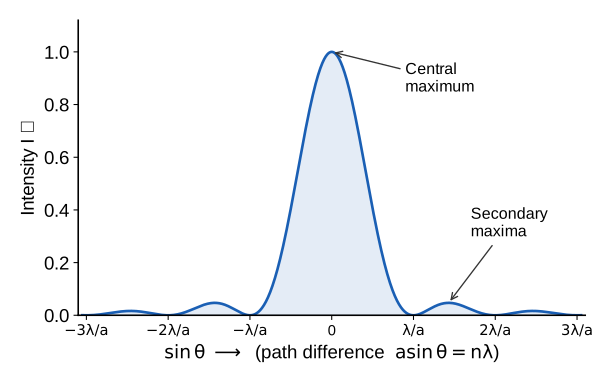
A central bright peak (twice as wide as the secondary bands) with rapidly diminishing side maxima; zeros at asinθ=mλ.
Concept. A single slit of width a acts as a set of Huygens wavelets. Path differences across the slit produce a diffraction pattern.
Why this shape. The intensity is I=I0(βsinβ)2 with β=λπasinθ. Minima occur where asinθ=mλ (m=±1,±2,…); secondary maxima lie roughly midway between minima with intensities ≈4.5%,1.6%… of the central peak.
…
- GSEB Higher Secondary Certificate (HSC) Examination 2026Set ANNUAL1 markMCQQ.Consider sunlight incident on a slit a width 10^4 Angstrom. The image seen through the slit shall ___.(a) a bright slit white at the center diffusing to regions of different colours(b) be a fine sharp slit white in colour at the center(c) a bright slit white at the center diffusing to zero intensities at the edges(d) only be a diffused slit white in colour
›Reveal solutionSolution
When the slit width (10^4 Angstrom = 1 micron) is comparable to the wavelength of visible light, diffraction dominates and the effect is strongly wavelength dependent, so the diffraction pattern spreads into colours away from the centre.
Visible light wavelengths span roughly 4000-7000 Angstrom, so a slit of width 10^4 Angstrom (10,000 Angstrom = 1 micron) is only about 1-2 times the wavelength - this is the regime where diffraction spreading is very pronounced and strongly depends on lambda. At the centre of the diffraction pattern all wavelengths reinforce (central maximum for every colour coincides), giving white lig …
- GSEB Higher Secondary Certificate (HSC) Examination 2023Set ANNUAL1 markMCQQ.A slit of size 'a' is illuminated by a parallel beam of light of wavelength lambda. The angle at which this light is diffracted is approximately ___.(a) a^2/lambda(b) lambda/a^2(c) lambda/a(d) a/lambda
›Reveal solutionSolution
Single-slit diffraction sends light into an angle of order theta = lambda/a.
For a slit of width a illuminated by wavelength lambda, the first diffraction minimum is at a sin(theta) = lambda, so for small angles: …
- GSEB Higher Secondary Certificate (HSC) Examination 2022Set ANNUAL1 markMCQQ.When the width of an aperture (obstacle) is a and the wavelength is λ, ray optics will be a good approximation for distances ______.(a) λ^2 / a(b) λ / a(c) a / λ(d) a^2 / λ
›Reveal solutionSolution
The Fresnel distance a²/λ marks the boundary up to which light travels essentially in straight lines (ray optics is valid); beyond it, diffraction spreading becomes significant.
For an aperture of width a and wavelength λ, the Fresnel distance is defined as:
zF=λa2
…
- GSEB Higher Secondary Certificate (HSC) Examination 2022Set ANNUAL1 markMCQQ.The number of interference fringes contained within the diffraction peak of a given width depends on the ratio ______ (where d = the distance between the two slits, a = width of the slit).(a) d^2 / a(b) a / d(c) d / a(d) a^2 / d
›Reveal solutionSolution
In a real double-slit experiment, interference fringes are modulated by the single-slit diffraction envelope; the number visible inside the central diffraction peak scales with d/a.
…
- GSEB Higher Secondary Certificate (HSC) Examination 2022Set ANNUAL1 markMCQQ.Which of the following statements is incorrect?(a) The intensity of the central diffraction fringe is the greatest(b) All the illuminated interference fringes have equal intensity(c) The interference fringes are of equal width(d) The diffraction fringes are of equal width
›Reveal solutionSolution
Diffraction fringes (unlike interference fringes) are NOT equally wide — the central maximum is twice as broad as the secondary maxima, making statement (d) the incorrect one.
Checking each statement:
- True - the central diffraction fringe carries the most intensity.
- True - in Young's double-slit setup with equal slit widths, interference fringes have essentially equal intensity (ignoring the slow diffraction envelope variation).
- True - interference fringes are equally spaced/equal width. …
- GSEB Higher Secondary Certificate (HSC) Examination 2022Set ANNUAL1 markMCQQ.A slit has width a. A convex lens of focal length f is placed immediately behind it. When light of wavelength λ is incident normally on the slit and comes to a focus, the width of the central (relative) maximum obtained will be ______.(a) f / (aλ)(b) λa / f(c) a / (fλ)(d) fλ / a
›Reveal solutionSolution
With a lens right behind the slit focusing the diffraction pattern onto its focal plane, the half-width of the central maximum works out to fλ/a.
For single-slit diffraction, the first minimum occurs at angle θ where asinθ=λ, i.e. θ≈λ/a for small angles.
…
- GUJCET 2019Set 131 markMCQQ.The angular spread of central maximum, in diffraction pattern, does not depend on........... (A) Frequency of light (B) Wavelength of light (C) Width of slit (D) The distance between the slit and source
›Reveal solutionSolution
The angular spread of the central diffraction maximum, 2θ=2λ/a, depends only on the wavelength and slit width.
Concept first: For single-slit diffraction the first minima lie at sinθ=±λ/a, so the angular width of the central maximum is
2θ≈a2λ. …
- GSEB Higher Secondary Certificate (HSC) Examination 2018Set ANNUAL1 markMCQQ.The angular spread of central maximum, in diffraction pattern, does not depend on ___.(a) the distance between the slit and sources(b) wavelength of light(c) width of slit(d) frequency of light
›Reveal solutionSolution
The angular half-width of the central diffraction maximum is lambda/a (full width 2*lambda/a); it depends on wavelength/frequency and slit width a, but not on the slit-to-source distance.
For single-slit diffraction, the first minimum is at sin(theta) = lambda/a, so the angular spread of the central maximum is about 2*lambda/a.
This depends on:
- wavelength lambda (and hence frequency, since c = f lambda), …
🎓Unlock everything free for 14 days
- ✓Full step-by-step solutions
- ✓Concept-first explanations
- ✓Methods, shortcuts & mistakes
- ✓PYQ mapping + timed mock tests
Full access for 14 days. No credit card required.