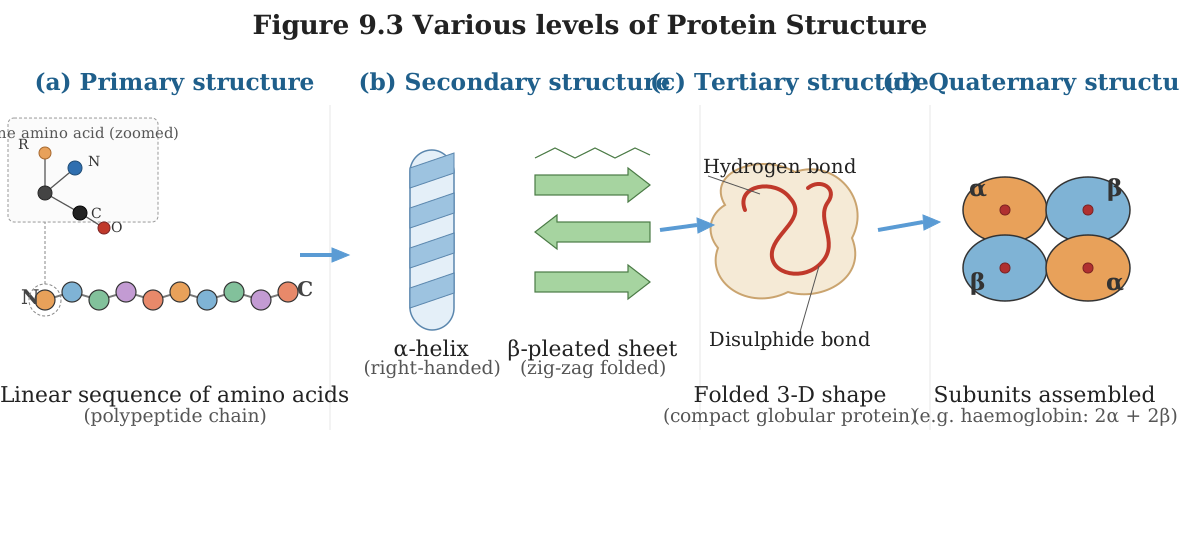
You are looking at a protein for the first time. It looks like a tangled knot of beads on a string. That string is a chain of amino acids, and the way that chain folds itself into a specific, functional shape is what we call its structure. But a protein doesn't just snap into its final shape all at once. It happens in distinct stages, or levels, each building on the last.
Think of it like building a house. You don't just throw bricks in a pile and hope for a living room. You start with a blueprint (the sequence of bricks), then you build the walls (local patterns), then you arrange those walls into rooms (the overall 3D shape), and finally you might combine several rooms into a mansion (multiple protein chains working together). That is exactly how a protein is built.
Level 1: The Primary Structure — The Blueprint
This is the simplest and most fundamental level. It is simply the linear sequence of amino acids in the polypeptide chain. That's it. No folding, no twisting, just a list.
Each amino acid is like a letter in a word. The order of these letters is determined by the gene that codes for the protein. Change one letter, and you change the word. Change one amino acid, and you can change the entire protein's final shape and function. This is why a single mutation in the gene for hemoglobin (changing one amino acid) causes sickle cell anemia — the entire protein folds wrong.
Primary Structure = The specific, linear sequence of amino acids, held together by peptide bonds.
Level 2: The Secondary Structure — The Local Folds
Now the chain starts to interact with itself. The backbone of the chain — not the side chains of the amino acids — forms regular, repeating patterns. These patterns are stabilized by hydrogen bonds between the carbonyl oxygen of one amino acid and the amide hydrogen of another, a few residues away.
There are two main shapes you will see:
- Alpha-helix (α-helix): A right-handed coil, like a spiral staircase or a spring. The hydrogen bonds form between every 4th amino acid, making the structure very stable.
- Beta-pleated sheet (β-sheet): The chain folds back and forth, forming a zigzag "pleated" shape. Hydrogen bonds form between adjacent segments of the chain, holding them side-by-side like a folded piece of paper.
Secondary structure is purely about the backbone. The side chains (the "R groups") of the amino acids point outward from these structures, ready to interact in the next level.
Level 3: The Tertiary Structure — The Global 3D Shape
This is where the protein becomes a functional, three-dimensional object. The entire polypeptide chain — including all its alpha-helices and beta-sheets — folds up into a compact, globular shape. This is driven by interactions between the side chains (R groups) of the amino acids.
These interactions are much more diverse than simple hydrogen bonds:
- Hydrophobic interactions: Nonpolar, "water-fearing" side chains cluster together in the core of the protein, away from water.
- Ionic bonds (salt bridges): Positively and negatively charged side chains attract each other.
- Hydrogen bonds: Between polar side chains.
- Disulfide bridges: A strong, covalent bond that forms between the sulfur atoms of two cysteine amino acids. This is like a permanent, welded lock that holds the shape together.
The tertiary structure is the final, functional shape for a single polypeptide chain. It is the result of all the interactions between the side chains, folding the secondary structures into a unique, biologically active conformation.
Level 4: The Quaternary Structure — The Team
Many proteins are not just one chain. They are made of multiple polypeptide chains (called subunits) that come together to form a single, functional complex. This assembly of multiple chains is the quaternary structure.
Each subunit is a fully folded tertiary structure on its own. But they only work when they are assembled together. …