Chemistry · Ch 7 — Alcohols, Phenols and Ethers
Chemical Reactions
Chemical Reactions
Alcohols and phenols both carry a hydroxyl group, so at first glance their chemistry looks similar. But where that –OH group sits changes everything: in an alcohol it hangs off an carbon, while in a phenol it hangs directly off an aromatic carbon that is itself wired into a delocalised π system. That single structural difference is the thread running through every reaction below — it makes phenols far more acidic than alcohols, lets phenols undergo ring substitution that alcohols simply cannot, and blocks phenols from most of the C–O bond-breaking chemistry that defines alcohol reactivity. Broadly, the reactions fall into two mechanistic buckets: those that break the O–H bond (acid–base chemistry, ester formation) and those that break the C–O bond (halide formation, dehydration, oxidation) — the second kind is essentially exclusive to alcohols.
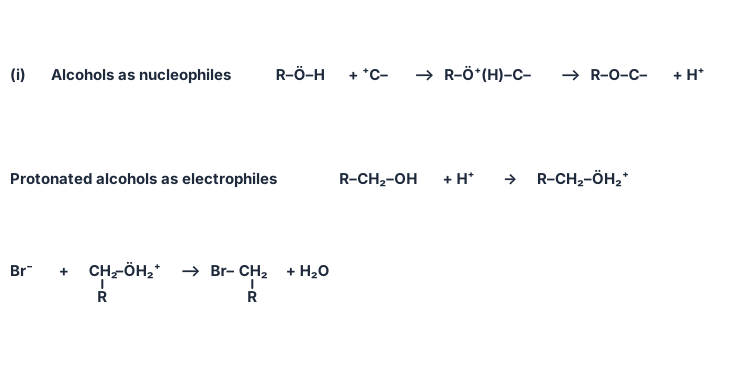
Drawn by us to help you understand the concept clearly, and verified to make sure it's accurate. For exams, practice from your textbook's own diagram.
Redrawn from the NCERT page with the structures, printed labels (CH2, –ÖH2⁺, Br–) and reagent placement exactly as the …
(a) Reactions Involving Cleavage of the O–H Bond
1. Acidity of Alcohols and Phenols
(i) Reaction with Metals
Alcohols react with reactive metals — sodium, potassium, even aluminium — displacing hydrogen and generating a metal alkoxide.
Aluminium behaves the same way with tertiary alcohols, giving an aluminium alkoxide salt — e.g. tert-butyl alcohol with aluminium turnings yields aluminium tert-butoxide plus hydrogen gas:
Just like alcohols, phenols react with active metals (sodium, aluminium) to liberate hydrogen and form a phenoxide salt, and — tellingly — phenols also react with aqueous sodium hydroxide to give sodium phenoxide and water, something alcohols do not do under ordinary conditions. This alone signals that phenols are appreciably more acidic than alcohols.
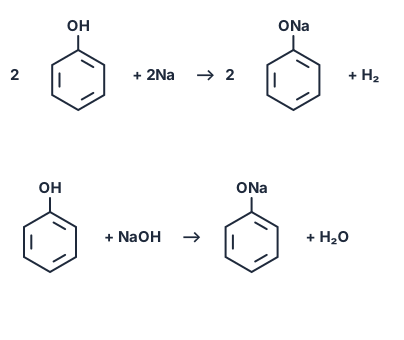
Drawn by us to help you understand the concept clearly, and verified to make sure it's accurate. For exams, practice from your textbook's own diagram.
Redrawn from the NCERT page with the structures, printed labels (OH, ONa) and reagent placement exactly as the t …
This is exactly the kind of reaction a Brønsted acid gives: the alcohol is donating a proton to a base (the metal, effectively, through the intermediacy of its electrons), and more generally an alcohol will hand its O–H proton to any sufficiently strong base , producing the conjugate acid and an alkoxide ion as the conjugate base:
(ii) Acidity of Alcohols
Why is an alcohol acidic at all, and why do different alcohols differ in acid strength? The O–H bond in an alcohol is polar because oxygen is far more electronegative than hydrogen, and it is this bond polarity that lets the proton be donated. An alkyl group attached to that oxygen is electron-releasing (a +I, or inductive, effect) — it pushes electron density toward the oxygen. That extra electron density does two unhelpful things for acidity: it partially cancels the O–H bond's polarity (a less positive H is a worse proton to give away), and — more importantly — it destabilises the alkoxide ion that would result after the proton leaves, because the negative charge on oxygen is now sitting next to an even more electron-rich alkyl framework pushing more density onto it. A less stable conjugate base means a weaker acid.
This effect compounds with every extra alkyl group on the carbon bearing the –OH. A tertiary alcohol has three electron-donating alkyl groups feeding density toward the oxygen (and destabilising the resulting tertiary alkoxide), a secondary alcohol has two, and a primary alcohol has only one. Consequently, acid strength of simple alcohols falls off sharply as substitution increases:
Despite being acidic enough to react with active metals, alcohols are still weaker acids than water. This can be shown by mixing an alkoxide with water: the alkoxide ion pulls a proton off water, regenerating the alcohol and forming hydroxide ion:
Since this reaction proceeds essentially to completion in the direction shown, water must be the better proton donor of the two — i.e., the stronger acid — while the alkoxide ion, being the stronger base of the pair, shows that alkoxides (such as sodium ethoxide) are stronger bases than hydroxide. The flip side of an alcohol's mild acidity is a mild basicity: the oxygen atom still carries lone pairs, so an alcohol can also act as a Brønsted base and accept a proton under sufficiently acidic conditions — this dual "acid or base depending on the partner" character comes directly from those lone pairs plus the polar O–H bond.
Among simple alcohols the acidity order is 1° > 2° > 3°, the exact reverse of the carbocation stability order you meet later in dehydration and substitution chemistry. Both trends have the same root cause (alkyl groups are electron donors) — they simply favour opposite species: a carbocation is stabilised by electron donation into the empty orbital, while an alkoxide anion is destabilised by extra electron density being pushed onto an already-negative oxygen.
(iii) Acidity of Phenols
The underlying reason is the hybridisation and electronic environment of the carbon the –OH sits on. In phenol, the hydroxyl oxygen is attached directly to an -hybridised ring carbon. An carbon is more electronegative than an carbon (more s-character means the bonding electrons are held closer to the nucleus), so this ring carbon behaves as an electron-withdrawing attachment rather than the electron-donating alkyl group an alcohol has. Because of this, and because the –OH oxygen's lone pair can conjugate into the ring, the resonance structures of neutral phenol actually place a fractional positive charge on the hydroxyl oxygen itself (delocalising electron density from oxygen into the ring) — the opposite of what happens in an alcohol, where the alkyl group pushes density toward the oxygen.
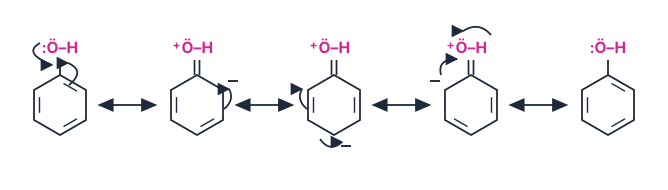
Drawn by us to help you understand the concept clearly, and verified to make sure it's accurate. For exams, practice from your textbook's own diagram.
Redrawn from the NCERT page with the structures, printed labels (:Ö–H, +Ö-H) and reagent placement exactly as the …
This has two reinforcing consequences for acidity. First, because the ring carbon withdraws density from oxygen, the O–H bond in phenol is more polarised than the O–H bond in an alcohol, which by itself favours easier proton loss.
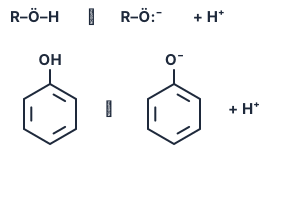
Drawn by us to help you understand the concept clearly, and verified to make sure it's accurate. For exams, practice from your textbook's own diagram.
Redrawn from the NCERT page with the structures, printed labels (OH, O⁻) and reagent placement exactly as the t …
Second — and more decisively — once the proton is lost, the resulting phenoxide ion is dramatically more stable than a simple alkoxide ion, because the negative charge is not stuck on oxygen alone: it delocalises around the ring through resonance, distributing the charge over the oxygen and the ortho/para ring carbons.
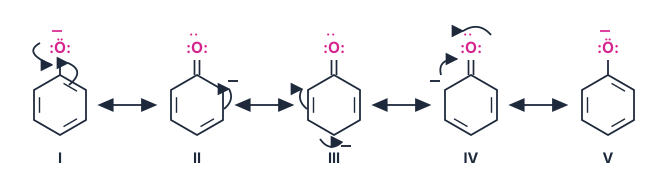
Drawn by us to help you understand the concept clearly, and verified to make sure it's accurate. For exams, practice from your textbook's own diagram.
Redrawn from the NCERT page with the structures, printed labels (:Ö⁻, :O:) and reagent placement exactly as the t …
An alkoxide ion, by contrast, has nowhere for its negative charge to go — it is localised entirely on the single oxygen atom. A more stable conjugate base means a stronger acid, so phenol ionises far more readily than any simple alcohol, even though phenol's neutral form is also somewhat stabilised by (a smaller amount of) resonance — the ion is stabilised by resonance more than the neutral molecule is, and it is that differential stabilisation that drives the equilibrium toward ionisation.
Phenol sits in the middle of a three-tier acidity ladder: it is enormously more acidic than an alcohol (resonance-delocalised phenoxide vs. a localised alkoxide — reflected quantitatively in the pKa values of Table 7.3, where phenol is roughly a million times more acidic than ethanol) but it is still markedly less acidic than a carboxylic acid, because a carboxylate ion delocalises its negative charge symmetrically over two equivalent, highly electronegative oxygens (a stronger stabilisation than spreading charge into a carbon-based aromatic ring can achieve). So the strength order is: carboxylic acid > phenol > alcohol (and phenol > water as well, given its reaction with NaOH).
Substituents on the ring tune this acidity further, and the direction of the effect depends on whether the substituent withdraws or donates electron density — and, importantly, on where it sits.
- Electron-withdrawing groups increase acidity. A group such as – pulls electron density out of the ring, which further stabilises the phenoxide ion's delocalised negative charge — so nitrophenols are noticeably more acidic than phenol itself. This effect is strongest when the electron-withdrawing group sits at the ortho or para position, because only from those positions can the group's own resonance/conjugation reach the very ring carbons that carry part of the phenoxide's delocalised negative charge; a meta-substituent can only act inductively (through the σ-framework) and not through the same direct resonance pathway, so its acid-strengthening effect is comparatively muted. This is why ortho- and para-nitrophenol are distinctly more acidic than meta-nitrophenol. Pushed to the extreme, a phenol carrying three nitro groups at the 2,4,6-positions (2,4,6-trinitrophenol, picric acid) becomes a strong acid, since three separate electron-withdrawing groups — two of them ortho/para to the oxygen — cooperate to stabilise the resulting anion very effectively.
- Electron-releasing groups decrease acidity. An alkyl substituent, being electron-donating (the same +I effect seen in alcohols), pushes density back onto the ring and works against phenoxide stabilisation — so the cresols (methylphenols), for example, are all somewhat less acidic than phenol itself, mirroring how an alkyl group reduces acidity in a simple alcohol.
| Compound | Formula | |
|---|---|---|
| o-Nitrophenol | o- | 7.2 |
| m-Nitrophenol | m- | 8.3 |
| p-Nitrophenol | p- | 7.1 |
| Phenol | 10.0 | |
| o-Cresol | o- | 10.2 |
| m-Cresol | m- | 10.1 |
| p-Cresol | p- | 10.2 |
2. Esterification
Alcohols (and, just as readily, phenols) react with carboxylic acids, acid chlorides, and acid anhydrides to form esters — a transformation broadly called esterification, and specifically acetylation when the group being introduced is the acetyl group, .
With a carboxylic acid, the reaction is acid-catalysed (a trace of concentrated sulphuric acid is typically used) and is an equilibrium:
Because this is a genuine equilibrium (this is the Fischer-type esterification you will meet formally with carboxylic acid chemistry), it does not run to completion on its own — the water produced has to be continuously removed (e.g. by distillation) to keep pulling the equilibrium toward the ester side.
With an acid anhydride, the same overall transformation happens, releasing a carboxylic acid instead of water, again acid-catalysed:
With an acid chloride, the reaction is driven forward by using a base — typically pyridine — rather than an acid catalyst:
The pyridine's job here is to mop up the HCl generated as it forms, which prevents HCl from building up and pushing the reaction backward — in effect it shifts the equilibrium (or, since acid chlorides react essentially irreversibly, simply removes an inhibitory by-product) firmly toward the ester product.
A pharmaceutically important example of this chemistry is the acetylation of salicylic acid (2-hydroxybenzoic acid) with acetic anhydride, which installs an acetate ester on the phenolic –OH and produces acetylsalicylic acid — aspirin — alongside acetic acid as the by-product:
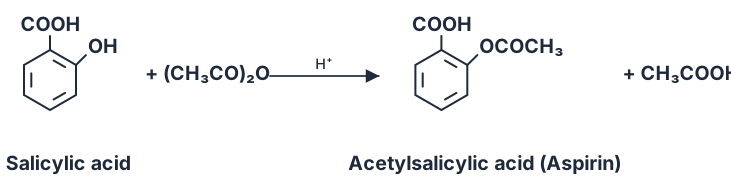
Drawn by us to help you understand the concept clearly, and verified to make sure it's accurate. For exams, practice from your textbook's own diagram.
Redrawn from the NCERT page with the structures, printed labels (COOH, OH, OCOCH₃) and reagent placement exactly as the …
Note that salicylic acid has both a phenolic –OH and a –COOH group; it is the phenolic oxygen that gets acetylated here, leaving the carboxylic acid untouched.
(b) Reactions Involving Cleavage of the Carbon–Oxygen (C–O) Bond in Alcohols
This entire class of reaction — breaking the bond between the carbon and the oxygen of the hydroxyl group — is essentially the private property of alcohols. Phenols do not undergo it, with one narrow exception (reaction with zinc dust, covered later under phenol-only reactions).
1. Reaction with Hydrogen Halides
Alcohols react with hydrogen halides to give the corresponding alkyl halide, with water as the by-product:
What makes this reaction diagnostically useful is that the three classes of alcohols react at very different rates, and this difference is exploited in the Lucas test. The Lucas reagent is a mixture of concentrated HCl and anhydrous (the zinc chloride acts as a Lewis acid, coordinating to the alcohol oxygen and helping it leave as a much better leaving group than plain hydroxide would be). All three classes of alcohol dissolve in the Lucas reagent to begin with (the reagent is polar enough, and the alcohol still has its polar –OH), but the alkyl chloride product that forms is not soluble — so as reaction proceeds a second, turbid/cloudy layer separates out. A tertiary alcohol forms this cloudiness almost immediately at room temperature (it ionises the fastest, following an -type pathway through a comparatively stable tertiary carbocation intermediate). A secondary alcohol takes several minutes to show turbidity at room temperature — the intermediate secondary carbocation is far less stabilised, so the ionisation step is slower, though the mechanism is still substantially carbocation-mediated. A primary alcohol shows essentially no turbidity at room temperature at all — a primary carbocation is too unstable to form readily, so a primary alcohol instead reacts (when it does, typically needing heat) by a more concerted, back-side-attack (-type) pathway in which chloride ion displaces the (zinc-chloride-activated) leaving group in a single step, without a fully-formed carbocation intermediate. The net effect is that the rate at which the turbidity appears — immediate, minutes, or essentially not-at-all-until-heated — tells you which class of alcohol you are looking at.
2. Reaction with Phosphorus Trihalides
Alcohols are also converted to alkyl halides — specifically alkyl bromides — by treatment with phosphorus tribromide. This is one more route into the same C–O bond-cleaving alkyl-halide chemistry as the hydrogen-halide reaction above.
3. Dehydration
Heating an alcohol with a protic acid such as concentrated sulphuric acid or phosphoric acid — or, alternatively, passing its vapour over a catalyst such as anhydrous zinc chloride or activated alumina — eliminates a molecule of water and produces an alkene:
Ethanol itself needs fairly forcing conditions — concentrated at 443 K:
Secondary and tertiary alcohols dehydrate far more easily, under noticeably milder conditions — for instance propan-2-ol dehydrates with 85% phosphoric acid at 440 K to give propene, and 2-methylpropan-2-ol (tert-butyl alcohol) dehydrates with just 20% phosphoric acid at the lower temperature of 358 K to give isobutylene (2-methylprop-1-ene).
This spread in required conditions gives a clean ease-of-dehydration order:
This order runs exactly parallel to carbocation stability, because the dehydration mechanism (for secondary and tertiary alcohols in particular) proceeds through a carbocation, and a more stable carbocation forms faster and under milder conditions. Concretely, the acid-catalysed dehydration of ethanol illustrates the three-step mechanism:
- Step 1 — protonation of the alcohol (fast): the acid protonates the hydroxyl oxygen, converting the poor leaving group –OH into the much better leaving group – (the "oxonium ion" / protonated alcohol). This is a fast, reversible acid–base step.
- Step 2 — loss of water to form a carbocation (slow, rate-determining): the C–O bond breaks heterolytically, water departs as a neutral leaving group, and a carbocation is left on the carbon that used to bear the hydroxyl. Because breaking a C–C-adjacent bond to generate a full positive charge is intrinsically the highest-energy step of the sequence, this is the slowest step and therefore controls the overall rate — which is exactly why more-substituted (more stable) carbocations dehydrate faster: a tertiary carbocation is reached over a lower energy barrier than a secondary one, which in turn is lower than a primary one.
- Step 3 — loss of a proton to give the alkene: a base (which can simply be another molecule of the solvent/acid system) removes a proton from a carbon adjacent to the cationic centre, and the electron pair from that C–H bond forms the new π bond, giving the alkene and regenerating a proton.
The proton consumed in step 1 is exactly the proton released again in step 3 — the acid catalyst is regenerated, not consumed overall. Because the whole sequence is an equilibrium, the alkene product is typically removed as it forms (e.g. by distilling it off, since it is often volatile) to keep driving the equilibrium toward completion.
When a secondary or tertiary alcohol can lose water in more than one direction (i.e., there is more than one β-hydrogen environment available to the carbocation), the more highly substituted, more stable alkene tends to dominate as the major product — the general preference for the more-substituted double bond in such eliminations is commonly called Saytzeff's (Zaitsev's) rule. It follows naturally from the same carbocation intermediate that governs the rate: whichever proton loss leads to the more conjugated/hyperconjugated, lower-energy alkene is kinetically and thermodynamically favoured.
4. Oxidation
Oxidation of an alcohol is, mechanistically, the reverse idea of dehydration in terms of bonds broken and made: instead of breaking a C–H and a C–OH bond to make a C=C, oxidation breaks an O–H bond and a C–H bond (on the carbon bearing the hydroxyl) to build a carbon–oxygen double bond. Because dihydrogen is effectively lost from the molecule in the process, these reactions are also described as dehydrogenation reactions.
What the alcohol is converted into depends on both its class (1°, 2°, or 3°) and on how strong/selective the oxidising agent is.
A primary alcohol, oxidised with a strong, unselective oxidant such as acidified potassium permanganate or acidified potassium dichromate, goes all the way through to the carboxylic acid — the intermediate aldehyde is not isolable because it too gets oxidised under those same vigorous conditions:
To stop cleanly at the aldehyde stage, a milder or more selective oxidant is needed. Chromium trioxide in an anhydrous medium will do this:
but the reagent of choice for reliably good yields of aldehyde from a primary alcohol is pyridinium chlorochromate (PCC) — a complex of chromium trioxide with pyridine and HCl — precisely because it is mild enough not to push the oxidation on to the acid, and it also tolerates a C=C double bond elsewhere in the molecule without touching it, e.g. an allylic primary alcohol is oxidised cleanly to the corresponding α,β-unsaturated aldehyde without over-oxidation or alkene attack.
A secondary alcohol is oxidised to a ketone by chromic anhydride (); since a ketone has no further hydrogen on that carbon to remove, there is no over-oxidation pathway analogous to the aldehyde-to-acid step, and the ketone is a stable end point.
A tertiary alcohol has no hydrogen on the carbinol carbon at all, so it simply cannot undergo this oxidation — there is no C–H bond there to break in forming a C=O. Under forcing conditions (a strong oxidant like combined with elevated temperature) a tertiary alcohol can still be attacked, but only by oxidative cleavage of various C–C bonds around that carbon, fragmenting the molecule into a mixture of smaller carboxylic acids rather than giving a single clean oxidation product.
A separate, catalytic route to the same aldehyde/ketone oxidation level is dehydrogenation over hot copper: passing the vapour of a primary or secondary alcohol over copper heated to 573 K removes dihydrogen catalytically, giving an aldehyde from a primary alcohol or a ketone from a secondary alcohol. A tertiary alcohol, lacking the necessary carbinol hydrogen for this dehydrogenation, instead undergoes dehydration under the same hot-copper conditions, giving an alkene rather than a carbonyl compound.
This oxidation chemistry has a grim real-world consequence. In the body, both methanol and ethanol are biologically oxidised the same way — alcohol first to the aldehyde, then to the acid. Methanol is oxidised to methanal (formaldehyde) and then to methanoic (formic) acid, and it is this metabolic product, not methanol itself, that causes the blindness and death associated with methanol poisoning. The standard emergency treatment is intravenous ethanol: because the oxidising enzyme preferentially handles ethanol, flooding the system with ethanol competitively ties up the enzyme, buying time for the kidneys to excrete the unmetabolised methanol before it can be converted to its toxic oxidation products.
(c) Reactions of Phenols
Because the phenolic –OH sits on an aromatic ring, phenol chemistry diverges from alcohol chemistry in two big ways: the O–H bond is more readily broken (higher acidity), while the C–O bond essentially cannot be broken by the routes available to alcohols. In addition, phenols gain an entirely new mode of reactivity that alcohols do not have at all — electrophilic substitution on the ring itself, since the –OH group is a powerful activator and ortho/para-director for the aromatic system it sits on.
Reactions that cleave the C–O bond — halide formation with HX, dehydration, oxidation to a carbonyl compound — are chemistry unique to alcohols and are not shown by phenols, with the single exception that phenols do react with zinc dust (covered below, under reactions of phenols only). The aromatic C–O bond in phenol is much stronger and far less prone to heterolytic cleavage than the aliphatic C–O bond of an alcohol, partly because breaking it would require generating a highly unstable aryl cation, and partly because that bond has significant double-bond character from conjugation of the oxygen lone pair with the ring.
1. Electrophilic Aromatic Substitution
Because the –OH group's oxygen lone pair conjugates into the ring (the same resonance donation that shows up in the phenoxide-stabilisation picture above and in the acidity resonance structures), the –OH group is a strong activator of the aromatic ring toward electrophilic substitution, and it directs incoming electrophiles to the ortho and para positions — those are precisely the ring positions that carry extra electron density in the resonance structures, making them the most nucleophilic (most attractive to an electrophile) sites on the ring.
(i) Nitration
With dilute nitric acid at a low temperature (298 K), phenol is nitrated to give a mixture of ortho- and para-nitrophenol.
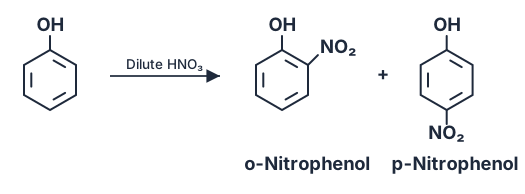
Drawn by us to help you understand the concept clearly, and verified to make sure it's accurate. For exams, practice from your textbook's own diagram.
Redrawn from the NCERT page with the structures, printed labels (OH, NO2) and reagent placement exactly as the t …
…
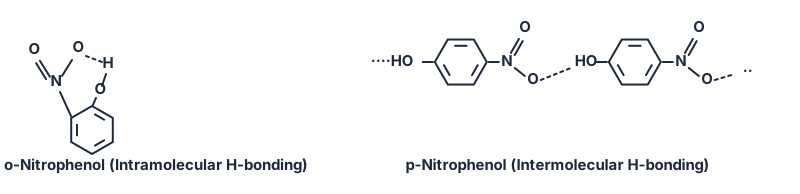
Drawn by us to help you understand the concept clearly, and verified to make sure it's accurate. For exams, practice from your textbook's own diagram.
Redrawn from the NCERT page with the structures, printed labels () and reagent placement exactly as the te …
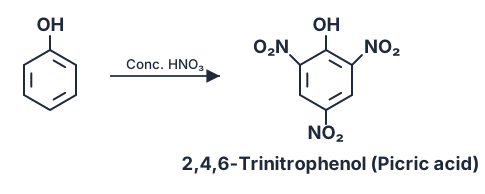
Drawn by us to help you understand the concept clearly, and verified to make sure it's accurate. For exams, practice from your textbook's own diagram.
Redrawn from the NCERT page with the structures, printed labels (OH, O2N, NO2) and reagent placement exactly as the …
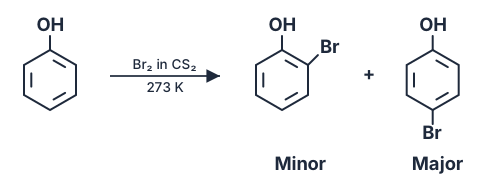
Drawn by us to help you understand the concept clearly, and verified to make sure it's accurate. For exams, practice from your textbook's own diagram.
Redrawn from the NCERT page with the structures, printed labels (OH, Br) and reagent placement exactly as the t …
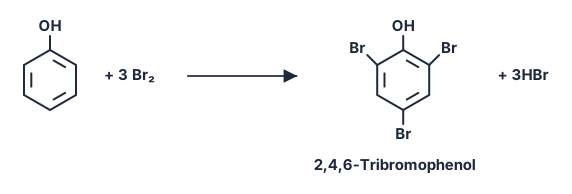
Drawn by us to help you understand the concept clearly, and verified to make sure it's accurate. For exams, practice from your textbook's own diagram.
Redrawn from the NCERT page with the structures, printed labels (OH, Br) and reagent placement exactly as the t …
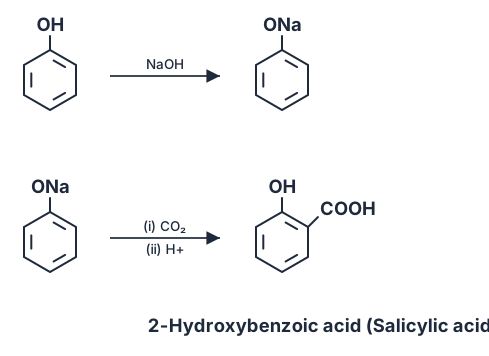
Drawn by us to help you understand the concept clearly, and verified to make sure it's accurate. For exams, practice from your textbook's own diagram.
Redrawn from the NCERT page with the structures, printed labels (OH, ONa, COOH) and reagent placement exactly as the …
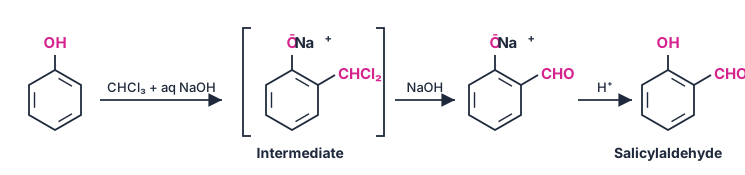
Drawn by us to help you understand the concept clearly, and verified to make sure it's accurate. For exams, practice from your textbook's own diagram.
Redrawn from the NCERT page with the structures, printed labels (OH, Ō Na⁺, CHCl2, CHO) and reagent placement exactly as the …
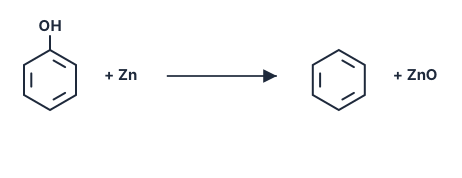
Drawn by us to help you understand the concept clearly, and verified to make sure it's accurate. For exams, practice from your textbook's own diagram.
Redrawn from the NCERT page with the structures, printed labels (OH) and reagent placement exactly as the t …
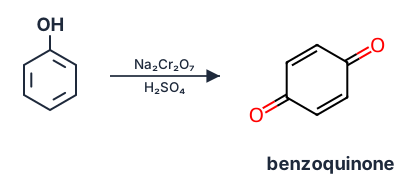
Drawn by us to help you understand the concept clearly, and verified to make sure it's accurate. For exams, practice from your textbook's own diagram.
Redrawn from the NCERT page with the structures, printed labels (OH, O, benzoquinone) and reagent placement exactly as the …