Question of 115
Q.While giving labelled diagram of dry cell write reactions taking place at cathode and anode.
Haryana BsehBSEH Intermediate Board 2019Subjective· 2mImportance★★★★★
0% · 0/115 Questions
You're viewing a preview — the full solution, concept, methods & PYQ mapping are locked.
Start your 14-day free trial to unlock the full solution →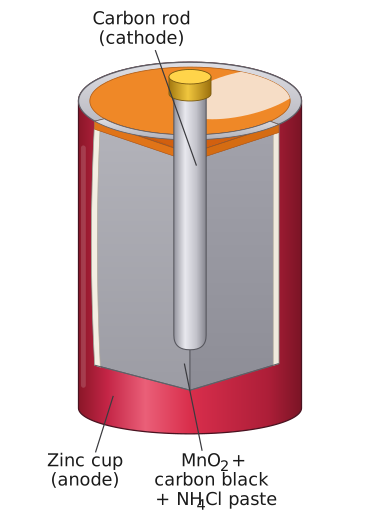
The dry cell has a zinc container as anode and a central carbon rod packed in MnO₂/carbon paste as cathode, with a moist NH₄Cl–ZnCl₂ paste as electrolyte.
Construction of the dry cell (Leclanché cell):
- The outer casing is a zinc container, which also serves as the anode.
- In the centre stands a carbon (graphite) rod, surrounded by a compressed paste/powder of manganese dioxide (MnO₂) and carbon black; this carbon rod (with the MnO₂/carbon mixture) is the cathode.
- Between the zinc container and the central cathode assembly is a moist paste of ammonium chloride (NH₄Cl) and zinc chloride (ZnCl₂), which acts as the electrolyte.
- The whole assembly is sealed to prevent the moist paste from drying out (hence "dry" cell, though it is not perfectly dry).
Electrode reactions:
Anode (oxidation, zinc container):
…
Unlock everything free for 14 days
- Full step-by-step solutions
- Concept-first explanations
- Methods, shortcuts & mistakes
- PYQ mapping + timed mock tests
Full access for 14 days. No credit card required.