Question of 42
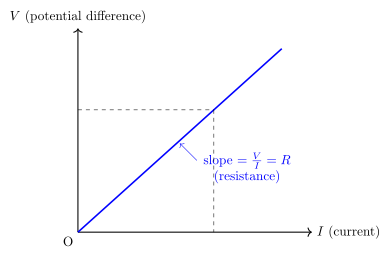
Q.Read the following paragraph carefully and answer the questions that follow : Ohm's law is obeyed by many substances, but one cannot say that it is the fundamental law of nature. It is a basic law regarding flow of current which define resistance as constant of proportionality. The dependence of R on length and area was discussed by Ohm's law. The potential applied on a conductor and current flowing through it was also one of the important points discussed of this law.
(i) Write limitations of Ohm's law. [1 mark]
(ii) Why Ohm's law is not a fundamental law ? [1 mark]
(iii) Draw variation of current versus voltage for GaAs. [2 marks]
OR
(OR)
for part
(iii) [2 marks]: Write the unit and dimension of resistance.
Haryana BsehBSEH Intermediate Board 2025Subjective· 4mImportance★★★★★
0% · 0/42 Questions
You're viewing a preview — the full solution, concept, methods & PYQ mapping are locked.
Start your 14-day free trial to unlock the full solution →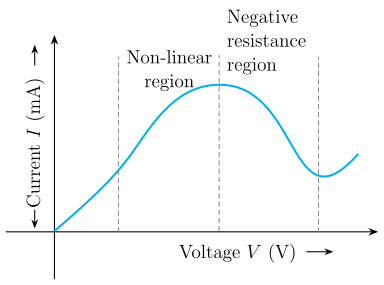
Ohm's law is only an approximate, material-dependent rule (not a universal law); many devices like GaAs show a distinctly non-linear, even non-monotonic, current-voltage curve.
(i) Limitations of Ohm's law: Ohm's law (, i.e. with R constant) holds only for certain "ohmic" conductors under constant physical conditions (like temperature). It fails for:
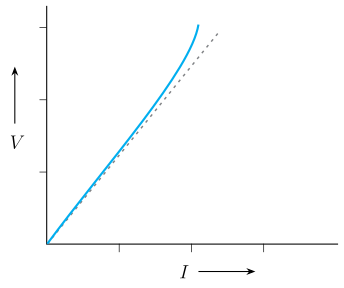
- Materials/devices where the V–I relationship is non-linear (V is not directly proportional to I) — e.g., a junction diode, in which current changes very differently depending on the direction and magnitude of voltage.
- Cases where V depends on I in a way that is not even single-valued — e.g., GaAs, where for a range of voltages, increasing V actually decreases I (negative resistance region).
- Cases where the relation between V and I depends on the sign of V (different R for forward and reverse voltage, as in a diode) — violating the requirement that R stay the same regardless of the sign/direction of V.
- Conductors where R itself changes with the current passing through them (e.g. due to heating raising the temperature and hence resistivity), so R is not truly constant. …
Unlock everything free for 14 days
- Full step-by-step solutions
- Concept-first explanations
- Methods, shortcuts & mistakes
- PYQ mapping + timed mock tests
Full access for 14 days. No credit card required.