Question of 67
Q.Read the following paragraph carefully and answer the questions that follow : The electric field due to a charge at a point in space may be defined as the force that a unit positive charge would experience if placed at that point; it is a vector quantity. Electric field lines start from positive charges and end at negative charges. In case of a single charge, they may start or end at infinity. Electric field lines do not pass through a conductor.
(i) What is the unit of electric field intensity ? [1 mark]
(ii) Draw electric line of force for single negative charge. [1 mark]
(iii) What is the value of electrostatic field inside a conductor and give reason also ? [2 marks]
OR
(OR)
for part
(iii) [2 marks]: Four point charges (Q) are placed at the corner of a square of side a cm. Find magnitude of electric field at the center of square and give reason also.
Haryana BsehBSEH Intermediate Board 2025Subjective· 4mImportance★★★★★
0% · 0/67 Questions
You're viewing a preview — the full solution, concept, methods & PYQ mapping are locked.
Start your 14-day free trial to unlock the full solution →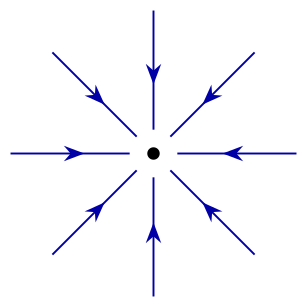
Electric field intensity is measured in N/C; field lines converge into a negative charge; and the field inside a conductor in electrostatic equilibrium is always zero because free charges rearrange to cancel any internal field.
- SI unit of electric field intensity: Since , its unit is newton per coulomb (N/C), equivalently volt per metre (V/m) (from ).
- Electric field lines for a single negative charge: Field lines point in the direction a small positive test charge would move. Since a negative charge attracts a positive test charge toward itself, the field lines are radially directed inward, converging symmetrically onto the negative charge from all directions (the reverse pattern of a positive charge, whose lines radiate outward).
- Electrostatic field inside a conductor: The field is zero everywhere inside a conductor in electrostatic equilibrium. …
Unlock everything free for 14 days
- Full step-by-step solutions
- Concept-first explanations
- Methods, shortcuts & mistakes
- PYQ mapping + timed mock tests
Full access for 14 days. No credit card required.