Why the Output Frequency of a Half-Wave Rectifier Equals the Input Frequency
The key result is: For a half-wave rectifier, the output ripple frequency fout equals the input AC frequency fin.
fout=fin
This is not a coincidence — it follows directly from how the rectifier treats each cycle of the input sine wave.
What the circuit does
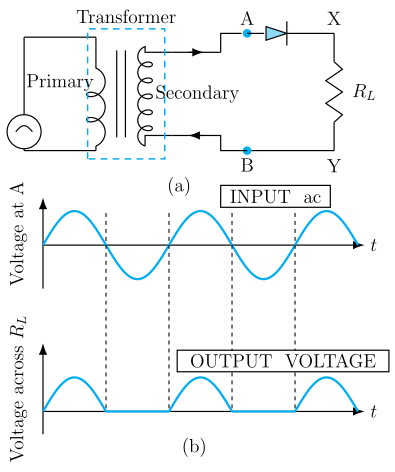
A half-wave rectifier uses a single diode that conducts only when the input voltage is positive (assuming an ideal diode). During the negative half-cycle, the diode is reverse-biased and blocks current entirely. So the output waveform consists of only the positive half-cycles of the input, with the negative half-cycles cut off.
Counting the pulses
Consider an input AC voltage at frequency fin=50 Hz. That means one complete cycle (one positive half + one negative half) takes T=1/fin=20 ms.
In each 20 ms period, the input has exactly one positive half-cycle. The output also has exactly one positive half-cycle (the same one). The negative half-cycle produces zero output.
So in one second (50 complete input cycles), the output has 50 positive pulses — one per input cycle. That is exactly 50 pulses per second, which is a frequency of 50 Hz.
The output is not a pure sine wave — it is a series of half-sine pulses separated by gaps of zero voltage. But the fundamental frequency of this pulsed waveform is still 50 Hz, because the pattern repeats every 20 ms.
Why it is not double the input frequency
A common confusion arises from full-wave rectifiers, where the output frequency is 2fin. In a full-wave rectifier, both the positive and negative half-cycles are flipped to become positive, so you get two output pulses per input cycle — hence double the frequency.
In a half-wave rectifier, you only get one output pulse per input cycle. The negative half-cycle is simply lost. So the repetition rate of the output pulses is the same as the repetition rate of the input cycles.
Formal derivation
Let the input be vin(t)=Vmsin(2πfint). …