Question of 37
Q.Explain the working of p-n junction diode as half-wave rectifier with circuit diagram.
Uttarakhand UbseUttarakhand Board Intermediate (Class 12) 2018Subjective· 3mImportance★★★★★
0% · 0/37 Questions
You're viewing a preview — the full solution, concept, methods & PYQ mapping are locked.
Start your 14-day free trial to unlock the full solution →A single diode conducts only on forward-biased half-cycles, so output is unidirectional (pulsating DC) for one half of every AC cycle.
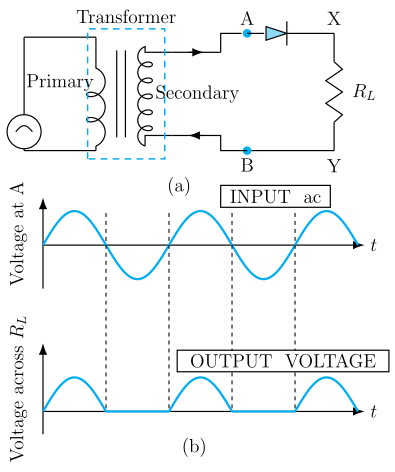
Principle. A p-n junction diode conducts appreciably only when forward biased and blocks current when reverse biased. This one-way action is used to convert AC into DC.
Circuit (description). The AC supply is fed to the primary of a transformer; the secondary is connected to a p-n junction diode in series with a load resistance . The output DC is taken across . (Circuit diagram: AC source → transformer → diode in series with ; output measured across .)
Working.
- Positive half-cycle: the diode's p-side is positive, so it is forward biased and conducts. Current flows through and an output voltage appears across it. …
Unlock everything free for 14 days
- Full step-by-step solutions
- Concept-first explanations
- Methods, shortcuts & mistakes
- PYQ mapping + timed mock tests
Full access for 14 days. No credit card required.