Q.State Huygens principle and prove the law of reflection on the basis of wave theory. OR Draw a labelled ray diagram showing the formation of image in a compound microscope. Define its magnifying power and write expression for it.
You're viewing a preview — the full solution, concept, methods & PYQ mapping are locked.
Start your 14-day free trial to unlock the full solution →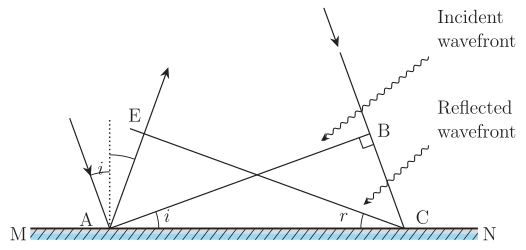
By treating each point on an incident wavefront as a source of secondary wavelets (Huygens' principle) and finding the reflected wavefront geometrically, the angle of incidence is shown to equal the angle of reflection.
Huygens' Principle: Every point on a wavefront acts as a source of secondary spherical wavelets that spread out in all directions with the speed of the wave in that medium. The new (later) wavefront is the surface tangent to (the forward envelope of) all these secondary wavelets.
Proof of the law of reflection:
Consider a plane wavefront AB of a parallel beam of light incident on a plane reflecting surface MN, making angle of incidence with the normal. Let be the speed of light, and let be the time taken for the point B on the wavefront to travel to the surface at point C, i.e. .
By Huygens' principle, while B travels to C, the secondary wavelet from A (which reaches the surface at the same instant B starts) spreads out as a hemisphere of radius into the same medium, i.e., where A' is the point the wavelet reaches on the reflected side. The reflected wavefront is the tangent plane from this expanding wavelet family.
In right triangles ABC and AA'C:
- (both wavelets travel the same distance in the same time in the same medium)
- AC is the common hypotenuse.
So triangles ABC and AA'C are congruent (RHS congruence), which gives
But is the angle between the incident wavefront and the surface, which equals the angle of incidence (angle between incident ray and normal); similarly equals the angle of reflection . Hence,
…
Unlock everything free for 14 days
- Full step-by-step solutions
- Concept-first explanations
- Methods, shortcuts & mistakes
- PYQ mapping + timed mock tests
Full access for 14 days. No credit card required.