Q.Explain Huygens' principle, using it prove Snell's law of refraction. OR Derive Lens Maker's Formula for convex lens using new cartesian sign conventions.
You're viewing a preview — the full solution, concept, methods & PYQ mapping are locked.
Start your 14-day free trial to unlock the full solution →Applying Huygens' principle to a plane wavefront meeting a refracting surface shows that equals the constant ratio of wave speeds in the two media — Snell's law.
Huygens' principle: Every point on a wavefront acts as a source of secondary wavelets that spread out in all directions with the speed of light in that medium. The new wavefront at any later instant is given by the common tangent (envelope) to all these secondary wavelets.
Derivation of Snell's law:
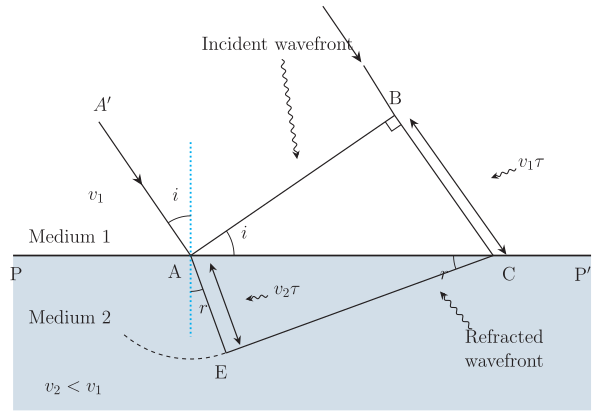
Consider a plane wavefront of monochromatic light incident on a plane interface separating medium 1 (speed ) from medium 2 (speed ), making an angle of incidence with the normal. Let be the time taken for the wavelet from to reach point on the surface, while the wavelet from travels into medium 2.
In time :
- Distance travelled by the wavelet from to :
- Distance travelled by the secondary wavelet from into medium 2 (radius of the wavelet centred at ):
The new refracted wavefront is (the tangent from to the wavelet centred at ).
…
Unlock everything free for 14 days
- Full step-by-step solutions
- Concept-first explanations
- Methods, shortcuts & mistakes
- PYQ mapping + timed mock tests
Full access for 14 days. No credit card required.