Chemistry · Ch 9 — Hydrocarbons
Aromaticity
Aromaticity
The Shift from a Smell to a Structure
The word "aromatic" originally came from the strong, pleasant smells of compounds like benzene. But as chemists studied these molecules more deeply, they realised the fragrance was a side effect of a much more fundamental structural feature. Today, aromaticity has nothing to do with smell. It describes a special kind of stability found in certain cyclic, planar molecules with a specific number of delocalised electrons.
Benzene is the classic example, but the definition now covers many ring systems that do not contain a benzene ring at all. A compound is aromatic if it satisfies three conditions simultaneously.
The Three Pillars of Aromaticity
For a molecule to be aromatic, it must meet every one of these criteria:
-
Planarity: The ring must be flat. All the atoms that make up the ring must lie in the same plane. This is essential because the p-orbitals on each atom need to be parallel to each other so they can overlap sideways to form a continuous ring of electron density above and below the plane.
-
Complete Delocalisation of π Electrons: Every atom in the ring must have a p-orbital that can participate in conjugation. This means the π electrons are not confined to a single bond or a pair of atoms. Instead, they are spread out, or delocalised, over the entire ring. This delocalisation is what gives aromatic compounds their extra stability.
-
The Hückel Rule (4n + 2 π Electrons): The ring must contain exactly π electrons, where is a whole number (0, 1, 2, 3, ...). This is the most precise condition. It is not a guess; it comes from quantum mechanics and explains why certain electron counts lead to exceptional stability while others do not.
A molecule must satisfy all three conditions to be aromatic. If it fails even one — for example, if it is planar and fully conjugated but has π electrons — it is called anti-aromatic (and is usually very unstable). If it is not planar or not fully conjugated, it is simply non-aromatic.
The Hückel Rule in Detail
The rule is often written as:
where
Let's see what this means for different values of :
- : π electrons. The smallest possible aromatic system. An example is the cyclopropenyl cation (), a three-membered ring with a positive charge.
- : π electrons. This is the most famous case. Benzene () has six π electrons, perfectly satisfying the rule.
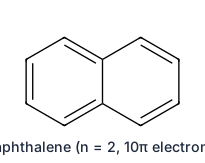
- : π electrons. Examples include naphthalene () and the cyclooctatetraenyl dianion ().
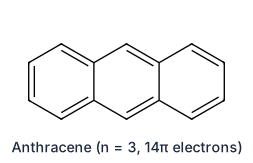
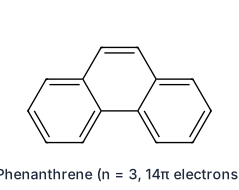
- : π electrons. Found in larger polycyclic aromatic hydrocarbons like anthracene and phenanthrene.
A common mistake is to count the total number of electrons in the ring. The Hückel rule applies only to π electrons that are part of the conjugated system. Do not count σ electrons or lone pairs that are not in p-orbitals aligned for conjugation.
Examples of Aromatic Compounds
The textbook lists several examples that illustrate the rule in action. Each one is planar, fully conjugated, and has π electrons.
| Compound | Structure Type | Number of π Electrons | value | Why it is Aromatic |
|---|---|---|---|---|
| Benzene () | Six-membered ring with alternating single and double bonds. | 6 | 1 | Each carbon contributes one p-orbital with one electron, giving six delocalised π electrons. |
| Naphthalene () | Two fused benzene rings. | 10 | 2 | The ten π electrons are delocalised across the entire fused ring system. |
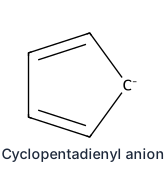
| Cyclopentadienyl anion () | Five-membered ring with a negative charge. | 6 | 1 | The ring has four carbon atoms each contributing one π electron, and the fifth carbon (which originally had a group) gains an extra electron from the negative charge, giving it a lone pair that participates in the π system. Total = 4 + 2 = 6. |
| Pyrrole () | Five-membered ring with one nitrogen atom. | 6 | 1 | Four carbon atoms each contribute one π electron. The nitrogen atom has a lone pair that is in a p-orbital, and it contributes two electrons to the π system. Total = 4 + 2 = 6. |
| Pyridine () | Six-membered ring with one nitrogen atom. | 6 | 1 | Five carbon atoms each contribute one π electron. The nitrogen atom contributes one π electron (its lone pair is in an sp² orbital, perpendicular to the π system, so it does not count). Total = 5 + 1 = 6. |
Notice how the cyclopentadienyl anion and pyrrole both have six π electrons, even though one is an ion and the other is neutral. The key is always to count the electrons that are actually in the conjugated π system, not the formal charge or the total number of atoms.
Drawn by us to help you understand the concept clearly, and verified to make sure it's accurate. For exams, practice from your textbook's own diagram.
The cyclopentadienyl anion, — a planar five-membered ring whose four alkene electrons plus the anionic lone pair give six delocalised electrons: the Hückel count with , so the ion is ar …
Drawn by us to help you understand the concept clearly, and verified to make sure it's accurate. For exams, practice from your textbook's own diagram.
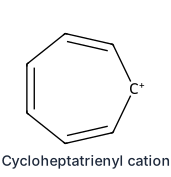
The cycloheptatrienyl (tropylium) cation, — a planar seven-membered ring with three double bonds and an empty orbital on the positively charged carbon. Its six electrons again satisfy the Hückel rule …
Drawn by us to help you understand the concept clearly, and verified to make sure it's accurate. For exams, practice from your textbook's own diagram.
Naphthalene as an aromaticity example: the fused bicyclic system carries ten delocalised electrons — the count with — sprea …
Drawn by us to help you understand the concept clearly, and verified to make sure it's accurate. For exams, practice from your textbook's own diagram.
Anthracene: three benzene rings fused in a straight, linear row, with fourteen delocalised electrons — the Hüc …
Drawn by us to help you understand the concept clearly, and verified to make sure it's accurate. For exams, practice from your textbook's own diagram.
Phenanthrene: the same molecular formula as anthracene (, fourteen electrons, ), but with the three rings fused in a bent, angular arrangement — fusion geometry disti …
A Deeper Look: Why 4n+2?
The Hückel rule is not arbitrary. It emerges from a quantum mechanical treatment of cyclic conjugated systems. For a planar, monocyclic ring of atoms, the energies of the π molecular orbitals can be calculated. The result is that the orbitals come in pairs of equal energy (degenerate pairs), except for the lowest-energy orbital and, if is even, the highest-energy orbital.
The stability of the system depends on how these orbitals are filled with electrons. A system is particularly stable (aromatic) when all the bonding orbitals are completely filled. This happens when the total number of π electrons is — the series. If the number of π electrons is (like 4, 8, 12...), the system has unpaired electrons in degenerate orbitals, making it highly unstable (anti-aromatic).
›Proof
Derivation of the 4n+2 Rule (Conceptual)
For a planar, cyclic system with atoms, the π molecular orbital energies can be represented on a circle (the Frost circle method). A polygon with sides is inscribed in the circle with one vertex at the bottom.
- The energy of each molecular orbital is proportional to the vertical height of a vertex of the polygon.
- The lowest-energy orbital is always non-degenerate (single orbital).
- The remaining orbitals come in degenerate pairs (same energy).
For aromatic stability, we need to fill all the bonding orbitals completely. The bonding orbitals are those below the centre of the circle.
…